
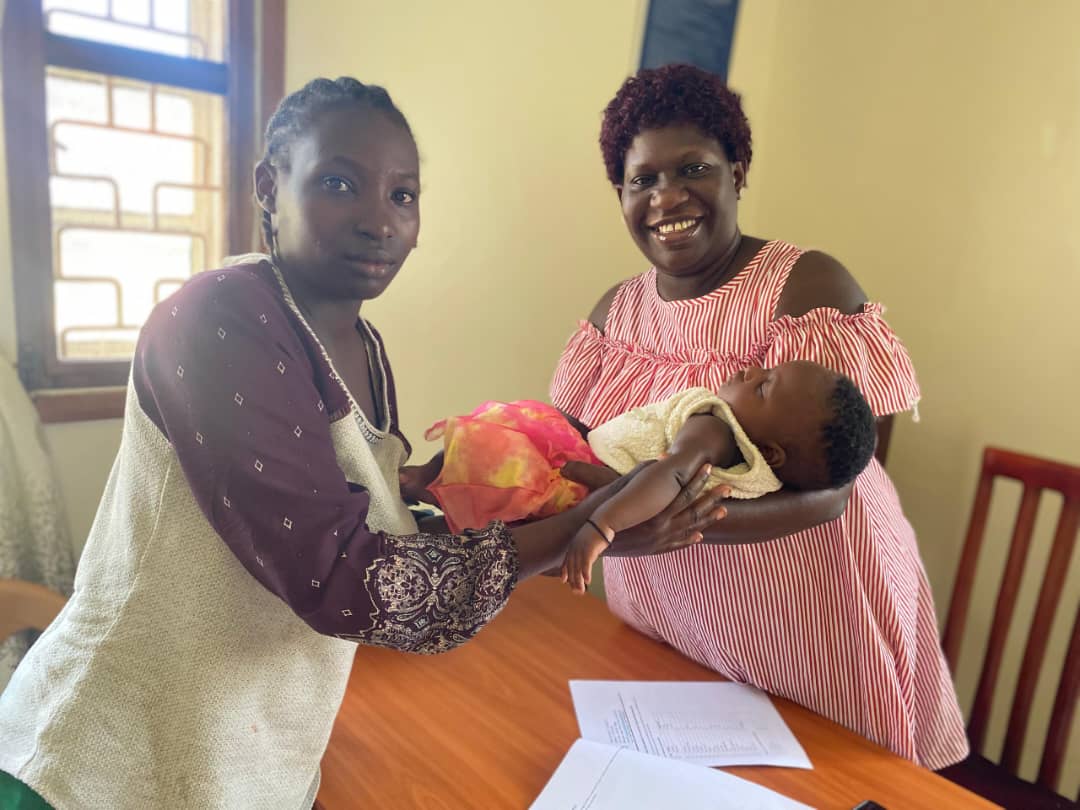
Adolescent-Friendly Health Services: Why a Phone Number Is Not a Referral
A girl is given a phone number on the torn corner of an exercise book. Somebody has been kind to her. Somebody has taken the trouble to find out where she should go.
And that is very often where the help stops.
Between the number in her hand and a health worker who actually examines her, there are perhaps nine separate things that all have to go right. She has to be allowed to leave the house. She has to reach the facility. She has to afford it. It has to be open. She has to survive being recognised in the queue. She has to understand what she is told. She has to be treated as a patient rather than as a moral problem. She has to be able to come back. She has to get home safely.
Hand her a number, and you have solved none of the nine.
This article is about closing that gap: what adolescent-friendly health care actually means, why so many referrals quietly fail somewhere between the number and the door, and what a small organisation in Jinja can honestly do about it.
What we do, and what we do not do
We should be plain about this before anything else, because the distinction matters more here than in almost any other part of our work.
Treasured Vessels does not provide clinical care. We do not diagnose. We do not treat. We do not prescribe. We do not deliver babies, test for infections, or decide whether a symptom is serious. Those are the work of qualified health professionals, and nothing in this article suggests otherwise.
What we can do is accompaniment, information and referral. We can help a girl work out where to go. We can explain what will probably happen when she gets there, so that it is less frightening. We can sit with her in the waiting area. We can help with the fare. We can follow up afterwards to find out whether the thing we sent her to do actually happened.
That may sound modest next to a clinic. It is not modest to her, and there is a specific reason we say it out loud rather than letting the ambiguity sit there.
Over-claiming is a safeguarding failure, not marketing enthusiasm. An organisation that lets people believe it provides medical care will eventually be handed a case it cannot handle, by somebody who could have gone straight to a health worker and did not. The delay belongs to whoever blurred the line.
It also protects her from us. A girl who thinks she has already seen "the people who deal with this" may not seek the assessment she needs. Being clear that we are the bridge and not the destination is part of making sure she reaches the destination.
And it makes partnership possible. Health facilities work with organisations that know the limits of their role. They are wary, reasonably enough, of the ones that do not.
Eight things "adolescent-friendly" actually means
The phrase gets used loosely. It is worth setting out what it means from where she is standing, rather than in the language of a policy document.
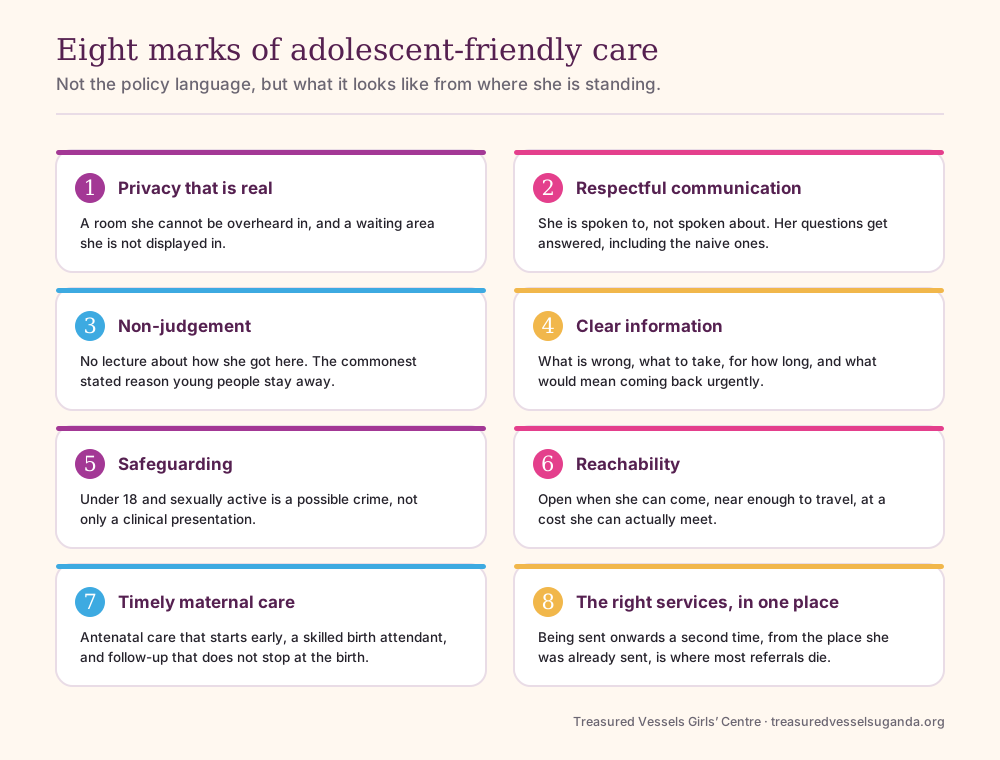
Privacy that is real, not stated. A consultation room where the conversation cannot be heard through the wall or the doorway. A register that is not lying open on the counter. A waiting area where a fifteen-year-old is not seated in full view of half her village.
Respectful communication. She is spoken to, not spoken about. Her questions get answered, including the ones that sound naive. If a relative has come with her, she is still the one being addressed.
Non-judgement. No lecture, no sighing, no comments about how she got here. This is the single most commonly reported reason young people avoid services, and it costs nothing to fix.
Clear information. What is wrong, what the options are, what the medicine is for, how long to take it, what would mean coming back urgently, all in a language she speaks, at a pace she can follow, checked by asking her to say it back.
Safeguarding. Where a girl is under eighteen and has been sexually active, a health worker is looking at a possible crime, not only a clinical presentation. Adolescent-friendly does not mean incurious. It means her disclosure is handled carefully rather than either ignored or broadcast.
Reachability. Open at hours she can attend, at a distance she can travel, at a cost she can meet. A service that is technically available and practically out of reach is not a service she has.
Timely maternal care. Antenatal care that begins early rather than in the last weeks, delivery with a skilled attendant, and postnatal follow-up that does not stop at the birth.
The right services, in one place. Being sent onwards a second time, from the place she was already sent, is where most referrals die.
Those eight are how it feels. Underneath them sits a formal framework: the World Health Organization's eight global standards for quality health-care services for adolescents, which cover health literacy, community support, an appropriate package of services, provider competencies, facility characteristics, equity and non-discrimination, data and quality improvement, and adolescents' own participation in shaping services. Uganda has its own version too. The Ministry of Health's Adolescent Health Policy Guidelines and Service Standards set out what adolescent-friendly provision should look like in Ugandan facilities.
The standards exist. The gap is rarely in the guidance.
The distance between a number and care
Here is the argument at the centre of this article, and it applies far beyond health.
A referral is not an event. It is a chain, and it is only as strong as the weakest link.
There is a useful national illustration of this. According to the Uganda Demographic and Health Survey 2022, around 95% of pregnant women in Uganda receive antenatal care from a skilled provider at least once, but only about 72% attend the recommended four or more visits. Almost everybody makes contact. Roughly a quarter do not complete.
Making contact was never the hard part. Completing is.
Now go back to the nine things that have to go right, and look at where they actually break.
She has to be allowed to go
For an adolescent living in someone else's household, a clinic visit is rarely her decision alone. Someone controls the money, someone notices the absence, and someone may have a strong interest in the visit not happening, particularly where a pregnancy involves a man who would prefer no record of it.
This is the link that fails silently, because from the outside it looks like she simply did not bother.
She has to get there and afford it
Transport costs money. So, often, does the visit itself, once you add the things that are out of stock and have to be bought elsewhere. A girl with no independent income faces a bill she cannot explain at home without disclosing why she needs it.
It has to be open when she can come
Facility hours and school hours overlap almost perfectly. A service that operates only during the school day asks her to choose between her education and her health, which is precisely the choice we spend the rest of our work trying to prevent.
She has to survive the queue
In a district where everyone knows her mother, being seen waiting outside a particular room carries a cost. Sometimes the anticipated shame is enough on its own to stop the journey.
She has to understand what she is told
Instructions given quickly, in a language she is not fluent in, to a frightened teenager, are frequently not instructions at all. A course of medication half-taken is a course wasted, and she will be blamed for it.
She has to be able to come back
Most useful health care is not one visit. Antenatal care is a series. Treatment is a course. Every additional visit multiplies the cost, the permission problem and the chance of being recognised, which is why completion rates fall away so steeply.
She has to get home safely
The last one gets forgotten. A girl travelling back after dark, or returning to a household that has worked out where she went, may be in more danger after the referral than before it.
None of this is an argument against referral. It is an argument against treating a phone number as though it were care.
Why adolescent maternal care is time-sensitive
There is a clinical reason not to be relaxed about any of the above.
The World Health Organization reports that mothers aged 10 to 19 face higher risks of eclampsia, puerperal endometritis and systemic infections than mothers aged 20 to 24, and that their babies face higher risks of low birth weight, preterm birth and severe neonatal conditions. Complications of pregnancy and childbirth are among the leading causes of death for girls aged 15 to 19 worldwide.
We put that here carefully, because it is easy to misuse. It is not a reason to frighten a pregnant fifteen-year-old, and it is certainly not a reason to treat her as a tragedy. She is far more likely to be fine than not.
It is a reason to move quickly, and to keep moving. Early antenatal contact and completed follow-up are among the most reliably useful things anybody can arrange for her, more useful than sympathy and more useful than advice.
A closed loop, not an open-ended hope
The practical answer to a chain that breaks is to check whether it broke.
We are building what is sometimes called a closed-loop referral: a short record that follows a single referral from the moment she agrees to it until we know what happened.
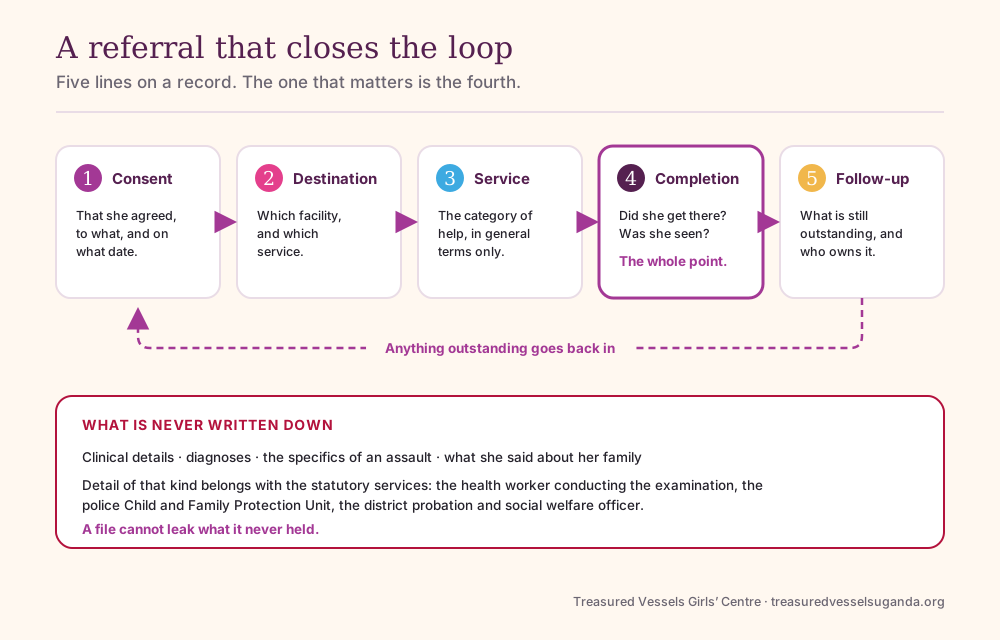
Five entries, and no more:
- Consent: that she agreed, what she agreed to, and on what date.
- Destination: where she was referred to, and to which service.
- Service sought: the category of help, in general terms.
- Completion: whether she got there and was seen.
- Follow-up: what, if anything, still needs doing, and who is responsible for it.
That is the whole system. Its value is entirely in the fourth line. A referral log that records only the sending is a record of our own activity; a log that records arrival is a record of whether anything happened to her.
What we deliberately do not write down
This part matters as much as the rest, and it usually gets less thought.
We do not record clinical details. We do not record diagnoses. We do not record the specifics of an assault. We do not record what she said about her family. A file cannot leak what it never held, and every unnecessary field in a record is a risk we chose to take with somebody else's safety.
Where an under-eighteen may have been harmed, the correct destination for detail is the statutory route, not our filing cabinet: the police Child and Family Protection Unit, the district probation and social welfare officer, or the health worker conducting the examination.
We hold the least we can hold and still be useful. Our full approach is in our privacy policy.
Consent is the first step, not a formality
Before any of that, she has to agree, and agreement has to mean something.
She should know who will be told, and who will not. She should know what happens if she says no, which is that we keep helping her with everything else, without sulking about it. She should know she can change her mind afterwards, including about follow-up.
A girl who has been coerced into a pregnancy does not need a second experience of being managed by adults who know best. If our referral process feels like the thing that happened to her, we have got it wrong, however good the clinic at the end of it is.
A Ugandan model worth studying
We are not inventing this. Uganda already has a long-standing example.
The Naguru Teenage Information and Health Centre in Kampala has been running since 1994. It began as an adolescent clinic and grew into a registered organisation working on adolescent sexual and reproductive health, serving young people roughly aged 10 to 24 and supporting public health facilities to make their own services more youth-friendly.
Two things about the model are worth borrowing, and one is not.
Worth borrowing: information and services in the same place. Young people arrive with a question far more often than with a diagnosis. A place that answers questions is a place they will return to when the question becomes urgent.
Worth borrowing: working through existing public facilities rather than building a parallel system. There is a government health centre near most of the girls we work with. Making that one better is more durable than opening our own.
Not for us: the clinical component. Naguru is a health provider. We are not, and a small CBO that starts calling itself one is heading for a serious mistake. Our version of the model stops at the door.
What we have not finished
You will notice that this article names no health facility in Jinja. That is deliberate, and we would rather explain it than have it look like an oversight.
We have not yet completed verification of our local health partners. Publishing a facility name is an implied recommendation. If the number has changed, the service closed, the fee is now higher than advertised, or the staff member who was good with young people has moved on, a girl acting on our recommendation pays for our carelessness.
An unverified referral directory is worse than none, because it converts our credibility into her wasted journey.
Verification, for us, means five checks on each entry:
- The service is currently offered, at that site, this year.
- The hours and costs are what we say they are.
- There is a named contact who knows the arrangement exists.
- The facility is willing to accept a referral from us and to confirm attendance where the girl consents.
- Someone from the centre has physically been there.
Until an entry passes all five, it stays out of the directory. We would rather publish a short list that works.
The same applies to emergency arrangements. Knowing where to go at two in the morning is a different question from knowing where to go on a Tuesday, and it needs its own answer before we claim to have one.
If you are worried about a girl right now
Do not wait for our directory.
The Uganda Child Helpline is 116, free from any network, 24 hours, run by the Ministry of Gender, Labour and Social Development. If a child is in immediate danger, that call comes before everything else on this page.
Three things not to do, which we say in every article of this kind because they keep happening:
- Do not name or photograph her online. It increases the risk to her and can destroy a prosecution.
- Do not confront the man you suspect. That is the police's job, and doing it yourself usually means she is the one who faces the consequences.
- Do not promise secrecy you cannot keep. Say instead what you will do and who you will tell.
What this has to do with faith
Our work is Christian, and this is one of the places where that is more than a label.
"But a certain Samaritan, as he journeyed, came where he was. And when he saw him, he had compassion. So he went to him and bandaged his wounds… Then he set him on his own animal, brought him to an inn, and took care of him." Luke 10:33-34, NKJV
The detail that gets skipped in that story is the transport. The Samaritan does not point out the inn. He puts the man on the animal, walks him there, and comes back afterwards to settle what is owed.
That is accompaniment, and it is roughly the whole of our role in adolescent health. Someone else does the medicine. Somebody still has to get her to the door and check that she arrived.
Help us build a referral system that closes the loop
This is the one thing we are asking for from this article.
A verified adolescent-health referral fund and directory needs two things: the verification work to build the list, and a small fund that removes the money barrier at the moment it matters: the fare, the consultation, the medicine that was out of stock, the second visit that completes the course.
We are not publishing unit costs for it yet, because we have not verified them, and we would rather be late than wrong. When those figures are checked, we will publish them here alongside what the fund actually paid for.
In the meantime, our published costs remain what they have always been:
- $15 provides a reusable sanitary kit for a year
- $50 keeps a girl in school for a full term
- $150 provides a sewing machine for a young mother building an income
If your organisation runs or works with a health service in the Jinja area, whether a facility, a clinic, a midwife or a counsellor, we would rather verify you than guess. Please get in touch.
Frequently asked questions
Does Treasured Vessels provide medical care?
No. We provide accompaniment, information and referral. Clinical assessment, diagnosis and treatment are provided by qualified health professionals at health facilities. We are the bridge, not the destination.
What does "adolescent-friendly" health care actually mean?
In practice: real privacy, respectful and non-judgemental communication, clear information in a language she understands, proper safeguarding, hours and costs she can manage, timely maternal care, and the right services in one place rather than a second referral onwards. The World Health Organization sets out eight global standards for adolescent health services, and Uganda's Ministry of Health has its own adolescent health policy guidelines and service standards.
Why is a phone number not enough?
Because a referral is a chain. She has to be allowed to go, get there, afford it, find it open, tolerate being recognised, understand what she is told, be treated respectfully, be able to return for follow-up, and get home safely. A number solves none of those. Nationally, around 95% of pregnant women in Uganda make at least one antenatal contact but only about 72% complete four or more visits. Contact is not the difficulty, completion is.
What is a closed-loop referral?
A short record that follows one referral from consent through to confirmed arrival and follow-up. The important line is whether she was actually seen. A log that records only what we sent is a record of our activity, not of her care.
What information do you keep about someone you refer?
As little as possible: that she consented, where she was referred, the general category of service, whether she attended, and what follow-up remains. We do not record clinical details, diagnoses or the specifics of an assault. Detail of that kind belongs with the statutory services, not with us.
Why does this article not list health facilities in Jinja?
Because we have not finished verifying them. Naming a facility is an implied recommendation, and an out-of-date entry costs a girl a wasted journey she may not be able to repeat. Each entry has to pass five checks before it goes on the list: service currently offered, hours and costs confirmed, a named contact, willingness to accept our referrals, and a visit in person.
Can a girl under 18 get health care without a parent in Uganda?
This varies by service and by facility, and it is not something we can answer generally or reliably in an article. It is one of the specific questions we are putting to each facility during verification, precisely because a girl needs to know the answer before she travels rather than after.
I work at a health facility near Jinja. How do we get involved?
Please contact us. We are looking for services willing to be verified, to accept referrals from the centre, and to confirm attendance where the girl has consented. We are also glad to be told when something on our list has changed.