
Ask most people why girls in Uganda leave school and you will hear one answer: pregnancy.
It is the explanation that comes up first in conversation, in sermons, and in a good deal of well-meaning fundraising. It is also, according to the evidence, responsible for a small minority of cases.
Reported figures indicate that pregnancy accounts for roughly 8% of girls who leave school in Uganda. Cost accounts for around six in ten of all school leavers, and UNICEF-reported data suggests some 53.8% of girls who drop out do so for financial reasons.
That gap between what people assume and what actually happens matters enormously, because if you misdiagnose the cause, you fund the wrong solution.
Dropout is a process, not a decision
The word "dropout" suggests a moment. A girl decides, or her family decides, and she stops attending.
That is almost never how it happens.
What actually happens is a drift. She misses a few days because the fees were late. She misses more because her period arrived and she had nothing to use. She falls behind. The lessons stop making sense. She feels foolish in class, then embarrassed, then reluctant to go at all. Her mother needs help with the younger children and she is the obvious person to ask. By the time anyone notices she has gone, leaving has already happened by degrees.
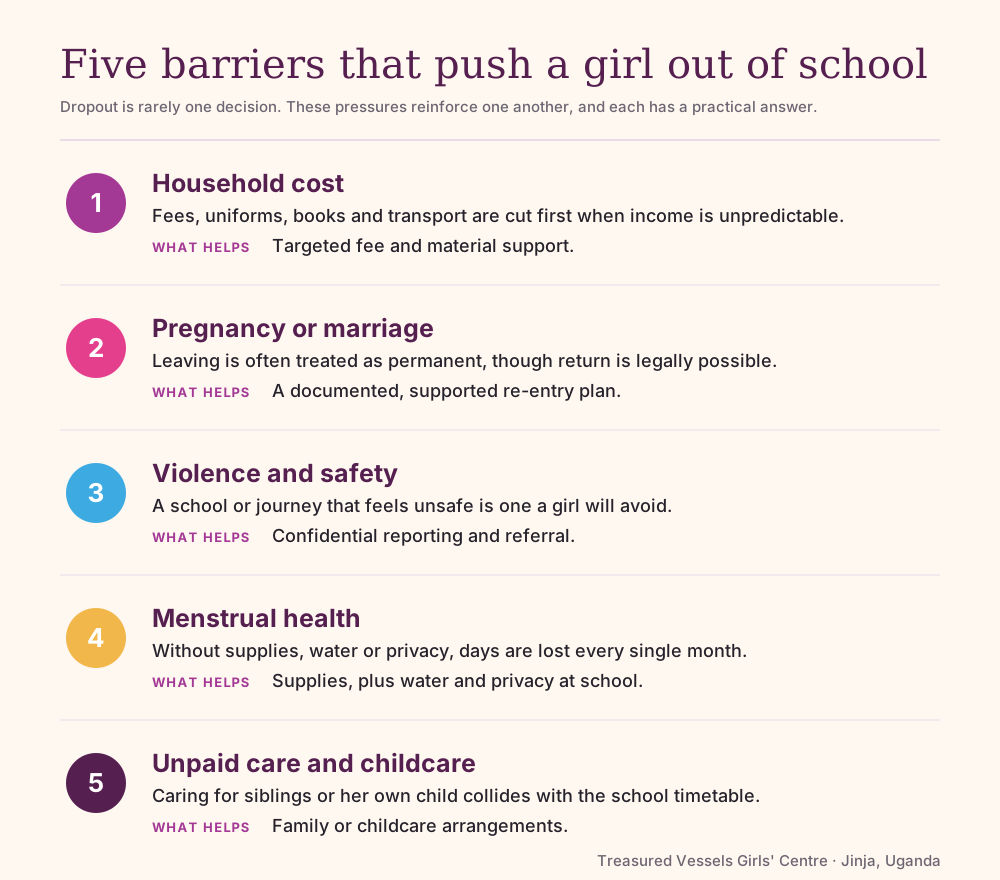
No single obstacle removed her. Five smaller ones did, over months, each making the next easier.
This matters practically. If dropout were one event, you could intervene once. Because it is a process, the intervention has to be a plan, and it has to arrive before the drift becomes permanent.
What the numbers actually show
Uganda's education statistics are worth reading carefully, because different measures give different impressions.
Reported completion figures vary by definition and year. Ministry of Education data has indicated a primary survival rate of around 33%, the share of enrolled pupils reaching the final year of primary. Uganda's National Development Plan recorded a primary completion rate of around 38% in 2018, while other series put completion nearer 53% in 2017. The measures differ; the direction does not. A large share of Ugandan children do not finish primary school.
The gender picture is more nuanced than it is usually presented, and it is worth being accurate about.
At the broad "out of school" measure, boys are not doing better: roughly 28.2% of boys and 25.7% of girls across education levels have been recorded as out of school. Where girls fall behind sharply is later: girls have the highest rates of dropout and irregular attendance across upper primary, secondary and tertiary education. Enrolment and attendance begin declining for girls from around age eight, and only about 27% of girls reach upper secondary, with roughly 4% entering tertiary education.
So the honest summary is this: Uganda struggles to keep children of both sexes in school, and girls are disproportionately lost as they get older, which is precisely the age at which cost, marriage, menstruation, safety and care responsibilities all begin to press at once.
And one more time, because the assumption is so persistent: pregnancy is not the main reason girls leave. It is a real reason, and it deserves a serious response. But it is roughly one case in twelve. Money is the story.
Barrier one: household cost
Universal primary education does not mean education without cost. Uniforms, exercise books, pens, examination fees, transport and lunch all still have to be found.
When household income is informal and unpredictable, as it is for many families in Masese-Walukuba and across Jinja, these costs compete directly with food and medicine. Something has to give. Where a family has both sons and daughters and cannot cover everyone, the daughter's costs are usually the ones cut.
This is not a statement about how much families love their daughters. It is arithmetic under pressure, and it deserves to be understood as such rather than condemned.
What helps: targeted fee and material support. Not a lump sum, but coverage of the specific items that break the chain: the term's fees, the uniform, the books. This is the single highest-leverage intervention available, precisely because cost is the single largest cause.
Barrier two: pregnancy or marriage
Uganda has guidance permitting girls to return to school after childbirth. In practice, many girls, families and even schools believe that leaving is permanent.
That belief does more damage than the policy does. A girl who thinks the door is closed will not try it.
The barriers to actually returning are real: recovery after birth, childcare during school hours, fees that must now be found again, stigma from classmates and sometimes staff, and a timetable that assumes no student has a baby.
What helps: a documented, supported re-entry plan: someone who talks to the school in advance, confirms the terms of return, arranges childcare, and stays involved for at least two terms afterwards. Formal school is not the only valid route; for some young mothers, accelerated learning or vocational training fits better, and that choice should be hers.
Barrier three: violence and safety
A girl will not keep attending a place where she does not feel safe, and she is rarely in a position to explain why.
The risk may be on the journey rather than at the school. It may be a specific individual. It may be corporal punishment severe enough that avoidance becomes rational. In some cases it is sexual harassment or abuse, and any honest account of girls' education has to hold that fact steadily, without sensationalising it and without pretending it is rare.
Silence is the most reliable predictor that nothing will change. A girl who has no confidential way to report simply stops turning up, and the record notes absenteeism.
What helps: confidential reporting and a referral route that a girl can actually use: one that does not require her to accuse someone publicly, and that connects to police, probation or child protection services when it needs to.
Barrier four: menstrual health
Research in Uganda has found that only around 10% of adolescent girls practise adequate menstrual hygiene management, and that girls miss an estimated 11% of school days because of menstruation.
Eleven per cent is roughly one day in every nine, lost to something entirely predictable and entirely solvable.
The problem is broader than products. A girl needs something she can trust to hold through a school day, somewhere private to change it, water and soap to wash, safe disposal, and a classroom where nobody mocks her. Remove any one of those and the others weaken.
What helps: reusable sanitary kits that last around a year, paired with education for girls and boys, and honest attention to whether the school's toilets have water, privacy and a working door. Products alone leave most of the barrier standing.
Barrier five: unpaid care and childcare
In many households the eldest daughter is the reserve labour force. When a parent is ill, when a younger sibling needs minding, when someone must fetch water or cook, she is the one asked.
Boys are asked too, but not usually first, and not usually at the cost of the school day.
For a girl who is already a mother, the collision is direct: the school timetable and an infant's needs cannot both be met without someone else in the arrangement.
What helps: practical childcare and family arrangements. Sometimes that means a conversation with parents about redistributing tasks. Sometimes it means childcare during school hours. It is unglamorous, and it is often the difference between a plan that works and one that quietly fails.
Why the five compound
Take any two of these barriers and the second is made worse by the first.
A girl short of money is less able to buy sanitary products. A girl missing days for her period falls behind, which makes school feel pointless, which makes marriage look like a reasonable alternative. A girl caring for siblings has less time to catch up on what she missed. A girl who feels unsafe has no reason to endure any of the rest of it.
This is why single-issue interventions so often disappoint. Paying a girl's fees while she has nothing to manage her period with, no safe route to school, and a baby at home is not a plan. It is one component of a plan.
And it is worth stating plainly what none of this is about: ambition. In our experience the girls least likely to finish school are not the ones who wanted it least. Treating dropout as a failure of aspiration misreads the problem entirely, and it insults young women who were doing everything asked of them until the arithmetic stopped working.
What an education-continuity plan looks like
The practical answer to a compounding problem is a plan that covers the components together and follows up over time.
For us that means starting with a documented assessment: what is actually threatening this girl's schooling, in her specific situation, rather than what we assume. It means liaising with her school so that fees, materials and re-entry terms are confirmed rather than hoped for. It means tracking attendance over at least two terms, because a plan nobody checks is a donation, not a plan. And it means connecting the other barriers to the right response: a sanitary kit, a childcare arrangement, a referral where safety is the issue.
We should be candid that our systems for this are still being strengthened. We can describe what we do and who we work with; the longitudinal outcome tracking we would like to report, meaning how many girls were still in school two years later, is something we are building rather than something we can already evidence. We would rather say that than imply otherwise.
The useful feature of this approach for supporters is that the components can be funded individually. You do not have to underwrite a girl's entire education to make a decisive difference to it.
Fund one component of a girl's education-continuity plan
Pick the piece you can cover, and it does real work on its own:
- $15 provides a reusable sanitary kit that lasts about a year, removing roughly one lost day in nine
- $50 covers a term's schooling for a girl whose fees are the thing breaking the chain
- $150 buys a sewing machine for a young woman for whom a trade, not a classroom, is the right route forward
One component, funded properly, is worth more than general goodwill spread thin.
Share this
A girl rarely leaves school because of one obstacle. Fees, pregnancy, unsafe conditions, periods and care responsibilities can reinforce one another. Keeping her learning requires more than paying a bill. It requires a plan, a safe school and a supportive community.
Frequently asked questions
Is pregnancy the main reason girls drop out of school in Uganda?
No. Reported figures attribute roughly 8% of girls' school leaving to pregnancy, while cost accounts for around six in ten school leavers overall, and UNICEF-reported data indicates about 53.8% of girls leave for financial reasons. Pregnancy is a real barrier, but it is not the primary one.
How many children in Uganda finish primary school?
Estimates vary by measure. Ministry of Education data has indicated a primary survival rate of around 33%, while completion-rate series have ranged from about 38% in 2018 to around 53% in 2017. All of them point the same way: a large share of children do not complete primary school.
Are girls more affected than boys?
It depends on the stage. At the broad out-of-school measure, boys have been recorded at slightly higher rates than girls. Girls fall behind sharply in upper primary, secondary and tertiary education, with attendance beginning to decline from around age eight.
How much does it cost to keep a girl in school?
In our programmes, $50 covers a term, and $15 provides a reusable sanitary kit lasting about a year. The right figure depends on which barrier is actually threatening her schooling, which is why we begin with an assessment rather than a fixed package.
Can a girl return to school after having a baby?
Yes. Uganda has guidance supporting re-entry, though in practice it needs someone to negotiate the terms with the school, arrange childcare and follow up. For some young mothers, accelerated learning or vocational training is a better route, and that choice should be theirs.
Why not simply pay school fees and leave it there?
Because fees are usually one of several barriers operating at once. A girl whose fees are paid but who has no way to manage her period, no safe route to school and an infant at home will still struggle to attend. Fees are the largest single component, not the whole plan.