
Inside the Skills Room: Learning Tailoring, Baking and Hairdressing
Most charity photographs of vocational training show a woman at a sewing machine, smiling, mid-stitch. It is a good image. It is also the last five per cent of the process, and it tells you almost nothing about whether the training works.
So here is the other ninety-five per cent: what a skills class at Treasured Vessels actually looks like on an ordinary Tuesday, and how a woman gets from her first day to something she can sell.
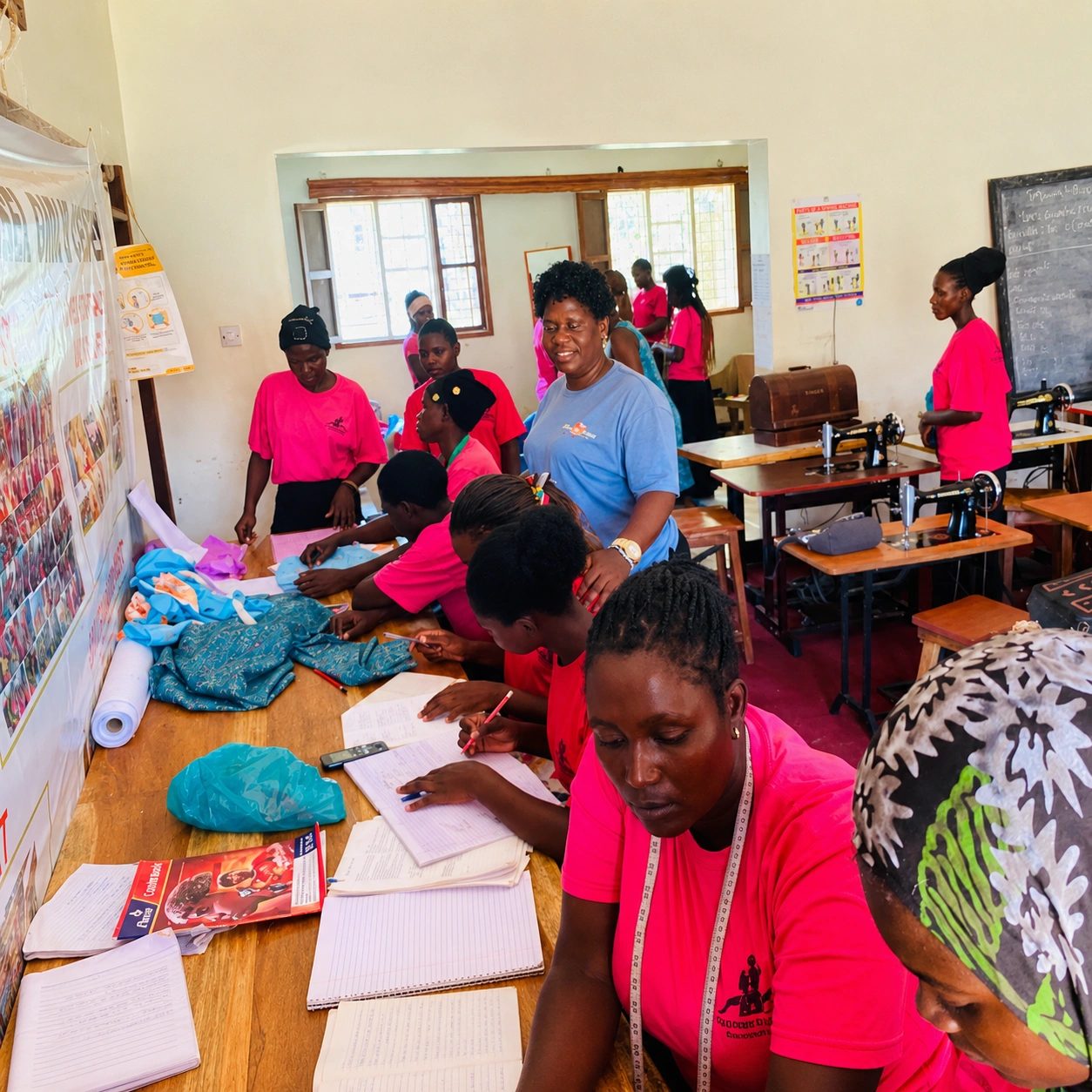
The room
It is a plain room with a concrete floor and a long wooden table down the middle. Along one wall there is a blackboard. Against the other, three treadle sewing machines: the cast-iron Singer kind, worked by foot, which need no electricity and can be repaired by anyone in Jinja with a spanner.
On the wall there is a printed poster titled Parts of a Sewing Machine. On the blackboard, in chalk, that day's lesson written out by hand.
The table is not tidy. There is folded fabric in teal and orange, a roll of pattern paper, scissors, chalk, a metre rule, and a scattering of exercise books, the ordinary lined kind schoolchildren use, open and being written in.
That last detail is the one most people find surprising.
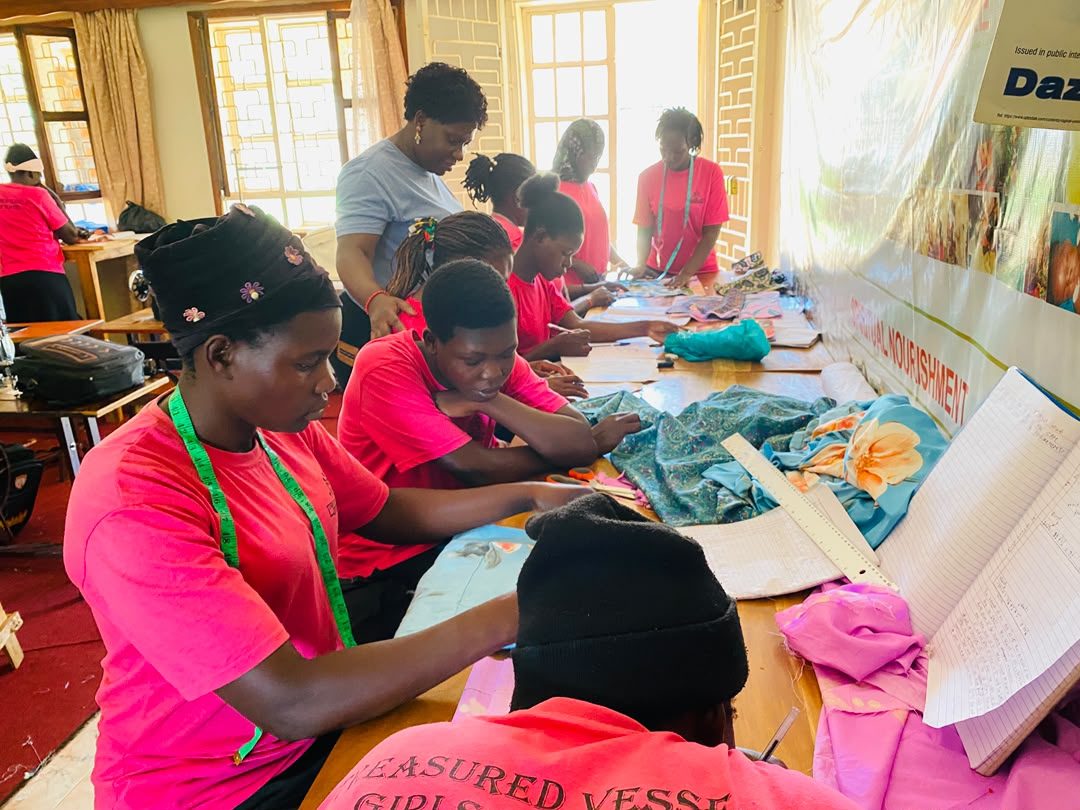
Why they are writing, not sewing
A woman's first weeks in the tailoring class involve very little sewing.
She learns the parts of the machine and what each one does. She learns to thread it, wind a bobbin, set tension, and recognise the three or four things that go wrong most often, because a tailor who cannot fix her own machine loses a day's income every time the thread bunches underneath.
She learns to take a measurement and write it down. She learns what a seam allowance is, and why a garment cut without one cannot be rescued afterwards.
The exercise books are where all of this lives. Nobody remembers thirty measurements and a cutting sequence from a demonstration. Six months later, when she is working alone in her own room with a customer waiting, the book is what she has.
This is the difference between training someone and showing someone. Showing takes an afternoon. Training takes months, and it is mostly writing, measuring, unpicking and doing it again.
One lesson, start to finish
Take a single session: a straight-seam skirt, early in the course.
The objective is stated at the start and it is deliberately narrow: cut two panels to a given measurement, join them with a straight seam of consistent width, and finish the waist. Not "make a skirt". One skill, done properly.
The equipment is laid out before anyone sits down: fabric, tape measure, tailor's chalk, a metre rule, pins, scissors, and a machine that has already been checked.
The safety instruction is short and repeated every time. Scissors are passed handles-first. Fingers stay behind the presser foot. Nobody threads a machine with their foot resting on the treadle. Pins go in the tin, never in the mouth. It sounds obvious until you have seen someone put a needle through a fingernail.
The trainer demonstrates once at normal speed, then again slowly, narrating. Then she stops talking and walks the table while the class works, which is where the actual teaching happens: one correction at a time, at each woman's shoulder.
The practice task is done by everyone, on cheap fabric, with the expectation that the first attempt will be wrong.
The quality standard is explicit, because "good enough" is useless as an instruction. The seam has to be within a set width along its whole length. The panels have to match at the hem. If it fails, it gets unpicked and sewn again. Not as punishment, but because a customer in Jinja market will not pay for a crooked seam, and it is kinder to say so in a classroom than to let her discover it at her first sale.
The next step is named before the class ends, so the sequence is visible: this seam becomes a skirt, the skirt becomes a school uniform, and school uniforms are the steadiest work available to a tailor in this town.
What we actually run
We would rather be precise here than impressive, so this section separates what happens now from what we are working towards.
Running now. Practical training in tailoring, hairdressing, baking, crafts, soap-making and shoemaking, alongside basic business and money skills. Our published programme is an intensive course of six to twelve months, depending on the trade and on how much time a woman can give. Many of our participants are mothers, and a full daily timetable is not always possible.
On graduation, participants receive a start-up kit so they can begin earning rather than waiting. For a tailor that means a sewing machine.
What we are working towards, and do not yet claim. Formal, externally recognised certification for each course is a goal rather than a current fact. So is a structured link into apprenticeships with local businesses. We would rather say that plainly than imply an accreditation we cannot yet evidence. If a donor or partner reads this and wants to help build it, that is a conversation we would welcome.
The other rooms
Tailoring is the easiest trade to describe because the sequence is so visible. The others follow the same logic: narrow objective, explicit standard, repetition until it is reliable.
Baking is the one people underestimate. It looks like following a recipe and it is not. Most of the early lessons are about measurement and consistency: the same loaf, the same weight, the same rise, every time. A baker who produces an excellent cake once has a hobby. A baker who produces the same acceptable loaf forty times has a business, because a shop will only reorder from someone whose product does not vary.
Costing is taught alongside it, and it is the part that decides whether a small food business survives. A woman who does not know what her flour, sugar, charcoal and time actually cost will price by guesswork, and in this trade guesswork usually means selling at a loss without realising it for months.
Hairdressing has the shortest route to income of any trade we teach, which makes it attractive to a young mother who needs to earn quickly. The training is heavier on hygiene than newcomers expect: clean tools between clients, safe handling of chemical relaxers and dyes, and knowing which treatments to refuse on damaged hair or on a child. Skipping that is how a new salon loses its reputation in a fortnight.
It is also the trade where customer manner matters most. A client sits for two hours. Whether she comes back has as much to do with how she was treated as with the finished style, and that is taught deliberately rather than left to personality.
Soap-making, crafts and shoemaking run on the same principles, and they suit different women for different reasons: capital required, physical demands, whether the work can be done at home with a baby nearby.
That last consideration decides more course choices than aptitude does, and we would rather a woman pick the trade that fits her life than the one that sounds most impressive.
The start-up kit is the whole point
A woman who finishes six months of training and goes home without equipment has been given a certificate-shaped disappointment.
She cannot practise. She cannot take an order. Within a few months the skill fades, and the training was a cost with no return, for her and for whoever funded it.
A treadle sewing machine costs about $150. That single item is the difference between a woman who can sew and a woman who is a tailor. It needs no electricity, which matters when power is unreliable, and it holds its value: it can be repaired locally and it will still be working in twenty years.
We currently need ten machines for the next cohort.
About buying what they make
We want to be careful here, because this is where a lot of well-meaning charity goes wrong.
If you buy a bag or a dress from a programme like ours, we would like you to buy it because it is well made and you want it. Not because of what happened to the woman who made it.
There is a version of this work, common enough that you will have seen it, where a product is sold on the strength of a participant's worst experience. A short account of hardship is attached, and the purchase becomes an act of pity. It shifts a few items. It also teaches the maker that her history is her most marketable asset, which is the opposite of what six months of training was for.
Value the product for its quality. Value the programme for the opportunity it creates. Those are two separate transactions and they should stay separate.
Practically, that means we hold the work to a market standard, we would rather lose a sale than pass off something poorly finished, and we do not attach personal histories to price tags.
For businesses and trainers
If you run a business in Jinja, or anywhere, there are three things worth more to us than a donation.
Orders. A standing order for uniforms, aprons, bags or workwear does more for a graduate than any grant, because it turns a skill into an income with a predictable rhythm. Even a small recurring order changes the arithmetic of a young woman's month.
Mentoring. An hour a month from someone who actually runs a tailoring business, a salon or a bakery is worth a great deal. Pricing, dealing with a difficult customer, knowing when to say no to a job: these are the things that sink new businesses, and they are not taught well from a textbook.
A route to market. Introductions to shops, schools needing uniforms, or a stall at an event. Access is usually the binding constraint, not ability.
If any of that is something you could offer, partner with us and let us know what is realistic for you. We would rather have a small commitment that lasts than a large one that does not.
What the equipment costs
A costed list, so you can see exactly what a gift buys:
| Item | Cost | What it does |
|---|---|---|
| Treadle sewing machine | $150 | Equips one graduate to start earning immediately |
| Set of shears, tape, chalk and rules | $25 | A full cutting kit for one trainee |
| Bolt of training fabric | $40 | Practice material for a class, so nobody learns on cloth they are afraid to cut |
| Hairdressing starter set | $60 | Clippers, combs and basic supplies for one graduate |
| Baking equipment share | $35 | Tins, utensils and ingredients for a cohort's practice sessions |
Ten machines for the next cohort is $1,500. That is the single item that most changes what happens after graduation.
"She girds herself with strength, and strengthens her arms. She perceives that her merchandise is good." Proverbs 31:17,18, NKJV
We do not think that verse is decoration. It describes a woman whose work is skilled, whose goods are genuinely good, and who knows it. That is the outcome we are training for.
Equip a woman to earn
Training without equipment is a half-finished job. If you would like to finish one:
- $25 provides a full cutting kit for a trainee
- $60 provides a hairdressing starter set for a graduate
- $150 provides a treadle sewing machine, the item that turns a trained woman into a working tailor
Fund a sewing machine for a graduate →
Frequently asked questions
How long is the training?
Our published programme runs as an intensive course of six to twelve months, depending on the trade and on how much time a participant can commit. Many are mothers, so a full daily timetable is not always workable and the pace is set accordingly.
Which trades do you actually teach?
Tailoring, hairdressing, baking, crafts, soap-making and shoemaking, alongside basic business and money skills.
Do participants receive a recognised certificate?
Formal, externally recognised certification is a goal we are working towards rather than something we currently offer. We would rather state that plainly than imply an accreditation we cannot evidence.
Do graduates receive equipment?
Yes. Participants receive a start-up kit on graduation so they can begin earning rather than waiting. For a tailor, that means a sewing machine.
Why treadle machines rather than electric ones?
They need no electricity, which matters when supply is unreliable; they can be repaired locally with ordinary tools; and they hold their value for decades. For a woman working from home in Jinja, a treadle machine is the more useful piece of equipment.
Can my business help without donating money?
Yes, and it may help more. Standing orders for garments, an hour a month of mentoring from someone who runs a similar business, or an introduction to a market or shop are all worth a great deal. Please get in touch and tell us what is realistic for you.
Can I buy something made by the programme?
We would like you to, on the condition that you buy it because it is well made. We hold the work to a market standard and we do not attach personal histories to price tags.