
This article is general information, not legal advice. It cannot account for the facts of any particular case. If a child may be at risk, contact the Uganda Child Helpline on 116, free on any network and available 24 hours, or a probation and social welfare officer, the police Child and Family Protection Unit, or a legal aid provider.
Most people we speak with in Jinja are surprised by two things about Ugandan law on child marriage.
The first is how clear it is. There is no ambiguity about the minimum age, no exception for pregnancy, and no loophole for family agreement.
The second is how little that clarity helps if nobody knows about it. A law that is plain on the page and unknown in the village protects nobody.
So this is the plain-language version: what the law actually says, the four misunderstandings we hear most often, and, the part that matters most, what to do if you think a child is about to be married.
The rule, in one line
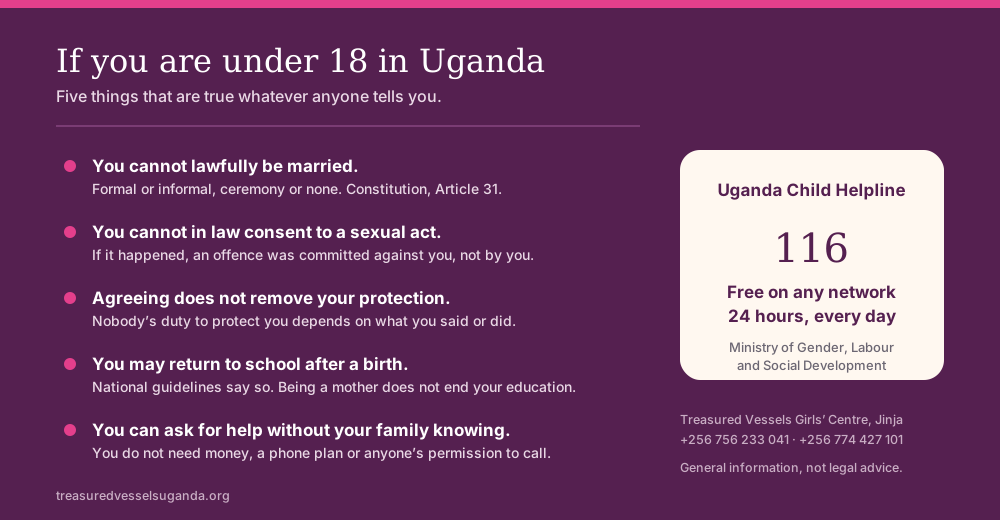
Nobody under eighteen can lawfully marry in Uganda.
That is it. Everything below is detail, qualification and consequence, but the rule itself does not have conditions attached.
Where the rule comes from
Three separate pieces of law work together here. It helps to know which is which, because people often argue with one while forgetting the others.
The Constitution sets the age
Article 31(1) of the Constitution of Uganda provides that a man and a woman are entitled to marry only if they are each of the age of eighteen years and above.
Article 31(3) adds that marriage shall be entered into with the free consent of the man and woman intending to marry.
Two requirements, both of which must be met: eighteen, and freely consenting. A union that fails either test is not a valid marriage under Ugandan law.
The Children (Amendment) Act defines child marriage
The Children (Amendment) Act 2016 addresses child marriage specifically, and its definition is deliberately broad: a formal or informal union involving a person below the age of eighteen for the purpose of living together as husband and wife.
The breadth is the point. The law was written knowing perfectly well that most child marriages in Uganda involve no registrar, no certificate and no ceremony anyone would recognise as a wedding.
The Penal Code makes the sexual act an offence
Under section 129 of the Penal Code Act, as amended in 2007, performing a sexual act with a person below the age of eighteen is the felony of defilement, carrying a maximum penalty of life imprisonment. An attempt carries up to eighteen years.
This is why child marriage is not simply a civil irregularity. A union in which a girl under eighteen is living as a wife will, in the ordinary course, involve conduct that the Penal Code treats as a serious crime.
Four things people get wrong
These are the four we hear most often, in roughly this order.
"It is not a real marriage, just an arrangement"
This is the most common, and the law anticipated it.
The Children (Amendment) Act covers informal unions. If a girl under eighteen has been placed with a man to live as his wife, the protective framework applies whether or not anything was registered, whether or not bride price changed hands, and whether or not anyone used the word marriage.
Calling it an arrangement changes the vocabulary. It does not change the legal position, and it does not change what happens to her.
"She is pregnant, so marriage is the solution"
Marriage is not a remedy for pregnancy, and attempting to use it as one makes the situation worse in three distinct ways.
It is not lawful. The age requirement has no pregnancy exception. It does not undo the offence that the pregnancy of a girl under eighteen evidences. And practically, it moves her out of reach: away from her own family, out of school, and into a household where the person who harmed her has authority over her.
Families who suggest this are usually trying to solve shame and money. Both of those are real problems and both have other answers.
"She agreed to it"
A child's apparent agreement does not remove anyone's duty to protect her.
The law does not recognise consent below eighteen for the purposes of a sexual act, which is the entire basis of the defilement offence. And "agreement" in these circumstances is rarely what the word implies. A fifteen-year-old told by her family that this is what will happen, with no money and nowhere else to go, is not exercising a free choice in any sense the Constitution would recognise.
The practical version: if you find yourself weighing whether she consented, you are asking the wrong question. The question is whether she is under eighteen.
"It is a cultural matter, not a legal one"
Culture is real and worth taking seriously. It does not create an exception to the Penal Code.
It is also worth being accurate about what tradition actually requires. In our experience, when families are asked directly, the reasons given are far more often economic than cultural: school fees, food, a household under strain. Culture is frequently the language used to describe a financial decision, which matters, because a financial problem has practical solutions and an inherited obligation appears not to.
What to do if you suspect a child marriage is being arranged
This is the section to read carefully, because acting badly here can make a girl's situation considerably worse.
1. Ask first whether she is in immediate danger
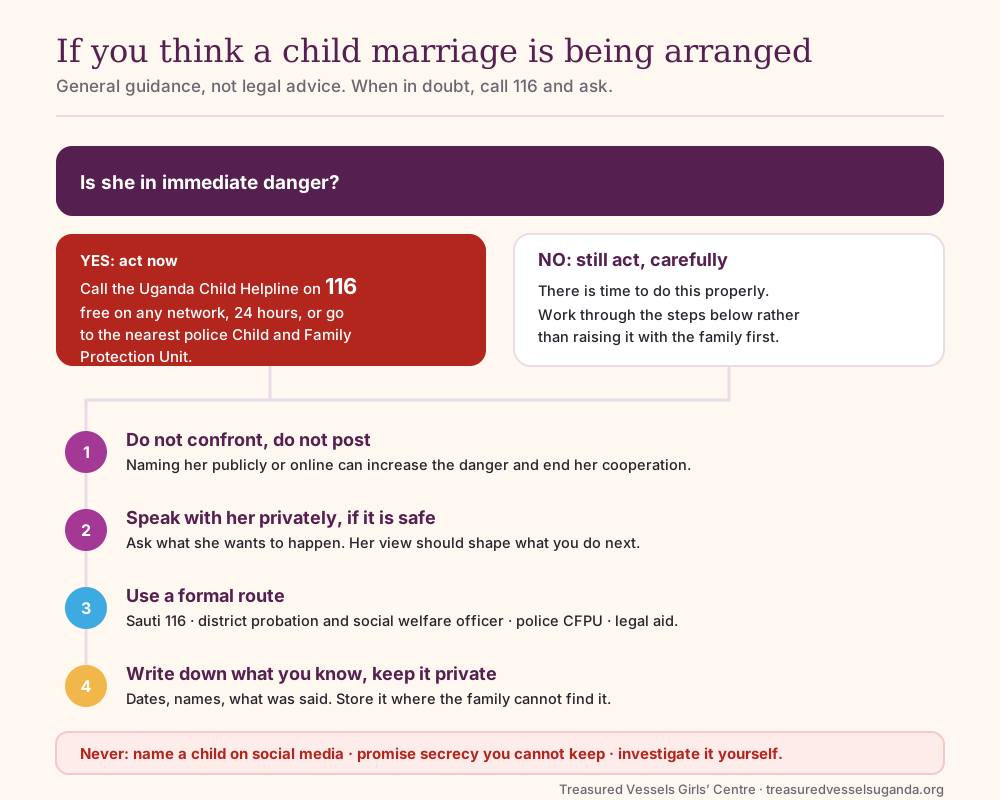
If a marriage is days away, if she has been removed from school and confined, or if you believe she is being harmed now, this is urgent.
Call the Uganda Child Helpline on 116. It is free from any network, operates 24 hours, and is run by the Ministry of Gender, Labour and Social Development. You can also go directly to the nearest police station and ask for the Child and Family Protection Unit.
You do not need to be certain. You do not need evidence. Reporting a concern is not an accusation.
2. Do not confront the family, and do not post anything online
Both instincts are understandable and both are dangerous.
Confronting a family tends to accelerate matters rather than stop them. A marriage that was planned for next month can happen next week, somewhere you cannot see it. It also identifies you as the person who interfered, which removes you as someone she can turn to later.
Posting about it on social media is worse. It can identify a child to her entire community, it can reach the family before any official does, and it can permanently attach the matter to her name in a way no outcome will remove. Never name a child publicly. Not with initials, not with a photograph, not with enough detail that anyone local could work it out.
3. Speak with her privately, if it is safe
If you can talk to her without anyone noticing, do.
Ask what she wants to happen. This is not a formality. A girl who has been decided about all her life is far more likely to engage with a plan she has helped shape, and she often knows things about her household that no outsider does: who might help, who must not be told, where the real pressure is coming from.
Do not promise that you will keep it secret. You may not be able to, and a promise you break is worse than one you never made. What you can say honestly is that you will tell her before you tell anyone else, and that you will not do anything without explaining it to her first.
4. Use a formal route
The people whose job this actually is:
- Uganda Child Helpline: 116. Free, any network, 24 hours. The simplest place to start if you are unsure of anything.
- The district probation and social welfare officer. The statutory child protection role at district level.
- The police Child and Family Protection Unit at your nearest station.
- A legal aid provider, where the question is genuinely legal rather than protective.
Pick a route that does not run through anyone connected to the family.
5. Write down what you know, and keep it somewhere private
Dates, what was said, who said it, what you observed. Write it while you remember it accurately.
Keep it somewhere the family cannot find, and share it only with the people in step four. This is not about building a case, which is not your job, but about the fact that memory degrades and details matter later.
What not to do
- Do not investigate it yourself, question the man involved, or gather evidence.
- Do not promise secrecy you cannot keep.
- Do not pay anyone to make it go away. It does not work and it creates a market.
- Do not assume someone else has reported it.
If you are the girl
You can call 116 yourself. It costs nothing, it works on any network, and you do not need anyone's permission.
Nothing that has happened is your fault, and nothing you agreed to changes your right to protection. If you are in the Jinja area and would rather speak to someone local first, you can contact us on +256 756 233 041 or +256 774 427 101 and we will help you work out what to do next. We will not contact your family without discussing it with you.
A note for religious and cultural leaders
You are, in practice, the people best placed to stop this.
A family considering an early marriage will very often consult a pastor, an imam or a clan elder before anyone else, and long before any official hears about it. What you say at that moment carries more weight than any law.
Two things are worth knowing. Officiating or blessing a union involving someone under eighteen associates you with conduct the Penal Code treats as a felony. And saying so plainly, once, from the front, changes what families believe is expected of them, which is the single most useful contribution available to anyone in your position.
"Learn to do good; seek justice, rebuke the oppressor; defend the fatherless, plead for the widow." Isaiah 1:17, NKJV
Save these contacts
The most useful thing you can do today takes one minute: put the helpline in your phone before you need it.
- Uganda Child Helpline: 116. Free, any network, 24 hours
- Treasured Vessels Girls' Centre, Jinja: +256 756 233 041 / +256 774 427 101
- Your district probation and social welfare officer
- Your nearest police Child and Family Protection Unit
Please do not expose a child on social media. If you want to help publicly, share this article rather than a child's situation.
Frequently asked questions
What is the legal age of marriage in Uganda?
Eighteen. Article 31(1) of the Constitution provides that a man and a woman may marry only if each is aged eighteen or above, and Article 31(3) requires the free consent of both. There is no exception for pregnancy and none for parental agreement.
Is a customary or informal union still child marriage?
Yes. The Children (Amendment) Act 2016 defines child marriage to include formal and informal unions involving anyone under eighteen for the purpose of living together as husband and wife. No certificate or ceremony is required for the law to apply.
Does pregnancy make an under-age marriage lawful?
No. There is no pregnancy exception to the minimum age. Marrying a pregnant girl under eighteen does not make the union lawful and does not undo any offence already committed.
What if the child says she agreed?
A child's apparent agreement does not remove the duty to protect her, and the law does not recognise consent below eighteen for the purposes of a sexual act. If she is under eighteen, the question of agreement does not change the legal position.
Who do I report a suspected child marriage to?
Start with the Uganda Child Helpline on 116, free from any network, 24 hours. You can also contact the district probation and social welfare officer, or the Child and Family Protection Unit at your nearest police station.
Should I post about it on social media to get help?
No. Naming or identifying a child publicly can increase the danger to her, alert the family before officials are involved, and follow her for years afterwards. Use a confidential route instead.
Do I need proof before I report something?
No. You are raising a concern, not making an accusation or bringing a case. Investigating is the job of the people you report to, and attempting it yourself can make matters worse.
Is this article legal advice?
No. It is general information intended to help people understand the framework and know where to turn. For advice on a specific situation, speak to a qualified legal practitioner or a child protection professional.