
There is a photograph every vocational programme in Uganda has. Twenty women in matching shirts, certificates in hand, a trainer at the end of the row. It is a real achievement and we take it too.
The honest question is what the photograph does not show. Six months later, how many of those women are earning money from the thing they were taught? Not "have a skill". Earning. And of those, how many keep the money they earn?
Almost nobody measures that. A completed course is an output: it is countable, it happens on a known date, and it can be reported to a donor within the funding year. Income is an outcome: it is slow, it is hard to verify, and it frequently does not happen. The gap between the two is where most vocational training quietly fails, and closing it is a different job from teaching somebody to sew.
This article sets out what the evidence says, what the gap is made of, the pathway we think gets a woman across it, the measurements we are committing to publish, and the routes to capital that already exist in Uganda and are under-used.
It is written for livelihood donors, businesses, training institutions and participants, and it is deliberately specific about what we do not yet do well.
What the evidence actually shows
The strongest evidence on this question in Uganda comes from BRAC's Empowerment and Livelihood for Adolescents programme, evaluated as a randomised controlled trial. Adolescent girls met in clubs that bundled several things at once: vocational skills, life skills, sexual and reproductive health knowledge, mentoring from slightly older women, and information about their legal rights.
Four years on, the results were substantial. Girls in the programme were about 48% more likely to be engaged in income-generating activity, an increase driven almost entirely by self-employment rather than by finding a job. Teen pregnancy fell by about 34%. The working paper and the World Bank version of the study report the same figures, and the published article in the American Economic Journal: Applied Economics reports the same direction of effect. Importantly, school enrolment did not fall: the girls were not trading education for income.
Two things in that result are easy to miss and matter more than the headline.
It was a bundle, and the bundle is the intervention. The clubs did not teach tailoring and stop. Vocational skills sat alongside life skills, health knowledge, mentoring and legal information, in a space the girls controlled. Nobody has shown that the vocational component alone produces those numbers, and there is good reason to think it would not.
The same model did not transfer. A replication in Tanzania found no robust effects of the standard ELA model on young women's economic and social outcomes. Adding microfinance produced larger effects there. That is an uncomfortable finding and it is the most useful one on this page: a programme that works in one country's labour market can fail in another's, and the difference is usually the market rather than the curriculum.
So the lesson is not "copy ELA". It is that skills plus context beats skills, and that nobody should assume a result will travel.
Why a finished course is only halfway
Picture a woman who has just completed six months of tailoring. She is competent. She can take a measurement, cut, and finish a garment properly.
Here is what stands between her and an income.
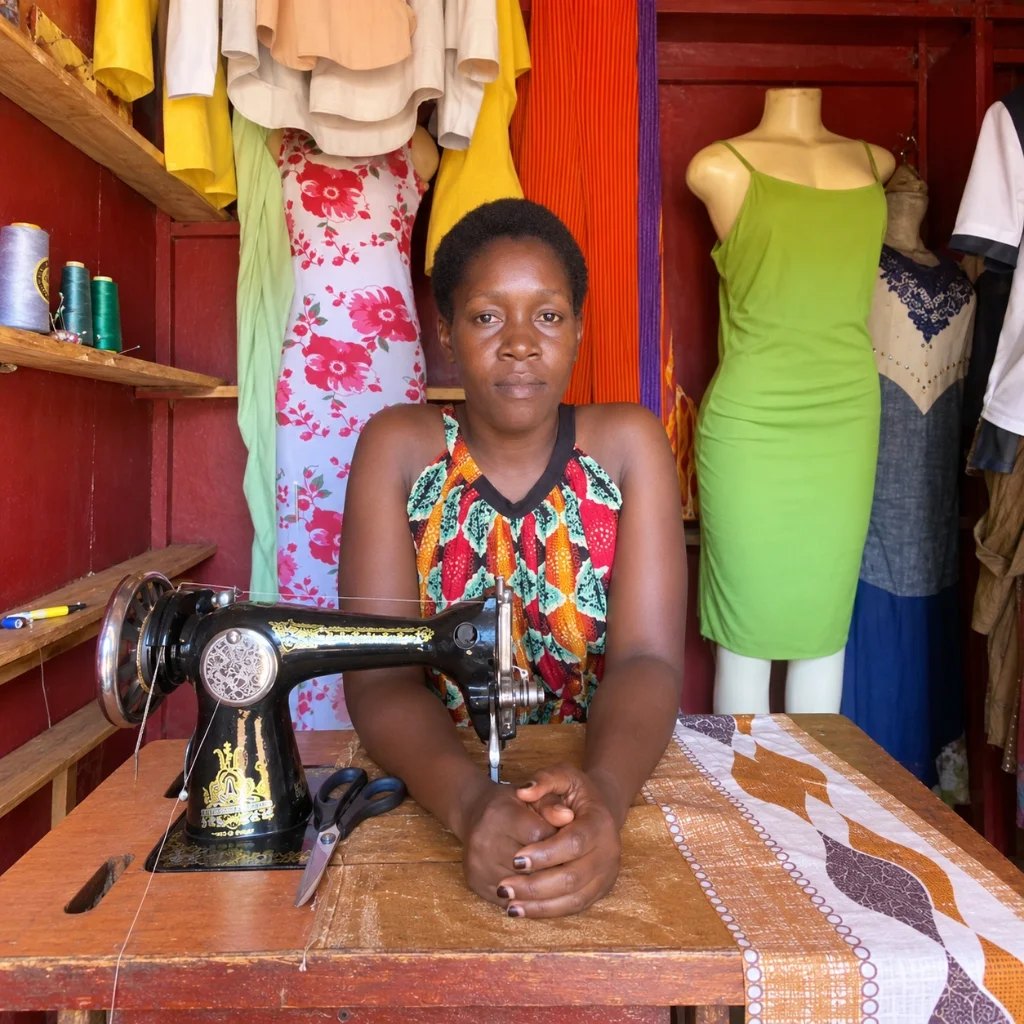
No machine. This is the single biggest one, and it is the thing our own students raise first. A tailoring graduate without a machine has to carry every job back to the centre and work on somebody else's timetable. Nekita, who is in our tailoring class now, says exactly this in her own words.
No stock. She can sew, and she cannot buy fabric. The first order has to be financed before it can be delivered, and no customer pays in advance for someone with no track record.
No customers. Nobody taught her how to find the first ten. Skill and demand are different problems and training programmes almost always address only the first.
No pricing. She charges what the woman down the road charges, without knowing whether either of them is making money. This one is invisible and it is lethal: a business can run for months at a loss while everybody involved believes it is working.
No childcare. A young mother cannot take a market stall, an apprenticeship or a day of deliveries if there is nobody to hold the baby. This disqualifies exactly the women the programme exists for.
No transport. The trade is in town and she is not.
No permission. In some households she needs it, and in some she will be punished for earning more than the man she lives with. We wrote about that evidence in recognising abuse without putting someone at greater risk, and it is not a hypothetical.
Six months of good teaching solves one problem on that list. That is not a criticism of training. It is an argument that training is a component rather than a programme.
The saturation problem, which nobody wants to discuss
This is the part of the sector that is least honest, including with ourselves.
Vocational programmes choose trades for reasons that have nothing to do with demand. Tailoring is chosen because machines are available, trainers are available, it photographs well, and it is what the last programme did. So twenty women are trained in tailoring. And then another twenty by the next organisation. And another twenty by the one after that.
In a town the size of Jinja, that arithmetic ends badly. The constraint is not how many women can sew. It is how many garments the town buys in a month, and that number does not grow because more people learned to sew. What happens instead is that the price falls, the newest entrant with no reputation and no capital gets the least work, and she is the one who concludes she failed.
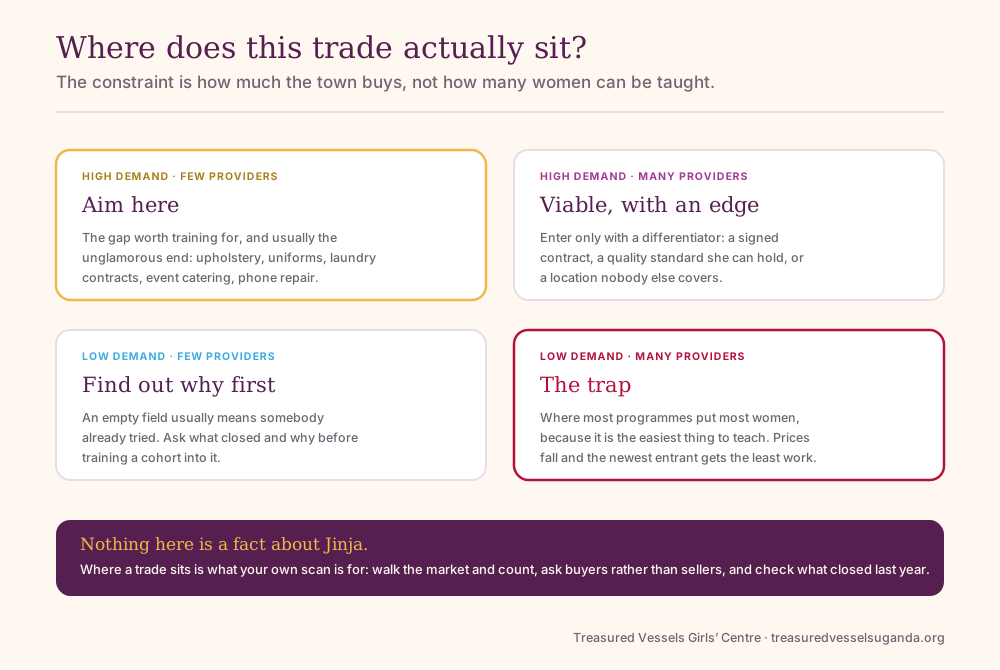
The question to ask before choosing a trade is not "can we teach it?" It is "who in Jinja is currently paying for this, how much, and how often?"
That is answerable, and it does not require a consultant. It requires somebody to spend four days doing the following.
Walk the market and count. How many tailoring stalls are there on this street. How many are busy at eleven on a Tuesday. How many have closed since last year.
Ask buyers, not sellers. Hotels, schools, clinics, churches, saloons and small manufacturers all buy things every month. Ask them what they buy, from whom, at what price, and what they struggle to source locally. A school that buys 300 uniforms a year is a more useful fact than any survey.
Look for the unglamorous gaps. The trades nobody photographs are often the ones with demand: upholstery, mattress making, catering for events, uniform contracts, laundry for hotels, phone repair, tent and chair hire, poultry feed, packaging.
Check what fails. If six soap-making businesses started last year and four closed, find out why before training a seventh batch.
Write it down and publish it. A market scan that lives in one person's head is not a market scan.
We are committing to running this before each new cohort, and to letting the result change what we teach, including dropping a trade we are good at if the town does not need more of it.
The enterprise pathway
Here is what we think the full job looks like. Training is one box out of twelve.
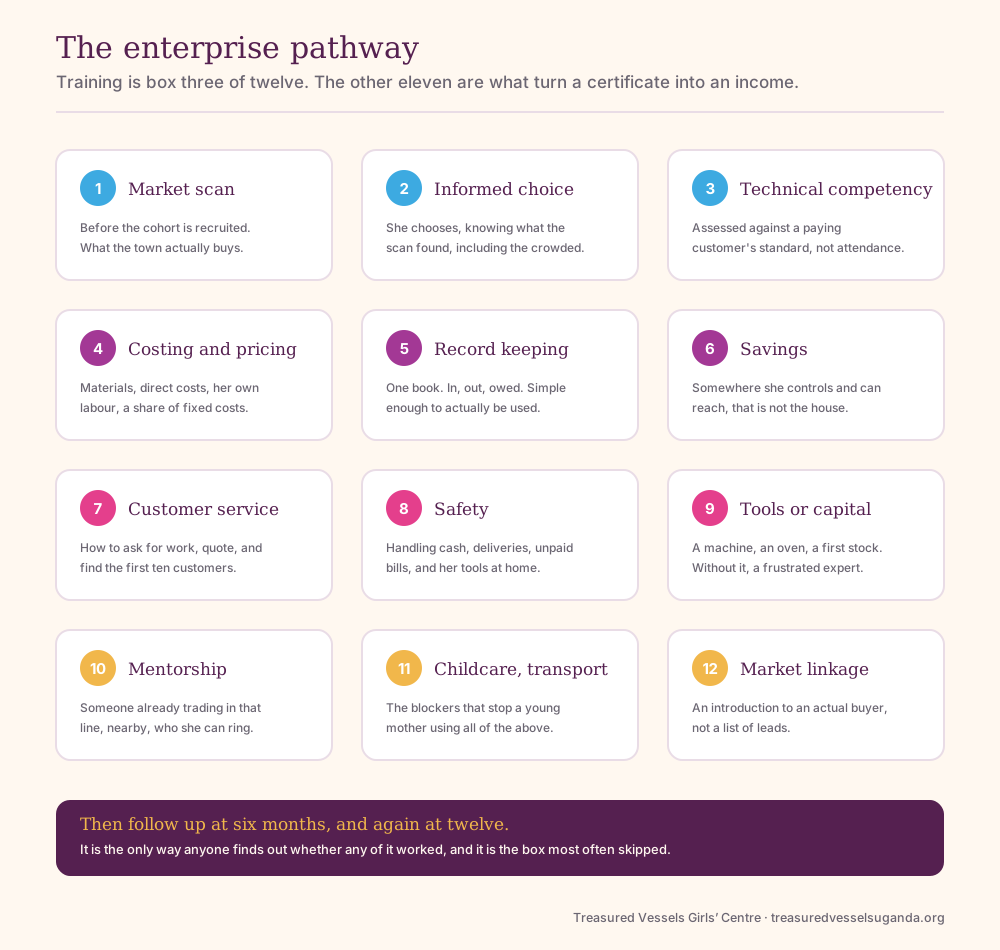
1. Market scan. Before the cohort is recruited, not after. Described above.
2. Participant choice, informed by it. She chooses, and she chooses knowing what the scan found, including that her preferred trade may be crowded. Choosing for her produces people who complete courses they do not want.
3. Technical competency, assessed. Not attendance. A graduate should have made the thing to a standard a paying customer would accept, and somebody independent should have said so.
4. Costing and pricing. Covered below, because it deserves its own section.
5. Record keeping. A single book. What came in, what went out, what is owed. Simple enough to actually be used.
6. Savings. Somewhere money can go that is not the house, that she controls, and that she can reach. A group savings arrangement, a mobile money wallet in her own name, or a bank account.
7. Customer service and getting the first ten customers. How to ask for work, how to price a quote, what to do when a customer is unhappy, how to get repeat business and referrals.
8. Personal and business safety. How to handle cash, which deliveries not to take alone, what to do about a customer who will not pay, and how to protect her stock and tools inside her own household.
9. Start-up tools or capital. A machine, an oven, a first stock of materials, or a small grant. Without this the previous eight boxes produce a frustrated expert.
10. Mentorship. Someone already trading in that line, nearby, who she can ring. This is the cheapest item on the list and we think the most under-rated.
11. Childcare and transport. The practical blockers that stop a young mother using everything above.
12. Market linkage. An introduction to an actual buyer. A school that needs uniforms, a hotel that needs laundry, a shop that will stock her product.
Then follow-up at six and twelve months, which is the only way anyone finds out whether any of it worked.
We do some of this. We do not do all of it well, and we do almost none of the follow-up. Writing the list down is the first step to being held to it.
Costing, because this is where businesses actually die
Ask a new trader what she charges and she will tell you. Ask her what it costs her to make, and the conversation usually stops.
A dress sells for a price that feels right, or that matches the shop next door. Nobody has subtracted the fabric, the thread, the zip, the buttons, the transport to buy the fabric, the electricity or the machine's wear. Nobody has valued her own time at anything. So the business runs, money moves, and it is slowly going backwards.
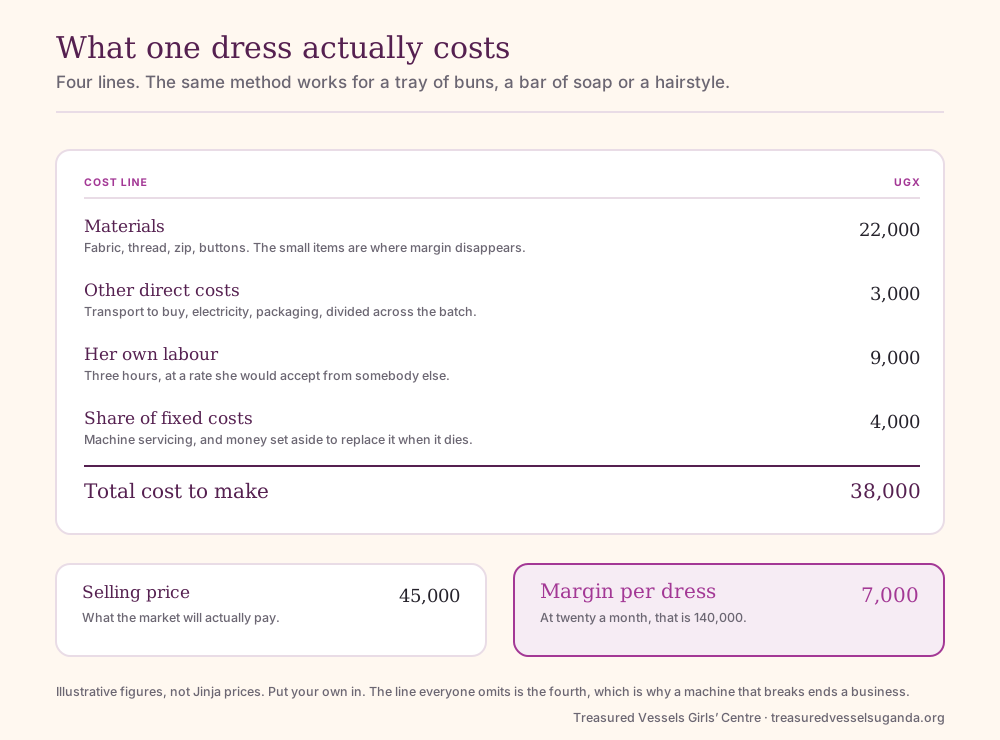
The method is four lines and it works for a dress, a tray of buns, a bar of soap or a hairstyle.
Materials for one unit. Everything consumed making it, including the small things. Thread and buttons are where the margin disappears.
Other direct costs. Transport to buy materials, charcoal, electricity, packaging, mobile money charges. Divided by the number of units that trip or that batch produced.
Her own labour. Hours taken, at a rate she would accept from somebody else. A business that only works because the owner is unpaid is not a business, it is a hobby that is losing money.
A share of the fixed costs. Rent if any, machine servicing, and a monthly amount set aside to replace the machine when it dies. This is the line everyone omits, and it is why a machine that breaks ends a business.
Add those four, and the selling price has to be higher. If the market will not pay more than the total, that is not a pricing problem, it is a market answer, and she has found it out on paper rather than after six months.
Download the costing and record sheet as a printable PDF Two A4 pages. Page one is a blank unit costing sheet and a weekly money-in and money-out record, large enough to fill in by hand. Page two is a worked example with the arithmetic shown. It photocopies in black and white and may be freely copied by any training programme.
Earning is not the same as keeping
A woman who generates money that somebody else takes has gained a workload, not an income.
We have set out the evidence on this before and it is worth repeating here, because livelihood programmes routinely ignore it. Analysis of Demographic and Health Survey data across sub-Saharan Africa found economic empowerment to be among the more promising routes to reducing intimate partner violence, while also finding a backlash effect: where a woman was employed and her partner was not, and where she earned more than he did, intimate partner violence was associated with an increase. A study of a microfinance-plus programme in rural South Africa found that women who reported not earning enough to cover their business costs faced higher odds of physical or sexual violence in the past year.
The full discussion is in recognising abuse without putting someone at greater risk. Three things follow for a livelihood programme.
Control over earnings is part of the intervention, not an afterthought. Savings she can actually reach, records she keeps herself, a mobile money account in her own name, and a place to keep money that is not the house.
A struggling business is a safeguarding signal. If a participant's stock keeps disappearing, or her trade is failing for reasons she cannot explain, that is a protection concern as well as a commercial one. Trainers should treat it that way rather than chasing the target harder.
Household negotiation is a skill worth teaching. How a woman presents a new income at home affects whether she keeps it. That is uncomfortable to write down and it is the reality the women describe.
Not everyone should be self-employed
The sector has a default assumption that the end point of training is a woman running her own micro-business. For many it should not be.
Self-employment means carrying the risk, finding the customers, financing the stock and absorbing the bad months, all at once, usually with no cushion. Some participants are well suited to it. Others would be better served by an apprenticeship with an established trader, or a wage placement with a local business, where somebody else carries the risk and she earns from week one while she learns the trade properly.
Wage work is less photogenic and often the better outcome. A placement at a steady wage beats a micro-business that fails in month five, and it can be the route to self-employment later with capital saved and customers known.
So the end of a course should produce an individual transition plan, not an assumption: self-employment, apprenticeship or placement, chosen with her, with the next three steps named and dated.
What we will measure, and publish
An organisation that reports only completions is reporting the easy number. Here is the scorecard we think is honest, and what we can currently say about each line.
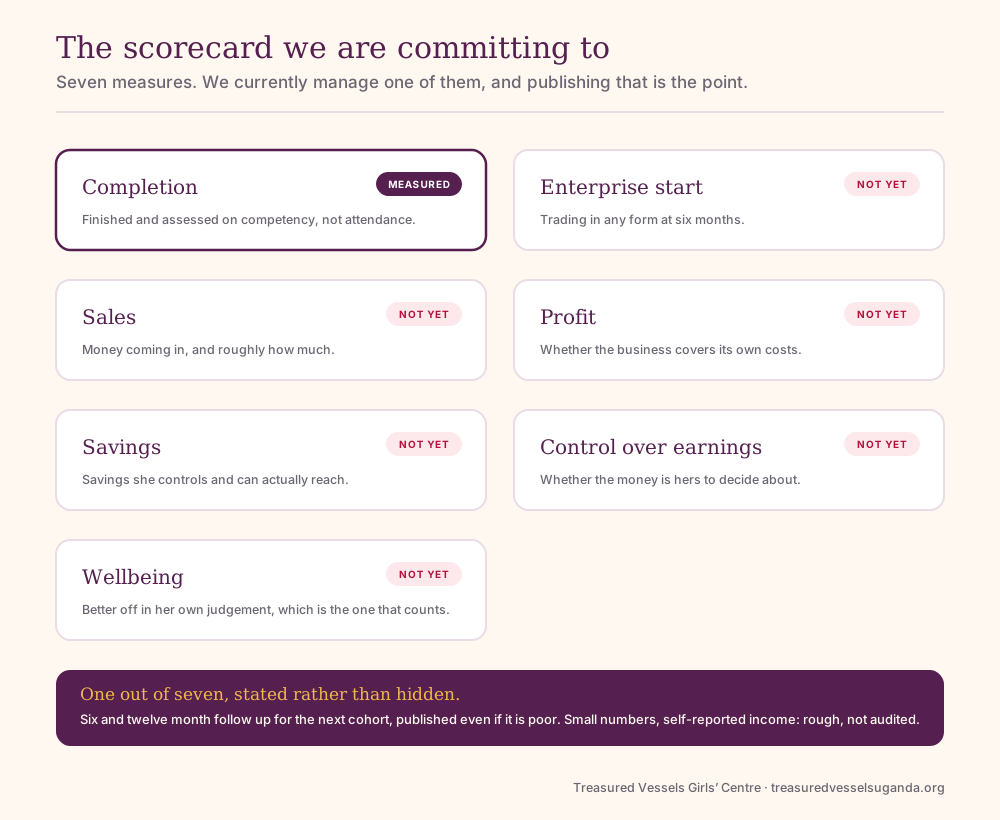
Completion. How many finished, assessed on competency rather than attendance. We measure this.
Enterprise start. How many are trading, in any form, at six months. We do not currently measure this.
Sales. Whether money is coming in, and roughly how much. Not measured.
Profit. Whether the business covers its own costs, using the costing method above. Not measured.
Savings. Whether she has savings she controls and can reach. Not measured.
Control over earnings. Whether the money she makes is hers to decide about. Not measured, and the one most likely to be uncomfortable.
Wellbeing. Whether she is better off in her own judgement, which is the only judgement that counts. Not measured.
That is one line out of seven. We are publishing the gap rather than hiding it, because a scorecard announced and then quietly dropped is worse than no scorecard. The commitment is to run six and twelve month follow-up for the next cohort and to publish the result, including if it is poor.
Two honest caveats. Our numbers will be small, so they will not be statistically meaningful and we will not present them as though they are. And self-reported income is unreliable everywhere, so it will be a rough measure rather than an audited one.
Capital that already exists in Uganda
Many organisations ask donors for start-up capital without telling participants about the national schemes they may already qualify for. Two are worth knowing about.
The GROW Project. Generating Growth Opportunities and Productivity for Women Enterprises is a Government of Uganda programme backed by a US$217 million World Bank grant, run by the Ministry of Gender, Labour and Social Development with the Private Sector Foundation Uganda. It targets women-owned micro and small enterprises, defined as at least 51% owned by one woman, and both registered and unregistered businesses can take part, although some products require registration. It offers loans through selected banks, microfinance institutions and SACCOs, and a business plan competition offering grants that do not have to be repaid. Reported grant bands for the current round run from about UGX 3.5 million for the smallest micro-enterprises up to about UGX 107 million for small enterprises employing between five and forty-nine people. It covers every district. Check the current guidelines at grow.go.ug before relying on any figure here, because the bands have changed between rounds.
The Uganda Women Entrepreneurship Programme. UWEP provides interest-free credit on a revolving fund basis through the Ministry of Gender, Labour and Social Development, disbursed via district local governments. Women apply in groups of ten to fifteen, which is also how repayment is secured, and a group can access up to UGX 12.5 million. A 2022 review found it had reached more than 10,000 groups representing nearly 170,000 women entrepreneurs, and also that COVID-19 damaged loan recovery.
Two cautions we would give any graduate. A loan is not a grant, and a woman who has not done the costing exercise above should not take one. And a group loan makes the group jointly responsible, so who is in the group matters as much as what the money is for.
What we are asking for
Sponsor a complete pathway rather than a course. The training is the cheap part. What is missing is the machine or oven, the first stock, the childcare that lets her attend, the fare, the mentor, and the two follow-up visits that find out whether it worked. Funding the course alone buys a certificate. Funding the pathway buys an income.
Become a market mentor. If you run a tailoring, catering, hairdressing, soap or retail business in or near Jinja, an hour a month on the phone to one graduate is worth more than most of what we can teach her. You would be answering the questions we cannot: what to charge this season, which supplier to avoid, how to handle a customer who will not pay.
Businesses: give us demand, not donations. A workplace visit so trainees see a real operation. An apprenticeship place. A wholesale price on materials. Or best of all, an order. A school that commits to buying its uniforms locally does more for this than a cheque.
Training institutions and policymakers: we will share our market scans and our scorecard results, including the bad ones, with anyone doing comparable work in the district. Duplicating saturated trades is a collective failure and it is solvable by talking to each other.
Frequently asked questions
Why is completing a vocational course not enough?
Because a completed course is an output and an income is an outcome, and several things sit between them: tools, stock, customers, pricing knowledge, childcare, transport and sometimes permission at home. Six months of good teaching solves the skill. It does not solve the other seven, which is why many graduates never trade.
What does the evidence say about vocational training for young women in Uganda?
The strongest Ugandan evidence is BRAC's Empowerment and Livelihood for Adolescents programme, evaluated as a randomised controlled trial. Four years on, participants were about 48% more likely to be engaged in income-generating activity, driven almost entirely by self-employment, and teen pregnancy fell by about 34%, with no reduction in school enrolment. The intervention bundled vocational skills with life skills, health knowledge, mentoring and legal information, so the bundle rather than the training alone is what produced the result. A replication in Tanzania found no robust effects from the standard model, which is a caution against assuming results transfer.
Why is training too many women in the same trade a problem?
Because the constraint is demand, not supply. How many garments a town buys in a month does not increase because more people learned to sew. When several programmes all train tailors, prices fall and the newest entrant, with no reputation and no capital, gets the least work and concludes that she failed. The fix is to find out what the town actually buys before choosing what to teach.
How should a small business work out its prices?
Four lines. Materials for one unit including the small items like thread and buttons. Other direct costs such as transport, charcoal, electricity and packaging, divided by the units that batch produced. Her own labour, valued at a rate she would accept from somebody else. And a share of fixed costs, including money set aside to replace the machine. The selling price must exceed the total of those four. If the market will not pay it, that is a market answer rather than a pricing problem.
What is an enterprise pathway?
The full set of steps between recruiting a participant and her earning a living: market scan, informed choice of trade, assessed technical competency, costing and pricing, record keeping, savings, customer service, personal and business safety, start-up tools or capital, mentorship, childcare and transport, and a market linkage, followed by six and twelve month follow-up. Training is one step out of twelve.
Should every graduate start her own business?
No. Self-employment means carrying the risk, finding customers, financing stock and absorbing bad months, usually with no cushion. For many participants an apprenticeship with an established trader or a wage placement with a local business is the better outcome, because she earns from the first week while someone else carries the risk. Every course should end with an individual transition plan rather than an assumption.
Does earning money make a woman safer?
Usually it expands her options, and the evidence is mixed rather than uniformly positive. Analysis across sub-Saharan Africa found that where a woman was employed and her partner was not, or where she earned more than he did, intimate partner violence was associated with an increase, while higher education and household wealth were associated with a decrease. Control over the earnings matters as much as the earnings, and a business that cannot cover its costs is a safeguarding signal as well as a commercial problem.
What funding exists in Uganda for women's businesses?
The GROW Project, a government programme backed by a US$217 million World Bank grant, offers loans through banks, microfinance institutions and SACCOs, and non-repayable grants through a business plan competition, to enterprises at least 51% owned by a woman. The Uganda Women Entrepreneurship Programme offers interest-free revolving credit to groups of ten to fifteen women through district local governments, up to UGX 12.5 million per group. Check current guidelines directly, because the amounts and rules change between rounds, and remember that a loan is not a grant.
What will Treasured Vessels measure and publish?
Seven lines: completion assessed on competency, enterprise start at six months, sales, profit, savings, control over earnings, and wellbeing in the participant's own judgement. We currently measure the first one only. We are publishing that gap rather than hiding it, and committing to six and twelve month follow-up for the next cohort with the results published even if they are poor. Our numbers will be small and self-reported income is unreliable, so they will be presented as rough rather than audited.