
Nobody has told you anything. That is what makes this difficult.
A woman in your savings group has stopped coming. A girl in your class flinches at a raised voice. A neighbour has started asking permission to do things she never used to ask permission for. Something is wrong, and she has not said so.
What you do with a suspicion is riskier than what you do with a disclosure, and this is the part people get wrong. When someone tells you, she has chosen the moment, weighed what it might cost her, and decided you were safe. When you have merely noticed, none of that has happened. Act on your own timing and you can set off consequences she was managing carefully.
This article is about noticing well: the forms abuse takes, what you might actually see, how to open a conversation without exposing her, and which of the obvious helpful moves make things worse.
It follows on from our survivor-centred response to gender-based violence, which covers what to do once someone has told you.
Six forms, described by behaviour
Abuse gets discussed as though it means hitting. Most of what a community volunteer will encounter is not that, and describing it by behaviour rather than by incident makes it recognisable.
We have deliberately not written graphic examples. They are unnecessary for recognition, and they turn a practical article into something a survivor cannot read.
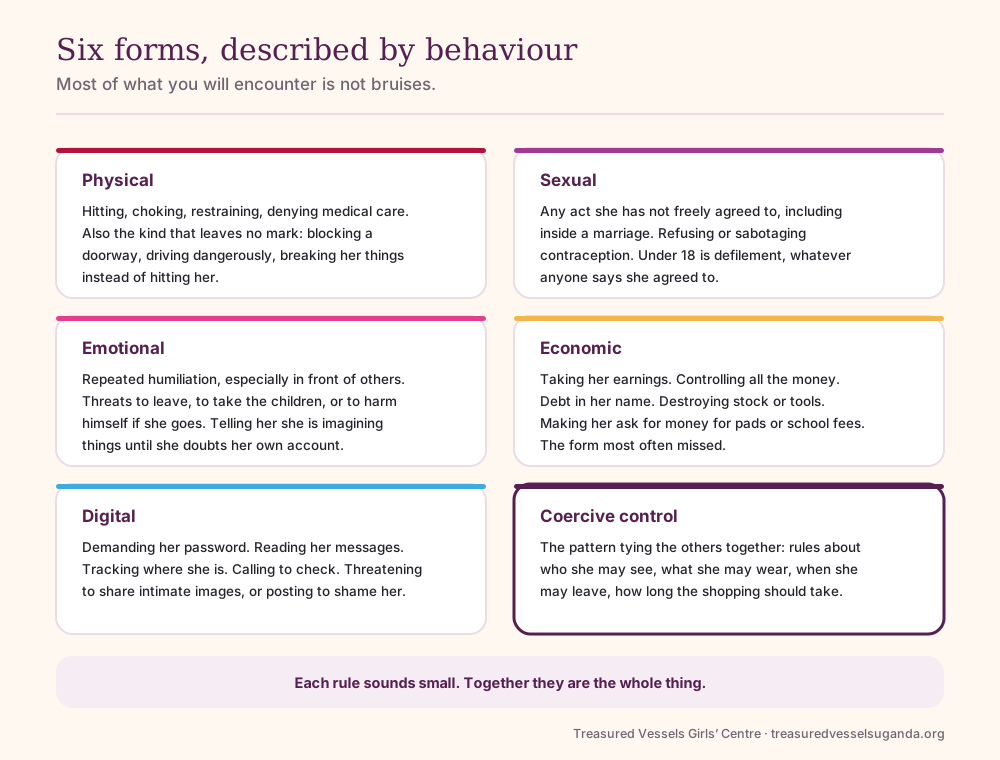
Physical. Hitting, pushing, choking, burning, restraining, denying medical care. Also the version that leaves no mark: standing in a doorway so she cannot leave a room, driving dangerously with her in the vehicle, breaking her things instead of hitting her.
Sexual. Any sexual act she has not freely agreed to, including within a marriage. Refusing contraception, sabotaging it, or pressuring a pregnancy. A sexual act with anyone under eighteen is defilement under Ugandan law, regardless of what anyone claims she agreed to.
Emotional. Repeated humiliation, especially in front of others. Name-calling, threats to leave her, threats to take the children, threats to harm himself if she goes. Telling her she is mad, forgetful or imagining things until she doubts her own account.
Economic. Taking her earnings. Controlling all the money and giving her an allowance she must account for. Refusing to contribute while preventing her from earning. Running up debt in her name. Destroying stock, tools or a sewing machine. Making her ask for money for sanitary pads or children's school fees.
Digital. Demanding her phone password. Reading her messages. Tracking where she is. Calling repeatedly to check she is where she said. Threatening to share intimate images. Posting about her to shame her, or contacting her family through her own accounts.
Coercive control. The pattern that ties the others together: a set of rules she has to live inside. Who she may see, what she may wear, when she may leave, how long the shopping should take. Each rule sounds small. Together they are the whole thing, and they are what most survivors describe as the hardest part.
What you might notice
These are prompts for a conversation. They are not evidence, and you are not investigating.
Any one of them has innocent explanations. Several together, changing over time, in someone whose circumstances you know, is a reason to make yourself available. It is not a reason to conclude anything.
She has withdrawn. Stopped attending things she used to attend. Left the savings group, the training, the church committee. Explanations that do not quite fit and are given a little too quickly.
Someone else answers for her. He comes to meetings she used to come to alone. He answers questions addressed to her. He is present at every conversation, pleasantly.
She checks before she does things. Small permissions for ordinary decisions. Anxiety about the time. Leaving suddenly because of a phone call.
The money is not hers. She cannot pay a small fee she could previously pay. Her stock has disappeared. She earns and has nothing. She cannot explain where the money went.
School or work has been sabotaged. Repeated late arrivals with no clear cause. A training place given up just as it started to pay. A business that fails for reasons she cannot describe.
Injuries that do not match the explanation, or that repeat.
She talks about him carefully. Watching your face to see what you think. Testing what you would say.
The children are involved. Told to report on her, used as leverage, or unusually watchful themselves.
Notice the shape of this list. Most of it is about control and isolation rather than injury, because most of it is.
Opening a conversation without exposing her
If you decide to say something, the whole risk lives in where, when and how.
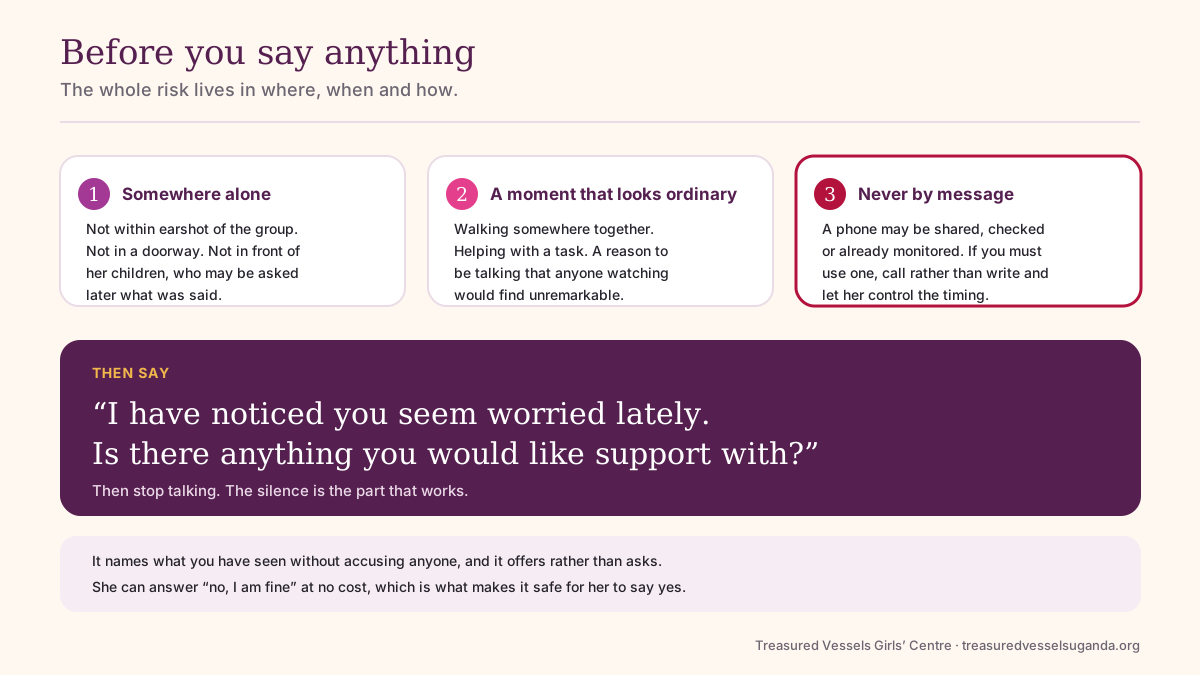
Choose a place where she is genuinely alone. Not within earshot of the group. Not in a doorway where someone might pass. Not in front of her children, who may be asked later what was said.
Choose a moment that has an innocent explanation. Walking somewhere together. Helping with a task. A reason for the two of you to be talking that anybody watching would find unremarkable.
Do not do it by message. A phone may be shared, checked, or already monitored. A text that says "are you safe at home?" sitting in her inbox can cause exactly the harm you are trying to prevent. If you must use a phone, call rather than write, and let her control when.
Then say something like this:
"I have noticed you seem worried lately. Is there anything you would like support with?"
That sentence is doing several careful things at once. It names what you have observed without naming a cause. It makes no accusation about anyone. It offers rather than asks. And it can be answered with "no, I am fine" at no cost to her, which means it is safe for her to say no.
Then stop talking. The silence after the question is the part that works. Do not fill it with your theory, your own experience, or a list of services.
If the answer is no, accept it warmly and completely, and say one short thing that leaves the door open: "That is fine. If that ever changes, you can come to me." Then behave normally afterwards. Many women say no several times before they say yes, and each no is information about her situation rather than a verdict on your concern.
If the answer is yes, you are now in the territory of the safe-disclosure guide: believe her, ask whether she is safe now, be honest about who you would have to tell, and ask what she wants to happen.
The helpful things that make it worse
Every item here is done regularly by people acting from genuine concern.
Confronting him. It warns him, it tells him she has been talking, and it can escalate immediately. You will be somewhere else that evening. She will not.
Raising it in a group. A savings group, a church meeting, a family gathering. Public exposure removes her control over the situation entirely, and the pressure that follows usually lands on her to explain, to deny, or to reconcile.
Telling her family first. Relatives may be supportive. They may also have a financial or reputational stake in the marriage continuing. You cannot know which without asking her, so ask her.
Messaging her. Covered above, and it is the most common mistake now that everyone has a phone.
Questioning the children. It puts them in an impossible position and it can be used against her later, including in court.
Presenting an ultimatum. "You have to leave him." She may have reasons you do not know, and the point of leaving is often the most dangerous moment in an abusive relationship. Support that is conditional on her taking your advice is not support.
Going quiet because you are unsure. The opposite failure, and the commonest of all. Being consistently, unremarkably present is worth more than a single dramatic intervention.
Economic abuse, and an honest word about our own work
This section is uncomfortable for an organisation that runs skills training, and we would rather write it than leave it out.
Economic abuse is the form most often missed, because it does not look like violence. It looks like a household arrangement. She earns; he holds the money. She has a trade; the tools belong to him. She has customers; he decides which days she may open.
The obvious answer is to help her earn. We do that, and we believe in it. But the evidence on economic empowerment and violence is genuinely mixed, and pretending otherwise would be dishonest.
Analysis of Demographic and Health Survey data across sub-Saharan Africa found economic empowerment to be among the more promising routes to reducing intimate partner violence, while also finding a backlash effect: where a woman was employed and her partner was not, and where she earned more than he did, intimate partner violence was associated with an increase. Higher education for both partners, and higher household wealth, were associated with a decrease.
A study of a microfinance-plus programme in rural South Africa found that women who reported not earning enough to cover their business costs faced higher odds of physical or sexual violence in the past year. A struggling business is not a neutral event inside a violent household.
We take three things from this.
Income is not automatically protection. It expands a woman's options, which is why we do it. It can also change the balance in a household in a way that some men respond to badly. Both are true and the second is not a reason to stop.
Control over earnings matters as much as earnings. A woman who generates money that somebody else takes has gained a workload, not an income. Savings she can actually reach, records she keeps herself, and a place to keep money that is not the house are part of the intervention, not an afterthought.
A business under strain is a risk factor, not just a disappointment. If a participant's trade is failing, that is a safeguarding signal as well as a commercial one, and it deserves a conversation rather than a target chased harder.
So we ask trainers to watch for the economic signs on this page, and to treat a woman whose stock keeps disappearing as a protection concern rather than an unreliable trainee.
Where to send someone
We are still building a verified referral directory for Jinja, and we are not publishing names until each entry has been confirmed as currently operating, at stated hours and costs, with a named contact, willing to accept a referral, and visited in person.
What we can give you now:
If a child is at risk or anyone is in immediate danger, the Uganda Child Helpline is 116, free from any network, 24 hours, run by the Ministry of Gender, Labour and Social Development.
For an adult, the Child and Family Protection Unit at the nearest police station also handles domestic violence, the district probation and social welfare officer can advise, and legal aid providers can explain the protection order route under the Domestic Violence Act 2010.
And you can contact us. We will not investigate, and we will not act without her agreement, but we can talk through options with you and, where she wants it, go with her.
What this asks of you
Not very much, which is the point.
Learn the six forms so you recognise the ones that are not bruises. Treat what you notice as a reason to be available rather than a case to be built. Pick the place and the moment carefully. Ask one open question and then be quiet. Accept a no without withdrawing your attention.
Download the safe-disclosure guide as a printable PDF → Two A4 pages covering what to say if she does tell you, what never to do, the confidentiality limits and the legal routes.
If you would like to fund the part of this that costs money, it is the confidential referral: the fare, the consultation, the staff member's day spent going with her, and the follow-up that finds out whether she arrived.
If your organisation provides protection, legal, medical or counselling services in the Jinja area, we would rather verify you than guess. Please get in touch.
Frequently asked questions
How can I tell if someone is being abused?
You often cannot, and trying to be certain is the wrong goal. Look for patterns rather than incidents: withdrawal from things she used to attend, someone answering for her, seeking permission for ordinary decisions, no control over money she earns, school or work being sabotaged, and injuries that do not match the explanation. Treat these as a reason to make yourself available, not as evidence.
What should I say to someone I am worried about?
Somewhere she is genuinely alone, at a moment that looks unremarkable to anyone watching, say something like: "I have noticed you seem worried lately. Is there anything you would like support with?" Then stop talking and let the silence do the work. It names what you have seen without accusing anyone, and she can safely answer no.
Why should I not message her about it?
Phones are commonly shared, checked or monitored in controlling relationships. A message asking whether she is safe can be read by the person she is unsafe with, and it puts a record of your concern where it can be used against her. If you must use a phone, call rather than write.
Should I confront the person I think is responsible?
No. It warns him, tells him she has been talking, and can escalate the situation immediately. You will be elsewhere that evening and she will not. Report through the police Child and Family Protection Unit, a probation and social welfare officer, or a legal aid provider.
She said nothing is wrong. What now?
Accept it warmly, say the offer stands, and carry on behaving normally. Many people say no several times before they say yes. Withdrawing your attention because you were rebuffed removes the one thing that made you worth telling.
What is economic abuse?
Controlling a woman's access to money and her ability to earn. Taking her earnings, running up debt in her name, destroying stock or tools, refusing to contribute while preventing her from working, or making her account for every shilling. It is the form most often missed, because it looks like a household arrangement rather than violence.
Does helping a woman earn money make her safer?
Usually it expands her options, which is why we run skills training. The evidence is mixed rather than uniformly positive. Analysis across sub-Saharan Africa found that where a woman was employed and her partner was not, or where she earned more than he did, intimate partner violence was associated with an increase, while higher education and household wealth were associated with a decrease. A microfinance study also found that women whose businesses did not cover their costs faced higher odds of violence. Income helps, control over that income matters as much, and a struggling business is a safeguarding signal.
What if I am wrong?
Then you have asked a kind question and been told that everything is fine, which costs nothing. The question is deliberately written so that a no is easy and free. The risk lies in confronting, exposing or messaging, not in quietly making yourself available.