
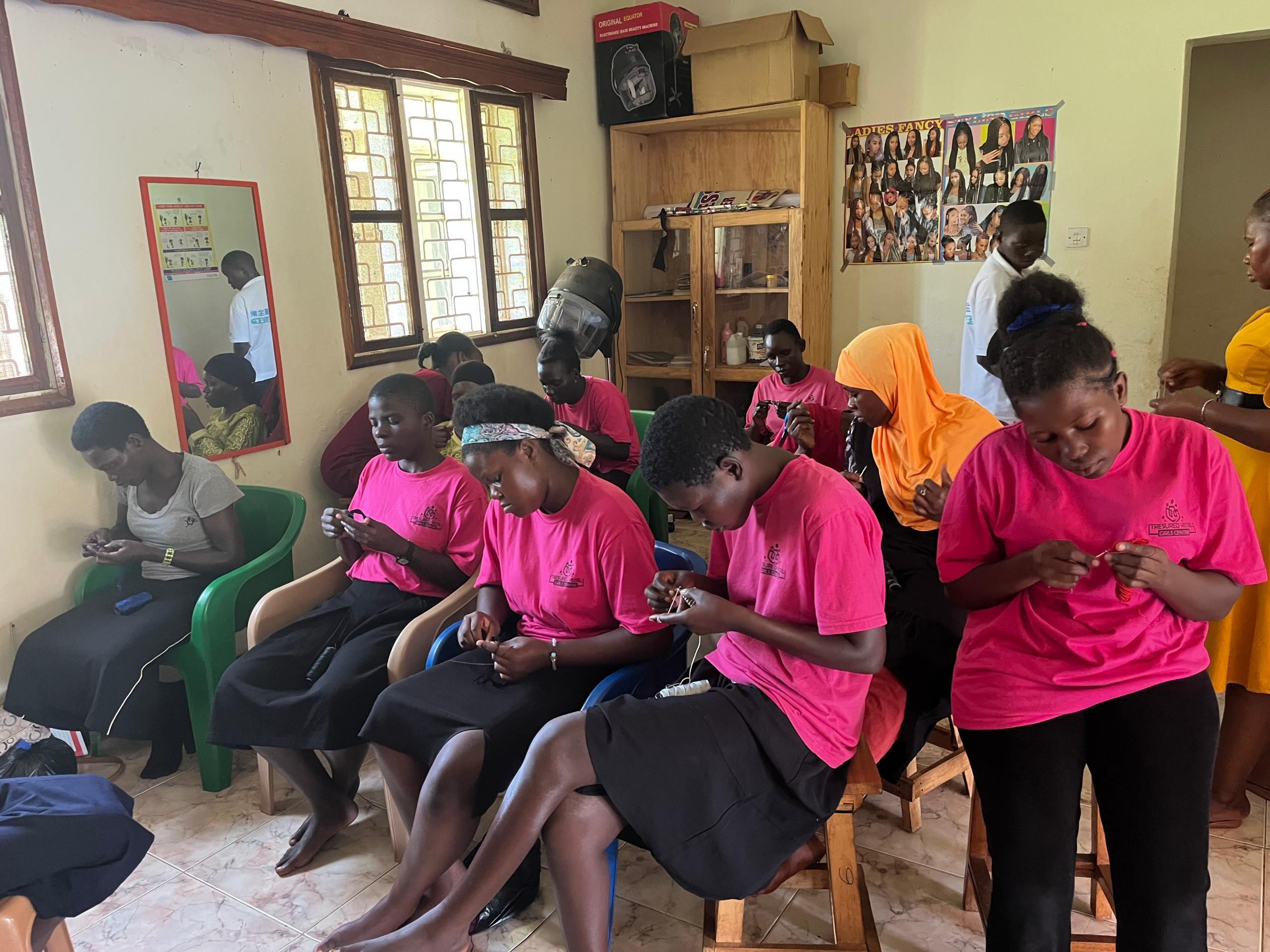
Sooner or later, someone tells you.
A woman at church stays behind after everyone else has gone. A girl asks her teacher a question that is not really about the question. A neighbour mentions something in passing and then watches your face to see what you do with it.
What happens in the next five minutes matters more than almost anything else you will do about it. Not because you are going to solve her situation, which you are not, but because your reaction decides whether she tells anyone else. A woman who is met with doubt, or with a flurry of activity she did not ask for, usually does not disclose a second time. She waits, sometimes for years.
This article sets out how Treasured Vessels responds to disclosures of violence, what the principles behind that are, what to say and what not to say, and what Ugandan law actually offers. It is long, because this is the part of our work where getting it wrong causes the most harm.
It is written for volunteers, teachers, church and mosque leaders, relatives and friends. It is not a substitute for professional training, and it is not legal advice.
The scale, and how to read it
The Uganda Demographic and Health Survey 2022 reports that 44% of women aged 15 to 49 have experienced physical violence since the age of 15, and that 23% experienced physical violence in the twelve months before the survey. Around 17% have ever experienced sexual violence. Among ever-partnered women, roughly 54% report having experienced spousal violence in emotional, physical or sexual form.
Those figures deserve a short caution, of the kind we applied to teenage pregnancy statistics in what "one thousand a day" really means.
They measure different populations. The 44% covers all women aged 15 to 49. The 54% covers only women who have been married or partnered. They cannot be added, compared or used interchangeably.
They are almost certainly undercounts. Violence prevalence is measured by asking women to disclose to an interviewer. Every known bias in that method runs in the same direction, and sexual violence is the most under-reported category of all.
A percentage is not a queue. Nobody in your congregation is a statistic. The reason the numbers are here at all is to make one point: if you work with a group of Ugandan women of any size, you are already working with survivors, whether or not anyone has told you.
That is the practical implication. You do not need to identify who. You need to be the kind of person, and part of the kind of institution, that someone would choose to tell.
What survivor-centred actually means
The phrase is used a great deal and defined rarely. Here is what it commits us to, and what each principle rules out.
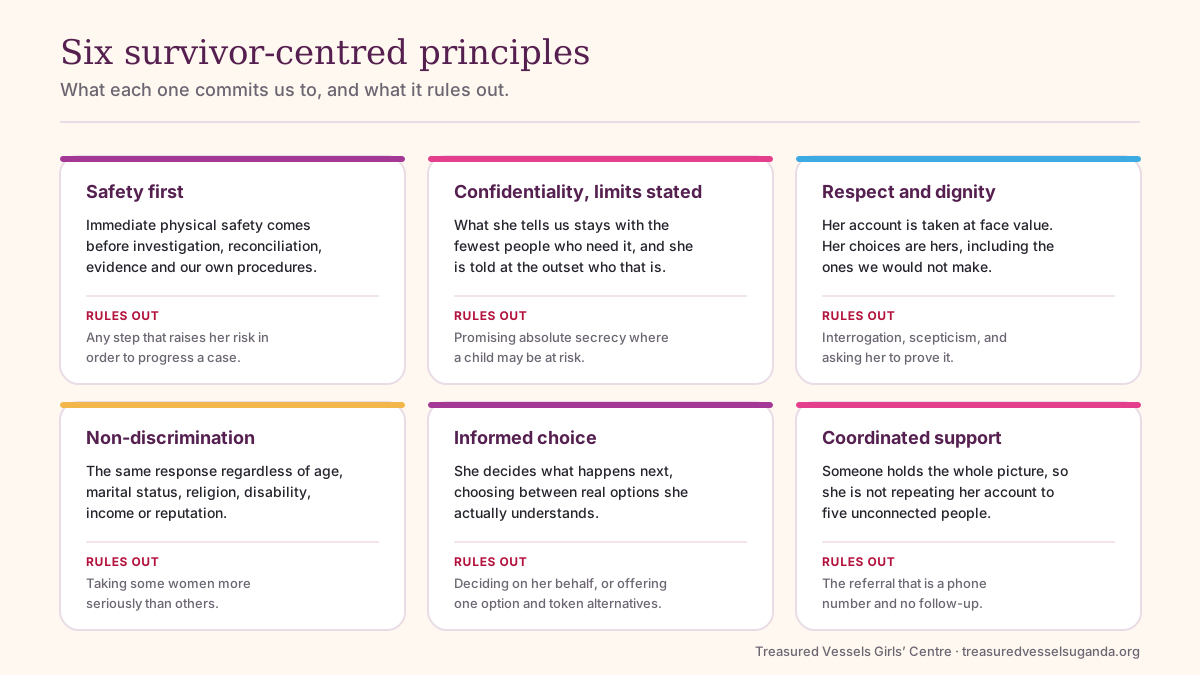
Safety first
Immediate physical safety comes before every other consideration, including investigation, reconciliation, evidence and our own procedures.
What it rules out: any action that increases risk to her in order to progress a case. If a step would be good for accountability and bad for her safety this week, her safety wins.
Confidentiality, with its limits stated
What she tells us stays with the smallest number of people who need it, and she is told at the outset who that is.
What it rules out: promising absolute secrecy. Where a child is at risk there are duties that override a promise, and she is entitled to know that before she decides what to tell us, not afterwards.
Respect and dignity
She is an adult making decisions in a situation she understands better than we do. Her account is taken at face value. Her choices are hers, including the ones we would not make.
What it rules out: interrogation, scepticism, and the particular tone of voice that people use when they have decided in advance that someone is exaggerating.
Non-discrimination
The same response regardless of age, marital status, religion, tribe, disability, income, HIV status, occupation or what anyone thinks of her reputation.
What it rules out: the widespread and quiet practice of taking some women more seriously than others.
Informed choice
She decides what happens next. Our job is to make sure she is choosing between real options she understands, not between the one thing we happen to offer and nothing.
What it rules out: deciding on her behalf, and the softer version of the same thing, which is presenting one option enthusiastically and the others as afterthoughts.
Coordinated support
Violence produces several needs at once: medical, legal, protective, financial, psychological. Someone has to hold the whole picture so she is not repeating her account to five different people who never speak to each other.
What it rules out: the referral that consists of a phone number and no follow-up. We set out what a referral that closes the loop looks like in adolescent-friendly health services.
What to say when someone discloses
Five things, in roughly this order. They take about two minutes and they are most of the job.
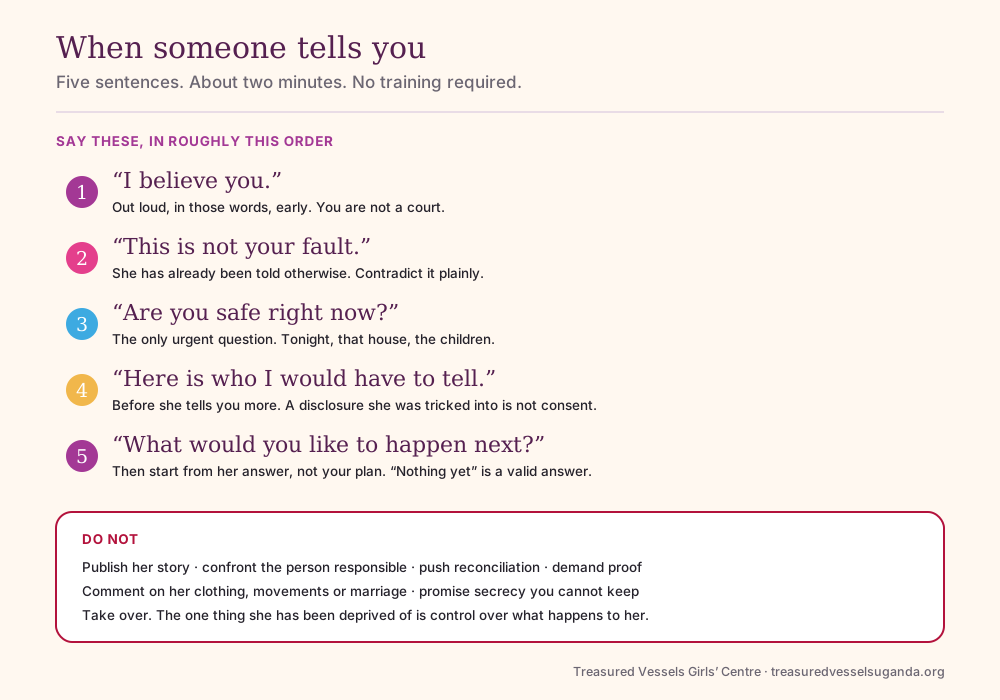
1. "I believe you."
Say it out loud, in those words, early.
You are not a court. Believing her is not a finding of fact about anybody else, and it costs you nothing. What it does is remove the thing she was most afraid of, which is that telling you would make it worse.
Do not ask her to prove it. Do not ask why she did not say something sooner. Do not ask what she was wearing, where she was, why she stayed, or whether she had been drinking. Every one of those questions communicates the same thing, and she will hear it.
2. "This is not your fault."
Also out loud. Also in those words.
Most survivors have already been told, or have told themselves, that some decision of theirs caused it. Contradicting that plainly, from outside, does more than it looks like it does.
3. "Are you safe right now?"
This is the only urgent question, and it is a practical one, not a legal one.
Is she going back to the same house tonight? Is the person who harmed her there? Are there children in the house? Does she need somewhere else to be, today?
If the answer means she is in immediate danger, that changes the order of everything else. Police, health care and a safe place come first, and the rest of this list waits.
4. "Here is who I would have to tell."
Before she tells you more, tell her the limits.
For an adult, that is usually: nobody, unless you ask me to, or unless a child is at risk. For anyone under eighteen, it is: I have to involve someone who can protect you, and I will tell you who and when.
This is the step that gets skipped, because it feels like it might stop her talking. Sometimes it does. That is her right, and a disclosure she was tricked into is not consent.
5. "What would you like to happen next?"
Then listen to the answer, and start from there rather than from your own plan.
She may want a referral. She may want somewhere to stay. She may want nothing at all today except for one person to know. All of those are legitimate. If the answer is "nothing yet", the correct response is to say that the offer stands and to mean it.
What not to do
Seven things, all of which are done regularly by well-meaning people, and several of which are dangerous.
Do not publish her story. Not on social media, not in a newsletter, not with her initials, not with the details changed. More on this below.
Do not confront the person who harmed her. It is not your role, it warns him, it can destroy a prosecution, and the person who bears the consequences of your conversation is her, not you.
Do not push reconciliation. This is the most common failure in community and faith settings, and the most damaging. A woman being encouraged back into a household by respected people has been told that her safety is negotiable. If she chooses to return, that is a different matter, and it is her choice to make.
Do not demand proof. You are not deciding a case. Evidence matters in a legal process, handled by people trained to handle it.
Do not comment on her clothing, her movements, her drinking or her marriage. Even sympathetically. Especially sympathetically.
Do not promise secrecy you cannot keep. Say what you will do and who you will tell. A broken promise here costs more than an unwelcome truth.
Do not take over. The instinct to act decisively on someone's behalf is generous and it removes the one thing she has been deprived of, which is control over what happens to her.
Why she stays, and why it is the wrong question
We listed "do not ask why she stayed" above without answering it, and the answer is worth having, because the question is usually asked sincerely.
Money. This is the largest single reason and the least discussed. A woman with no independent income, whose earnings are taken, or whose trade depends on a workshop in his compound, is not choosing between safety and danger. She is choosing between danger and destitution for herself and her children. It is why our skills training and savings work is a protection intervention as much as an economic one, and why we wrote about control over income rather than just earning it.
Children. Leaving frequently means leaving them, or taking them out of school, or both. Many women calculate, not unreasonably, that a bad house their children can stay in beats an uncertain one they cannot.
Housing. Where the house belongs to him or to his family, leaving is the same act as becoming homeless.
Family pressure. Relatives on both sides may push her to stay, sometimes because a bride price would have to be returned, sometimes because separation is treated as her failure.
Escalation. The most dangerous period in an abusive relationship is often the point of leaving. A woman who says "not yet" may be reading the risk more accurately than the person urging her to go.
And she may not want to leave. She may want the violence to stop, which is a different objective. Treating separation as the only successful outcome quietly tells her that the support is conditional on a decision she has not made.
The useful question is not why she stays. It is what would have to be true for her to be safe, and which of those things somebody could actually help with.
What a safety plan is
A safety plan is not a document and it is not something you write for her. It is a short, practical conversation about what she would do if things got worse, and it is useful whether she is staying, leaving or undecided.
Where would she go, tonight, if she had to leave in a hurry? A specific house, a specific person, not a general intention.
How would she get there, and does she have the fare set aside somewhere he does not look?
What would she need to take, and can some of it be kept elsewhere in advance? National ID, children's school documents, medication, phone charger, a little money.
Who would she tell, and what is the shortest way to say it? Some women agree a word or a phrase with a neighbour that means "call for help" without explaining anything.
Which room is safest if there is no time to leave? Away from the kitchen, away from anywhere with one exit, near a door, near a neighbour's wall.
What about the children? Where are they, who would collect them, do they know who to run to?
None of that requires funding or expertise. It requires twenty minutes and someone willing to think about the practicalities with her rather than deciding on her behalf. If she is not ready to act on it, she still leaves the conversation with a plan she did not have, which is the point.
The confidentiality conversation, properly
This deserves its own section, because it is where good intentions most often go wrong.
For an adult survivor, confidentiality is close to absolute. What she tells us is not discussed with her family, her employer, her church, our volunteers or our donors. She decides who else is told. If she asks us to speak to a health worker or a police officer on her behalf, we do that, and only that.
Where a child is at risk, that changes, and it changes whether or not the person disclosing is the child. A sexual act with anyone under eighteen is defilement under Ugandan law, as we set out in what Ugandan law says about child marriage. Where we learn that a child is being harmed, we cannot simply hold it.
The honest way to handle this is to say it first. "Before you tell me more, I want you to know that if this involves a child being hurt, I will have to involve someone who can protect them. I will tell you who, and I will tell you before I do it."
That sentence sometimes ends the conversation. We would still rather say it. The alternative is a woman who told us something in confidence discovering later that we passed it on, which teaches her, correctly, that we cannot be trusted.
What we record is the minimum: that she consented, where she was referred, the category of support sought, whether she attended and what follows. We do not write down the details of an assault. Detail of that kind belongs with the statutory services, not in a community organisation's filing cabinet. Our full approach is in the privacy policy.
What the law actually offers
This is general information and not legal advice. For a specific situation, speak to a qualified legal practitioner or a legal aid provider.
Uganda's Domestic Violence Act 2010 is the main civil route, and it is used far less than it could be, largely because few people know it exists.
Protection orders. The Act provides for interim protection orders and full protection orders, dealt with in sections 10 to 16. A victim, or someone acting on her behalf, may apply to a magistrates' court using the form set out in the Act, supported by an affidavit. An interim order can be made quickly where the situation is urgent, with a fuller hearing to follow.
Where to apply. Every magistrates' court has competence to hear domestic violence matters and to issue protection orders. Local council courts also have a role and can make a range of orders, which matters practically, because an LC court is often much closer and much less expensive to reach than a magistrate.
Other remedies. The Act allows for criminal sanctions, civil remedies and compensation, including costs and restitution.
The criminal route is separate. Assault, defilement and other offences are prosecuted under the Penal Code, through the police and the Directorate of Public Prosecutions. A protection order and a criminal case are not alternatives and one does not replace the other.
Two things to hold on to.
The decision is hers. An adult survivor decides whether to pursue any of this, with qualified advice, and she is entitled to decide not to. Pursuing a case she does not want is not support.
Except where a child is involved. Child protection duties are not hers to waive and not ours to negotiate.
What we do, and what we hand over
We should be as clear here as we were about health services.
We are not a shelter, a clinic, a legal service, a counselling service or a child protection authority. We do not investigate. We do not mediate between a survivor and the person who harmed her. We do not take custody of children.
We do listen properly, help her work out her options, accompany her, help with the fare, and follow up to find out whether the thing we referred her to actually happened.
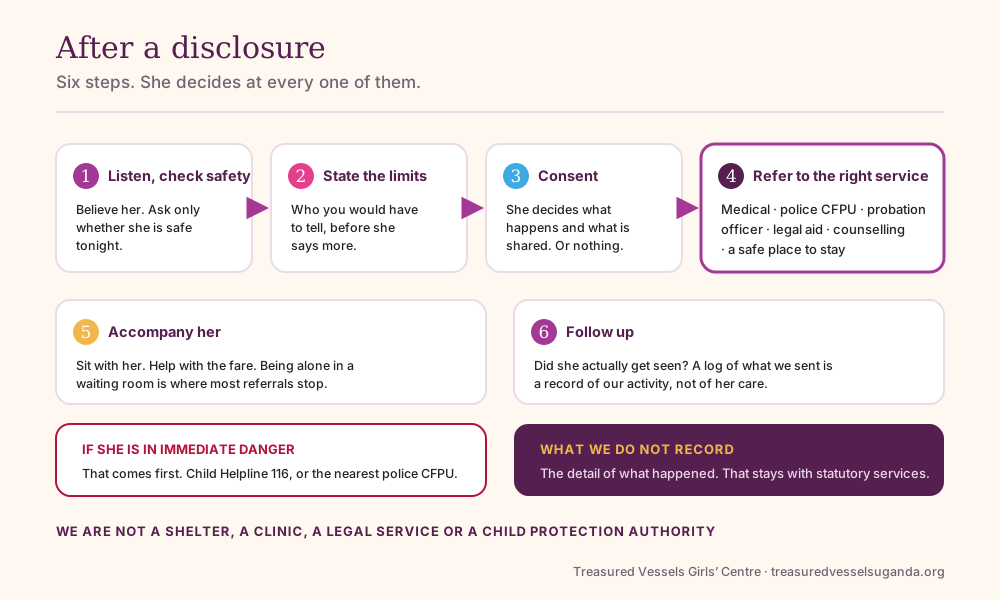
The categories we refer into are medical care, police and the Child and Family Protection Unit, the district probation and social welfare officer, legal aid, counselling, and a safe place to stay. Which of those, and in what order, depends entirely on her situation and her decision.
We have not finished building this. As with our health referrals, we are not yet publishing named local services, because an unverified referral costs a woman a wasted journey she may not be able to repeat, and in this context a wasted journey can also be a dangerous one. Each entry has to be confirmed as currently operating, at stated hours and costs, with a named contact, willing to accept a referral from us, and visited in person. Until an entry passes all five, it stays off the list.
Why we do not publish survivor stories
This is a deliberate decision and it costs us money, so it is worth explaining.
Survivor stories raise funds. They are the single most effective fundraising asset an organisation in our position has. We do not use them, in any form, including anonymised.
Anonymisation does not work at this scale. In a district, a story with the age, the trade, the number of children and the nature of the incident removed is still identifiable to the people who matter most, which is her neighbours and the man involved.
Consent given at the wrong moment is not reliable consent. A woman who is being helped, by the people asking her permission, weeks after the worst thing that has happened to her, is not positioned to refuse. She may agree at twenty-six to something she would refuse at forty, and the article does not expire when her feelings change.
The danger is real, not theoretical. Publication can trigger retaliation, end a prosecution, and cost a woman her housing, her income or her children.
What we publish instead is our practice, our principles and our failures. If that is less moving than a story, we accept the trade.
What we are still building
We would rather list this than imply we have finished.
- A verified GBV referral directory for Jinja, against the five checks above.
- A named safeguarding focal person, publicly identified, with training and time allocated to the role rather than added to somebody's existing job.
- A complaints route that works when the complaint is about us, including a way to complain to someone who is not the person complained about.
- Psychological first aid training for every volunteer who might receive a disclosure, which at present is all of them.
- Out-of-hours arrangements. Knowing where to send someone at two in the morning is a different question from knowing where to send her on a Tuesday.
If you work in this field in the Jinja area and can help with any of the above, we would genuinely like to hear from you.
A word to churches
We are a Christian organisation, and this is one of the places where faith communities have a specific and well-documented failure mode.
The pressure to reconcile, to forgive quickly, to keep the family together and to avoid scandal falls hardest on the person with the least power in the situation. Forgiveness is real and it belongs to her, on her timing. It is not something a third party can require, and it is not the same thing as returning to an unsafe house.
"Learn to do good; seek justice, rebuke the oppressor; defend the fatherless, plead for the widow." Isaiah 1:17, NKJV
The verb is rebuke, and its object is the person with power. That is a considerably harder instruction than being sympathetic to the person without any, and it is the one the verse actually gives.
What you can do
If you take one thing from this article, make it the five sentences in the disclosure section. They are free, they require no training, and they are what a woman deciding whether to tell anyone is waiting to hear.
Download the safe-disclosure guide as a printable PDF → Two A4 pages. Page one is the five things to say and the seven not to do, sized to pin up in a vestry, a staff room or a health centre. Page two covers confidentiality limits, the legal routes and what to record. It photocopies in black and white and may be freely copied.
If someone is in immediate danger right now, that comes before everything on this page. The Uganda Child Helpline is 116, free from any network, 24 hours, run by the Ministry of Gender, Labour and Social Development. For an adult, the police Child and Family Protection Unit at your nearest station also handles domestic violence, and the district probation and social welfare officer can advise.
And if you want to fund the part of this that costs money, it is the confidential referral: the fare, the consultation, the accompanying staff member's day, the follow-up that finds out whether she got there.
If your organisation provides medical, legal, protection or counselling services in the Jinja area, we would rather verify you than guess. Please get in touch.
Frequently asked questions
What does a survivor-centred response mean?
That the survivor's safety, confidentiality, dignity and choices drive what happens, rather than the organisation's procedures or the community's preferences. In practice it means six commitments: safety first, confidentiality with its limits stated openly, respect and dignity, non-discrimination, informed choice, and coordinated support that does not make her repeat her account to five unconnected people.
What should I say if someone tells me they have been abused?
Five things. "I believe you." "This is not your fault." "Are you safe right now?" "Here is who I would have to tell." "What would you like to happen next?" Then start from her answer rather than your plan. Do not ask her to prove it, do not ask why she did not speak sooner, and do not ask what she was wearing or doing.
Can I promise to keep it secret?
Not absolutely, and you should say so before she tells you more. For an adult, what she says is hers to control. Where a child is at risk, there are duties that override a promise, and she is entitled to know that in advance rather than discover it afterwards.
Should I confront the person responsible?
No. It is not your role, it warns him, it can damage a prosecution, and the person who faces the consequences of that conversation is her. Report through the police Child and Family Protection Unit, a probation and social welfare officer, or a legal aid provider.
What does Ugandan law offer a survivor of domestic violence?
The Domestic Violence Act 2010 provides for interim and full protection orders under sections 10 to 16. A survivor, or someone acting for her, applies to a magistrates' court with a supporting affidavit; local council courts also have a role and are often closer and cheaper to reach. The Act allows for criminal sanctions, civil remedies and compensation. Criminal offences are prosecuted separately under the Penal Code. This is general information, not legal advice.
Does the survivor decide whether to report?
An adult survivor does, with qualified advice, and she is entitled to decide not to. Pursuing a case she does not want is not support. Where a child is at risk, child protection duties apply and are not hers to waive.
Does Treasured Vessels provide shelter or counselling?
No. We provide listening, information, accompaniment, help with the cost of getting to a service, and follow-up. Medical care, legal advice, counselling, shelter and child protection are provided by qualified services, and our job is to help her reach them and to check that she did.
Why do you not publish survivor stories?
Because anonymisation does not work in a district where neighbours can identify a woman from the remaining details, because consent given weeks after an assault by someone we are helping is not reliable consent, and because publication can trigger retaliation, end a prosecution or cost her housing, income or children. We publish our practice and our failures instead.