
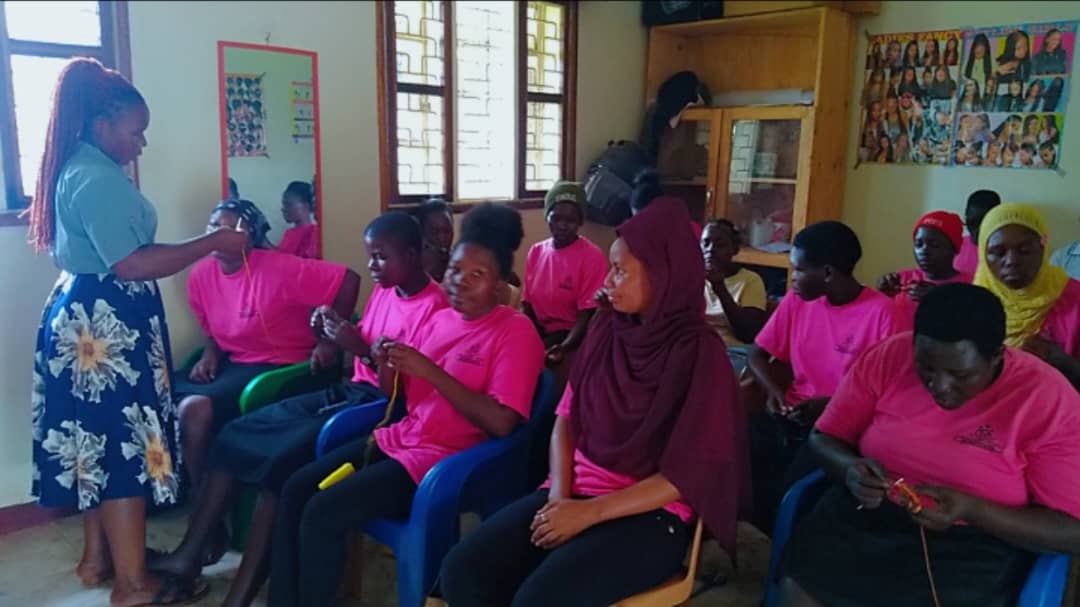
Grace finishes six months of baking at a centre like ours. She passes. She can make bread, buns and cakes to a standard a customer would pay for, and there is a photograph of her holding a certificate.
Grace is not a real person. She is assembled from what trainers here and elsewhere describe happening to real graduates, and the point of walking through her first six weeks is that every one of these obstacles is ordinary.
Six weeks
Week one. She has no oven. The centre's oven belongs to the centre. A neighbour has one and will let her use it for a fee, in the afternoon, when she is finished with it.
Week two. She prices her ingredients. Flour, sugar, yeast and margarine bought in the small quantities she can afford cost considerably more per kilo than the sacks a bakery buys. Her unit cost is higher than her competitor's before she has baked anything.
Week three. She has a baby. She can bake when her sister is free to hold him, which is not the same hours as the neighbour's oven.
Week four. She sets a price by looking at what the woman near the taxi stage charges. That woman buys flour by the sack and bakes at home. Grace matches her price and does not know that she is now losing money on every tray.
Week five. She has no customers. Nobody taught her how to find the first ten. She walks around with a basin and sells some, at the end of the day, cheap, because bread does not keep.
Week six. She stops. The flour money has gone into the household and there is nothing to restock with.
In the programme records, Grace is a success. Enrolled, attended, assessed, completed. Nothing in the reporting says she is not baking.
An output is not an outcome
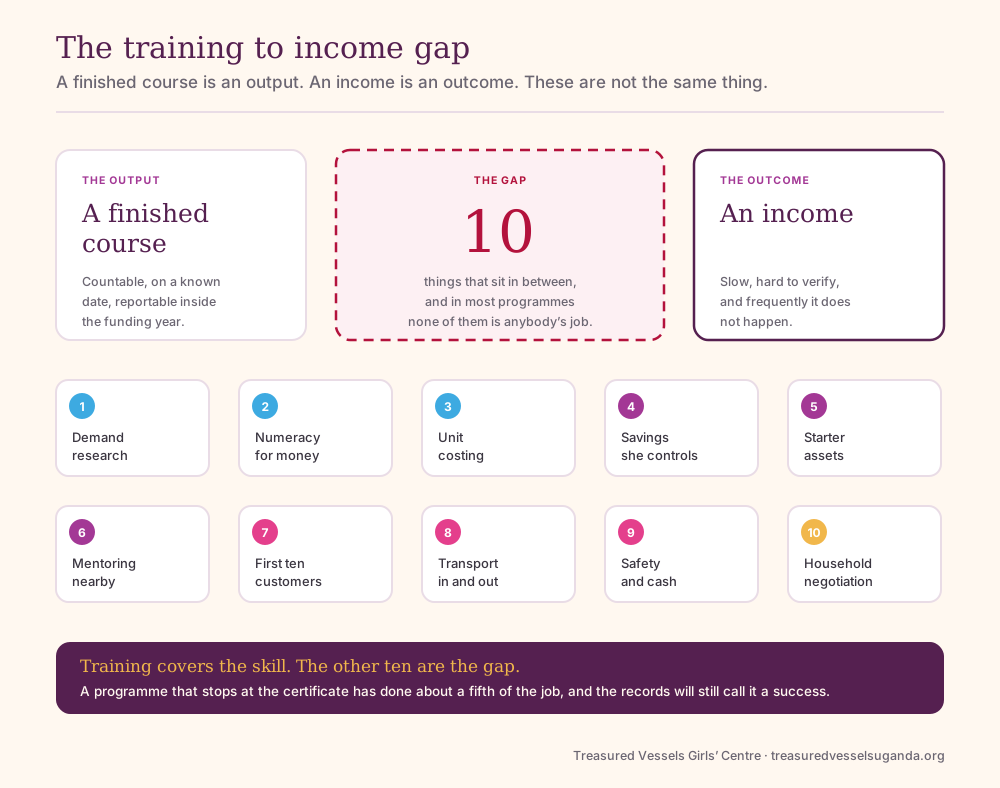
A completed course is an output. It is countable, it happens on a known date, and it can be reported inside a funding year.
An income is an outcome. It is slow, it is hard to verify, and it frequently does not happen.
Grace's story is not a failure of teaching. The teaching worked. She can bake. What failed is everything that was supposed to happen after the photograph, and almost none of it was anybody's job.
We set out the full twelve-stage version of that job in from practical skills to sustainable income. This article is about the ten specific things Grace needed and did not get.
What was actually missing
Demand research. Nobody asked how many people in that trading centre already sell bread, or what the place is short of. Grace entered the most crowded trade available because it was the one being taught.
Basic numeracy, applied to money. Not school arithmetic. The ability to work out what a tray costs and what it earns.
Unit costing. Four lines: materials, other direct costs, her own labour, and a share of fixed costs. Grace did the first one in her head and none of the rest. Our costing and record sheet exists for exactly this.
Savings she controls. A place for the restocking money that is not the household tin. Week six happens because there is no such place.
Starter assets. An oven, or a reliable arrangement for one. This is the obvious gap and it is not the only one, which is why giving her an oven alone would also have failed.
Mentoring. Somebody already baking, nearby, she can ring. Half of what went wrong would have been a two-minute phone call.
Customer acquisition. The first ten customers, how to ask, how to quote, how to get repeat orders. Skill and demand are different problems and training almost always addresses only the first.
Transport. Ingredients in, product out, and the fare to do either.
Safety. Handling cash, which deliveries to refuse, and what to do about a customer who will not pay.
Household negotiation. How she keeps the restocking money separate from the household's needs, which is a conversation at home rather than a lesson at the centre, and which nobody prepares her for.
Ten items. Training covers none of them, and a programme that stops at training has done perhaps a fifth of the job.
Why "did she start a business?" is the wrong question
This is the part that should change how donors read a report.
Uganda's labour market is overwhelmingly informal. The large majority of people in work, women and men, are in informal employment, and women are more likely than men to be own-account workers with no employees: a person working alone, for themselves, with no staff, no contract and no cushion. Women's labour force participation is also markedly lower than men's, and measures of vulnerable employment have been falling nationally while remaining higher for women than for men.
We are deliberately not quoting a precise percentage here. The published figures differ depending on the year, the survey and whether subsistence agriculture is counted as employment, and we would rather give you the direction than a decimal point we cannot stand behind. The underlying data is published by the Uganda Bureau of Statistics and by UN Women, and both are linked at the end of this article.
The direction is enough to make the point. "She started a small business" describes the default condition of working women in Uganda. It is not, by itself, an achievement. A woman selling bread at a loss until her capital is gone has started a business. So has a woman earning well. The reporting cannot tell them apart.
So the measures that matter are profit and stability, not existence:
- Is the business covering its own costs, including her labour?
- Is it still running at six months, and at twelve?
- Does she control what it earns?
- Could it survive the machine breaking, or a bad month?
Those are harder to collect than a headcount. They are also the only ones that describe whether anything changed.
Some graduates should not be self-employed
The sector assumes the end point of training is a woman running her own micro-business. For a good number of participants that assumption is doing harm.
Self-employment means carrying the risk, finding the customers, financing the stock and absorbing the bad months, all at once, usually with no savings behind her. It suits some people and some trades. It does not suit everyone, and it is a strange thing to require of someone with the least margin for error in the whole economy.
Two alternatives are usually available and rarely offered.
An apprenticeship with an established trader. She learns the trade properly, in a working business, with the owner carrying the risk. In many trades this teaches more in three months than a course teaches in six, because it includes the parts a classroom cannot simulate: customers, suppliers, bad weeks.
A wage placement with a local business. She earns from the first week. It is less photogenic than a woman with her own stall, and for a mother with no cushion it is frequently the better outcome, as well as the route to self-employment later with savings behind her and customers known.
Grace, specifically, would have been better served by three months in an existing bakery than six months of training and an oven she does not have.
Start with a scan, finish with a plan
Two changes would have caught most of what happened to Grace, and neither is expensive.
Every course begins with a local market scan. Four days of walking the market, counting who already trades, and asking buyers rather than sellers what they struggle to source. Then the cohort chooses a trade knowing what the scan found, including that the trade they fancy is crowded.
Every course ends with an individual transition plan. Not a graduation. A single page, filled in with her in the last fortnight, that names what happens next and when.
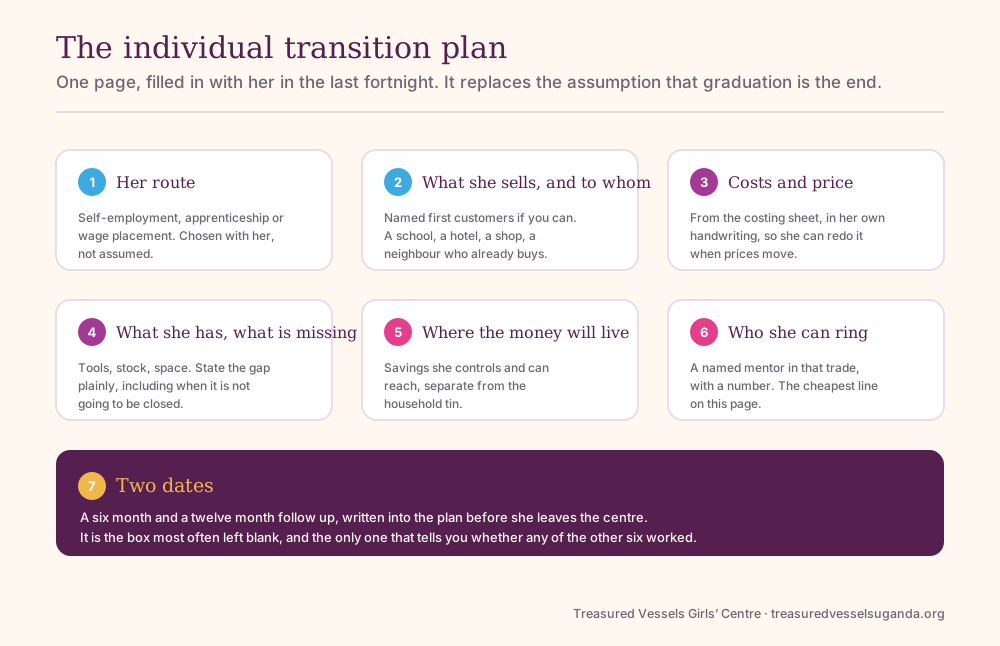
The plan answers seven things.
Her route. Self-employment, apprenticeship or wage placement, chosen with her and written down.
What she will sell, and to whom. Named first customers if possible. A school, a hotel, a shop, a neighbour who already buys.
What it costs and what she will charge, from the costing sheet, in her handwriting.
What she has and what is missing. Tools, stock, space. The gap stated plainly, with how it will be closed or an honest note that it will not be.
Where the money will live. A savings arrangement she controls and can reach, separate from the household.
Who she can ring. A named mentor in that trade, with a number.
Two dates. A six-month and a twelve-month follow-up, written in before she leaves.
Download the transition plan as a printable PDF Two A4 pages. Page one is the blank plan, to be completed with the participant in her last fortnight. Page two is the same plan filled in for Grace, showing what a realistic one looks like, including the gap that does not get closed. It photocopies in black and white and may be freely used by any training programme.
What businesses can give that money cannot
If you run a business in or near Jinja, there are four things you can offer that are worth more to a graduate than an equivalent sum of money, and three of them cost you almost nothing.
A workplace visit. Two hours. Let a group of trainees watch a real operation: how you buy, how you price, what you throw away, what a bad week looks like. Trainees who have seen one working business make better decisions than those who have only seen a classroom.
An apprenticeship place. One graduate, three months, in your business. You get help; she gets the trade as it is actually practised.
A wholesale price. Let graduates buy materials at the price you pay rather than the price a single customer pays. Grace's unit cost problem is solved by this alone, and it costs you nothing but a note to your supplier.
An order. The most valuable item on the list. A school that commits to buying its uniforms locally, a hotel that sends out its laundry, a shop that stocks a graduate's product. Demand is the one thing no training programme can manufacture.
Coaching. An hour a month on the phone to one graduate, answering the questions we cannot: what to charge this season, which supplier to avoid, how to handle a customer who will not pay.
We would rather have any of these than a training fee. A fee buys another certificate. A market buys an income.
If you would rather fund the work, the useful thing is a whole pathway rather than a course: the starter assets, the childcare that lets her attend, the fare, the mentor, and the two follow-up visits that find out whether it worked.
Frequently asked questions
Why is vocational training alone not enough?
Because a finished course is an output and an income is an outcome, and roughly ten things sit between them: demand research, applied numeracy, unit costing, savings she controls, starter assets, mentoring, customer acquisition, transport, safety, and the household negotiation that keeps her working capital from being spent. Training addresses the skill. A programme that stops there has done about a fifth of the job.
What usually goes wrong after a graduate finishes?
In order: no tools, so she works on somebody else's timetable. Higher input costs, because she buys in small quantities. No childcare, so she can only work some hours. A price copied from a competitor with a lower cost base, so she loses money without knowing it. No customers, because nobody taught her how to find the first ten. Then the working capital is absorbed by the household and she stops.
Should a training programme just give graduates equipment?
It helps and it is not sufficient. An oven solves one item on a list of ten. A graduate with an oven, no costing, no customers and no savings will still fail, more slowly and more expensively. Starter assets work when they arrive with pricing, a market linkage, somewhere to keep money and someone to ring.
Why is "she started a business" a weak measure of success?
Because in Uganda it describes the default rather than an achievement. The labour market is overwhelmingly informal, and women are more likely than men to be own-account workers with no employees. A woman selling at a loss until her capital is gone has started a business, and so has a woman earning well; a headcount cannot tell them apart. Measure profit, survival at six and twelve months, control over earnings, and whether the business could absorb a bad month.
Is self-employment always the right goal?
No. Self-employment means carrying the risk, financing the stock and absorbing the bad months with no cushion, which is a lot to ask of someone with the least margin for error. An apprenticeship with an established trader or a wage placement with a local business often teaches more and pays sooner, and can be the route to self-employment later with savings behind her.
What is an individual transition plan?
A single page completed with each participant in her last fortnight. It names her route, what she will sell and to whom, her costs and price, what assets she has and what is missing, where the money will live, who she can ring for advice, and two follow-up dates. It replaces the assumption that graduation is the end of the programme.
How can a business help, other than donating?
Offer a workplace visit so trainees see a real operation, an apprenticeship place, a wholesale price on materials, an hour a month of coaching, or best of all an order. Demand is the one thing no training programme can manufacture, so a school that buys its uniforms locally does more than a cheque of the same value.
Where can I read the Ugandan labour market data?
The Uganda Bureau of Statistics publishes the labour force statistics, including the gender breakdown, and UN Women publishes an analysis of women in the labour force drawing on the same surveys. Both are linked from this article. Be careful comparing headline figures between sources, because they vary with the year, the survey and whether subsistence agriculture is counted as employment.