
If you search for the scale of this problem in Uganda, you will find three numbers repeated everywhere: 24%, 34%, and one in three.
They get quoted in the same paragraph, often in the same sentence, as though they describe one group of girls. They do not. They measure three different things, about three different populations, from three different surveys, and treating them as interchangeable is the most common error in writing about this subject.
That matters beyond pedantry. Get the numbers wrong and you design the wrong response. A programme built to prevent marriages will not help a girl who is already a mother. A programme built to get mothers back into school will not stop a fourteen-year-old being married next month.
This article is the long version: what the figures actually say, what Ugandan law actually requires, why this keeps happening, what it costs, and what a serious prevention and response effort looks like in Busoga. It is written to be the reference we point people to, so it is longer than most things we publish.
Contents
- Three words that are not synonyms
- What the numbers actually measure
- What the law says
- Why it keeps happening
- What it costs
- What the data does not tell us
- Busoga specifically
- A prevention and response framework
- The community action checklist
- Frequently asked questions
Three words that are not synonyms
Child marriage is a union, formal or informal, involving a person under eighteen. It includes customary and religious arrangements that were never registered anywhere. It can happen to a girl who has never been pregnant.
Adolescent pregnancy is a pregnancy in a girl aged, depending on the survey, 10 to 19 or 15 to 19. It can happen to a girl who is not married and never will be.
Adolescent birth is a live birth to a girl in that age range. It is a subset of adolescent pregnancy, because not every pregnancy results in a birth.
These three overlap, but the overlap is partial and nobody should assume its size. A girl can be married at fifteen and not pregnant. She can be pregnant at fifteen and unmarried. She can be both, or neither and still at risk of both.
When an organisation writes "child marriage and teenage pregnancy" as though it were a single phenomenon with a single cause and a single fix, that is usually a sign that nobody has looked closely.
What the numbers actually measure
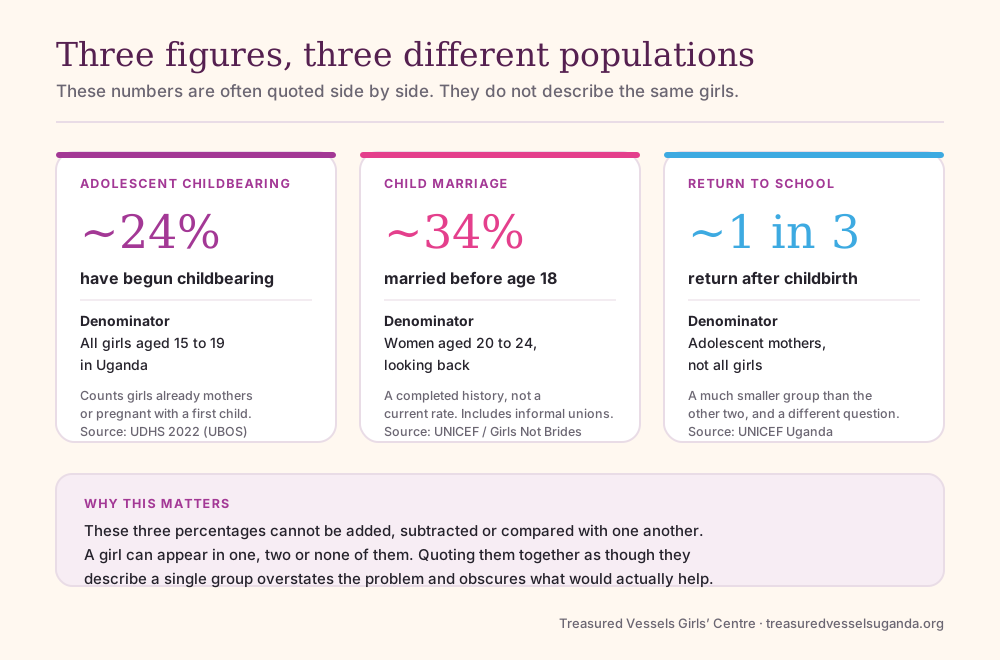
Here are the three figures, with the denominator each one is calculated against.
"Around 24%"
The Uganda Demographic and Health Survey 2022, conducted by the Uganda Bureau of Statistics, found that approximately 24% of girls aged 15 to 19 have begun childbearing, meaning they are already mothers or are pregnant with their first child. The figure was around 25% in rural areas and 21% in urban ones.
Three things to notice. The denominator is all girls aged 15 to 19, not all girls. It is a snapshot of a moment, not a lifetime risk. And "begun childbearing" is a specific composite: mothers plus currently-pregnant first-timers. It is not the same as "have ever been pregnant", which would be a larger number, because it excludes pregnancies that ended.
You will also see the figure quoted for ages 10 to 19. That is a different denominator, covering four additional years in which pregnancy is rare, and it will not produce the same percentage. If a source does not tell you the age band, the figure is not usable.
"Around 34%"
Roughly 34% of Ugandan women aged 20 to 24 were married or in union before their eighteenth birthday, according to UNICEF's compilations and Girls Not Brides.
This is a retrospective measure. It asks women who have already passed through adolescence what happened to them, which means it describes the recent past rather than the present. If prevention efforts started working three years ago, this number would not show it yet.
It also includes informal unions. A customary arrangement with no paperwork counts, which is correct, because the harm does not depend on registration, but it means the figure captures something broader than a marriage certificate count would.
"Around one in three"
UNICEF reports that only about a third of adolescent mothers in Uganda return to school after childbirth.
The denominator here is the smallest of the three and the most specific: girls who have already given birth. This is not a statement about all girls, or all pregnancies. It is a statement about what happens after.
Why the distinction is not academic
These three percentages cannot be added, subtracted or compared with one another. A girl may appear in one, two, or none of them.
Quoting them together as a single crisis figure inflates the apparent scale and, more damagingly, hides which intervention would help. The 24% figure points at prevention and health services. The 34% figure points at family economics and community norms. The one-in-three figure points at school re-entry, which is a completely different operational problem requiring different people.
We wrote about that last one in detail in returning to learning after teenage pregnancy.
What the law says
Uganda's legal framework on this is stronger than most people, including many Ugandans, realise. The problem is not the law.
The minimum age of marriage is eighteen
Article 31(1) of the Constitution of Uganda provides that a man and a woman are entitled to marry only if they are each of the age of eighteen years and above. Article 31(3) requires that marriage be entered into with the free consent of both parties.
There is no exception for pregnancy. There is no exception for parental consent. A marriage involving a person under eighteen does not become lawful because a family agreed to it.
Child marriage is defined broadly and is criminalised
The Children (Amendment) Act 2016 addresses child marriage directly, and the definition is deliberately wide: a formal or informal union involving anyone below eighteen for the purpose of living together as husband and wife.
The word informal is the important one. A common defence of the practice is that "it is not a real marriage, just an arrangement." That distinction does not exist in the protective framework. If a girl under eighteen has been placed in a union to live as a wife, the law is engaged regardless of what anyone calls it or whether any ceremony took place.
A sexual act with anyone under eighteen is defilement
Under section 129 of the Penal Code Act, as amended in 2007, performing a sexual act with a person below the age of eighteen is the felony of defilement, carrying a maximum sentence of life imprisonment. Attempting to do so carries up to eighteen years.
The consequence follows directly: where a girl under eighteen is pregnant, an offence has been committed against her. Not by her. This is not a moral position we are advancing; it is the plain effect of the statute.
Two further points that come up constantly:
- A child's apparent agreement does not remove protection. The law does not recognise consent below eighteen for this purpose, which is precisely why the offence exists.
- Marriage does not cure it. Marrying a pregnant girl to the man responsible does not undo the offence, and it removes her from the reach of nearly everyone who might otherwise help.
This is general information, not legal advice. For an individual case, contact a probation and social welfare officer, the police Child and Family Protection Unit, or a qualified legal aid provider.
The framework, in order
It is worth seeing these together, because the most common misconception about this subject is that Uganda is waiting for a law.
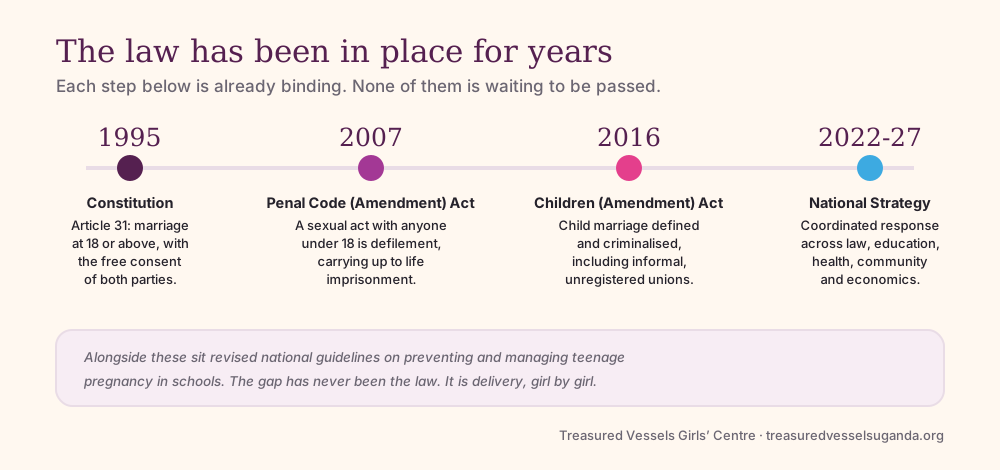
The oldest of these provisions is over thirty years old. A girl born the year the Constitution came into force has children of her own now. Whatever is failing, it is not the absence of a rule.
The national strategy
Uganda has a National Strategy to End Child Marriage and Teenage Pregnancy (2022/23 to 2026/27), which sets out a coordinated national response across legal reform, education, health services, community engagement and economic empowerment.
It is a credible document. As with the school re-entry guidelines, the gap is between what is written and what reaches a village in Busoga on a Tuesday.
Why it keeps happening
Given good law and a national strategy, the obvious question is why the numbers have barely moved.
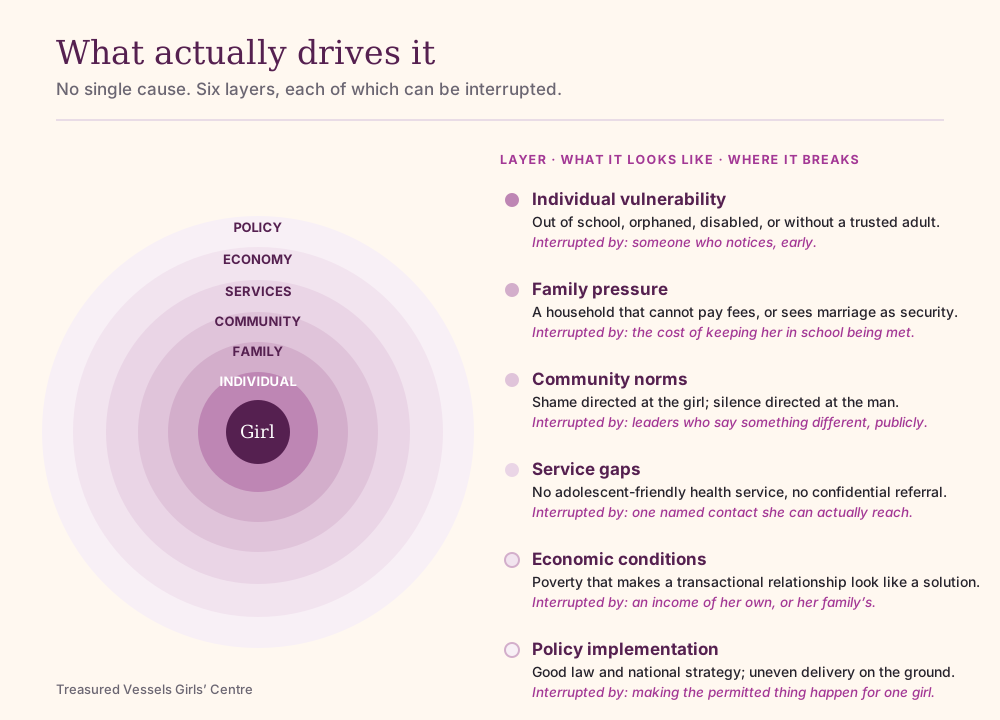
The answer is that no single cause is doing the work. Six layers operate at once, and each one can quietly undo an intervention aimed at another.
Individual vulnerability
Some girls are markedly more exposed than others: those already out of school, those who have lost one or both parents, those with a disability, and those without a single trusted adult who would notice a change in their circumstances.
The absence of that last one, someone who would notice, is a better predictor than almost anything else.
Family pressure
Most families do not want this for their daughters. They face arithmetic they cannot solve.
School costs money the household does not have. A daughter at home is an expense; a daughter married is, in the short term, one less expense and sometimes an income. Where a family believes she has no educational future anyway, marriage can present itself as the responsible option rather than the harmful one.
This is why cost-of-schooling interventions do more than they appear to. They are not just paying fees; they are removing the argument.
Community norms
Norms operate in two directions, and the asymmetry is the problem.
Shame attaches to the girl. Silence attaches to the man, very often an adult man, sometimes a considerably older one. A community that is scandalised by a pregnant fifteen-year-old and incurious about who made her pregnant has, in effect, decided that the offence is hers.
Norms are also the layer most people assume cannot be changed. In our experience they are among the most changeable, because they are held less firmly than they are expressed. What is missing is usually not persuasion but permission: someone respected saying the different thing first, in public.
Service gaps
A girl who cannot get accurate information, cannot access an adolescent-friendly health service, and does not know one confidential number to call is not making informed choices. She is guessing.
The gap is rarely total absence of services. It is more often services that exist but are not reachable by a fifteen-year-old, because staff know her family, because the clinic is open only when she is in school, or because she has no reason to believe a conversation would stay private.
Economic conditions
Poverty is the substrate under all of this. It determines whether school fees are payable, whether an older man's offer of support looks like exploitation or like a solution, and whether a family can absorb another mouth.
It also explains why so many adolescent pregnancies are transactional rather than romantic, a distinction that matters enormously for how a girl should be treated afterwards, and one that shame-based responses erase entirely.
Policy implementation
The last layer is the widest and the most frustrating: good law, real strategy, uneven delivery.
Guidelines exist for school re-entry. A minimum marriage age exists. Reporting mechanisms exist. Whether any of them functions for one particular girl in one particular village depends on whether a particular officer, head teacher or health worker knows the rules and applies them.
Most useful local work is not advocacy for new policy. It is making the existing, permitted, already-funded thing actually happen for one named girl.
What it costs
We want to set this out carefully. The consequences are serious and there is no need to dramatise them.
Health
Adolescent pregnancy carries elevated risk for both mother and child: obstructed labour, obstetric fistula, anaemia, and higher rates of complications in younger mothers, particularly those under sixteen whose pelvic growth is incomplete. Antenatal attendance is often late and incomplete, which compounds each of these.
Schooling
Education usually stops, and usually permanently. With roughly a third of adolescent mothers returning to school, the majority of interrupted educations are never resumed.
Income
Earning capacity is set early and set low. A woman whose formal education stopped at fourteen faces a lifetime of narrow options, most of them insecure and poorly paid, with very little scope to change that later.
Safety
A girl in an early union is at heightened risk of intimate partner violence and has fewer means of leaving it. Economic dependence, distance from her own family, and the social expectation that she remain all work against her.
Mental wellbeing
This is the consequence that receives the least attention and is described most often by the young mothers themselves: isolation, the abrupt loss of a peer group, and being spoken about rather than spoken to. Several have told us that the hardest part was not the birth or the poverty but the silence that followed.
And the next generation
Children of adolescent mothers are less likely to complete school themselves. That is the mechanism by which one interrupted education becomes a two-generation problem, and it is the strongest argument for intervening early rather than accepting the outcome.
What the data does not tell us
An article like this should be as clear about the limits of the evidence as about the evidence, so here is what we cannot tell you.
How much the three groups overlap. We have said repeatedly that child marriage and adolescent pregnancy are distinct. What we cannot give you is a reliable figure for how many girls experience both, in what order, in Busoga. National surveys are not designed to answer that at sub-regional level.
How old the fathers are. This is arguably the most important missing number in the whole subject. Where a pregnancy involves a schoolgirl and an adult man, that is a criminal matter rather than a public health statistic, but the routine data collection does not capture partner age in a way that makes the scale visible. The absence is itself telling.
Whether the numbers are moving. The child marriage figure is retrospective, describing women who are now 20 to 24. Even a highly effective programme starting today would not show in it for several years. Anyone claiming a recent national trend from that number is over-reading it.
What is happening between surveys. The UDHS runs every few years. District-level reporting in between is patchy, sometimes drawn from health facility records that only capture girls who attended a facility, which systematically misses the most isolated.
How many girls are never counted at all. A girl who leaves school, is placed in an informal union in a rural village, and never presents at a health centre may not appear in any dataset. Our own experience suggests this group is not small.
None of this is a reason to disbelieve the figures. It is a reason to treat them as a floor rather than a full picture, and to be sceptical of anyone quoting them to a decimal place.
Busoga specifically
National averages hide a great deal, and Busoga is where the hiding matters most.
The sub-region has repeatedly been reported among the highest in Uganda for teenage pregnancy, and Jinja District has taken local legislative steps in response, passing by-laws aimed at curbing teenage pregnancy and child marriage. We covered the district-level picture in why Jinja and Busoga need a girls' support centre.
Three features of the local context shape what works here:
Density and mobility. Jinja is a city with a large surrounding rural district. Girls move between the two for school, work and family, which makes them harder for any single institution to keep track of, and easier to lose.
Economic structure. Fishing communities, markets and casual labour create environments where transactional relationships between adult men and adolescent girls are normalised and largely unremarked.
Institutional density. This one is in our favour. Busoga has schools, health centres, churches, mosques, district officials and a considerable number of community organisations. The raw material for a coordinated response exists. What is usually missing is coordination itself: a girl referred by a teacher to a health centre and then lost, because nobody owned the case.
A prevention and response framework
What follows is what we believe a serious effort in Busoga looks like. It is deliberately practical and deliberately unglamorous.
1. Keep girls learning
This is the single highest-return intervention and it is not close. Girls who remain in education marry later, have children later and have fewer of them, a finding the World Bank has set out at length in its work on educating girls as a way of ending child marriage and teenage pregnancy.
In practice this means removing the specific obstacle facing one girl, which is usually cost, and sometimes menstrual supplies, transport, or a uniform. See five barriers that push a girl out of school for what these look like in detail.
2. Accurate information and reachable health services
Adolescents need information that is correct, age-appropriate and delivered before it is needed rather than after. They also need at least one health service they believe they can attend without their family finding out.
"Adolescent-friendly" is not a slogan. It means opening hours a schoolgirl can actually use, staff trained not to lecture, and a confidentiality practice that survives contact with a small community.
3. Address violence directly
Any framework that treats all adolescent pregnancy as the result of choices made by girls will fail the substantial proportion involving coercion, exploitation or force.
That means asking who the father is and how old he is; it means functioning reporting routes; and it means understanding that a girl who fears being blamed will not disclose anything.
4. Engage parents, men and boys
Programmes aimed exclusively at girls place the entire burden of prevention on the people with the least power in the situation.
Parents need practical alternatives, not lectures. Boys and men need to be addressed as participants in the outcome rather than as background scenery. In a community where adult men face no social consequence for a relationship with a schoolgirl, no amount of girls' empowerment will close the gap.
5. Support young mothers rather than writing them off
Prevention and response are not competing priorities. A young mother who is supported back into learning or a trade is also the most persuasive possible argument to the next girl's family that a future exists after a pregnancy.
6. Strengthen confidential reporting
Every one of the above depends on a girl, or someone near her, being able to raise a concern safely.
That requires named contacts rather than institutions, routes that do not run through the person most likely to be implicated, and a visible track record of confidentiality being kept. It is slow to build and easy to destroy.
"Speak up for those who cannot speak for themselves, for the rights of all who are destitute." Proverbs 31:8
The community action checklist
If you are a head teacher, a church or mosque leader, a health worker, a local official or simply a neighbour, here is what you can do without funding, permission or training.
If you lead a school
- State your position on pregnancy re-entry publicly, before anyone has to ask.
- Name one confidential contact within the school and tell every girl who it is.
- Do not identify a returning mother in assembly or to her class.
- Treat clinic appointments as legitimate absence.
If you lead a congregation
- Say publicly, once, that shame directed at a girl is not the position of this community.
- Ask openly about the responsibility of adult men. The silence on this is the problem.
- Make it known that a family in difficulty over school fees can raise it without embarrassment.
If you work in health
- Offer at least one clinic time an adolescent can attend without missing school.
- Make the confidentiality policy explicit and repeat it out loud.
- Know your referral routes for a girl disclosing coercion, and keep them current.
If you are a neighbour or relative
- Notice a girl who has stopped attending school and ask why, early.
- Do not name any child publicly on social media, in any circumstances.
- Know one number you could call for advice, and keep it.
If you are a local official
- Make the existing by-laws and national guidance known in a form people actually read.
- Ensure one person owns a case from referral to resolution, so nobody is lost between institutions.
None of that requires a budget. Nearly all of it requires someone to go first.
Download the checklist as a printable PDF →: two A4 pages, designed to photocopy in black and white. The second page carries the Uganda Child Helpline number, what never to do, and the four things the law already says. Print it for a staff room, a vestry or a health centre noticeboard. It may be freely copied.
Where we fit
Treasured Vessels Girls' Centre is one small organisation in Jinja District. We are not going to end child marriage in Busoga, and we would be suspicious of anyone who claimed they were.
What we do is at the individual level, repeatedly: education sponsorship that removes the cost obstacle for a specific girl; vocational training for young women who are out of school; support for teenage mothers; menstrual health outreach so periods do not cost a girl a week of school a month; and referral for protection concerns.
We are also clear about what we are not. We are not a legal service, a clinic, or a child protection authority. Where a case needs one of those, our job is to get the girl to it and stay alongside her, not to attempt it ourselves.
Support one prevention or reintegration activity
The checklist above costs nothing. If you can also fund something, these are the specific costs:
- $15 provides a reusable sanitary kit for a year: prevention, in the most literal sense
- $50 keeps a girl in school for a full term: the single highest-return intervention there is
- $150 provides a sewing machine for a young mother building an income
Keep a girl in school this term →
Frequently asked questions
What is the legal age of marriage in Uganda?
Eighteen. Article 31(1) of the Constitution provides that a man and a woman may marry only if each is aged eighteen or above, and Article 31(3) requires the free consent of both parties. There is no exception for pregnancy or for parental consent.
Is an informal or customary union still child marriage?
Yes. The Children (Amendment) Act 2016 defines child marriage to include formal and informal unions involving anyone under eighteen for the purpose of living together as husband and wife. An unregistered customary arrangement is covered.
How many girls in Uganda become pregnant as teenagers?
The Uganda Demographic and Health Survey 2022 found that around 24% of girls aged 15 to 19 had begun childbearing, meaning they were already mothers or pregnant with a first child. Figures quoted for ages 10 to 19 use a different denominator and are not directly comparable.
How common is child marriage in Uganda?
Around 34% of women aged 20 to 24 report having been married or in union before the age of eighteen. Note that this is a retrospective figure about women who have already passed through adolescence, so it describes the recent past rather than the current rate.
Is teenage pregnancy the same thing as child marriage?
No. They overlap but are distinct. A girl can be married under eighteen without being pregnant, or pregnant without being married. Conflating them produces responses that miss both.
What should I do if I think a child is about to be married?
Do not confront the family publicly or identify the child on social media. Both can increase the danger to her. Assess whether she is in immediate danger, then contact a probation and social welfare officer, the police Child and Family Protection Unit, or a legal aid provider. Where possible, be guided by what the child herself says she wants.
Does Uganda have a national plan for this?
Yes. The National Strategy to End Child Marriage and Teenage Pregnancy (2022/23 to 2026/27) sets out a coordinated response across legal reform, education, health services, community engagement and economic empowerment. The persistent difficulty is implementation at local level rather than the content of the strategy.
What is the single most effective thing to fund?
Keeping girls in school. The evidence on this is unusually consistent: girls who stay in education marry later and have children later. Most other interventions are supporting this one.