
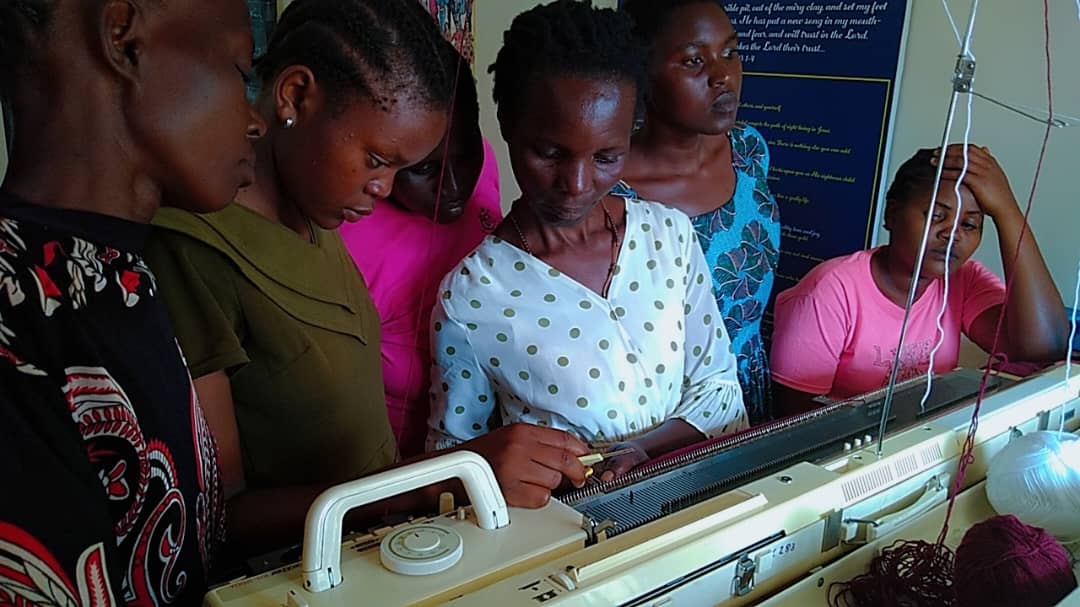
A girl comes back to the skills room after three months away. She can do the work. Her hands know the machine. But she is not sleeping, she cries at things that would not normally make her cry, and when a trainer asks her a direct question she goes somewhere else for a second before answering.
Nobody has a budget line for this. It is the part of recovery that does not appear in any funding proposal, because it has no output you can photograph.
This article is about what that girl is experiencing, in plain language, and about the honest limits of what an organisation like ours can do about it.
One thing first, before anything else. Nothing here is a diagnosis, and reading a list of symptoms is not an assessment. If you recognise yourself in this, it means you should talk to someone qualified, not that you now know what is wrong with you.
Four words, in plain language
These words get used interchangeably and they are not the same thing.
Stress is the ordinary response to a demand. Your heart is faster, you are alert, you are focused on the problem. It is uncomfortable and it is meant to be. It ends when the demand ends.
Trauma is what can be left behind after something overwhelming: violence, an assault, a birth that went badly, a death. The event is over and the body has not been told. The signs are specific rather than general: memories that arrive without being called, jumpiness, avoiding places and people connected to what happened, and a flat numbness that can look from outside like not caring.
Anxiety is fear that has outlasted its cause and spread. Worry that cannot be switched off, a racing heart with nothing in the room to explain it, difficulty sleeping, and a growing list of things that feel unsafe to do.
Depression is heaviness that does not lift. Not sadness, which comes and goes, but a persistent flatness: no interest in things that used to matter, exhaustion that sleep does not fix, feeling worthless, and in the more serious cases thoughts about not being here.
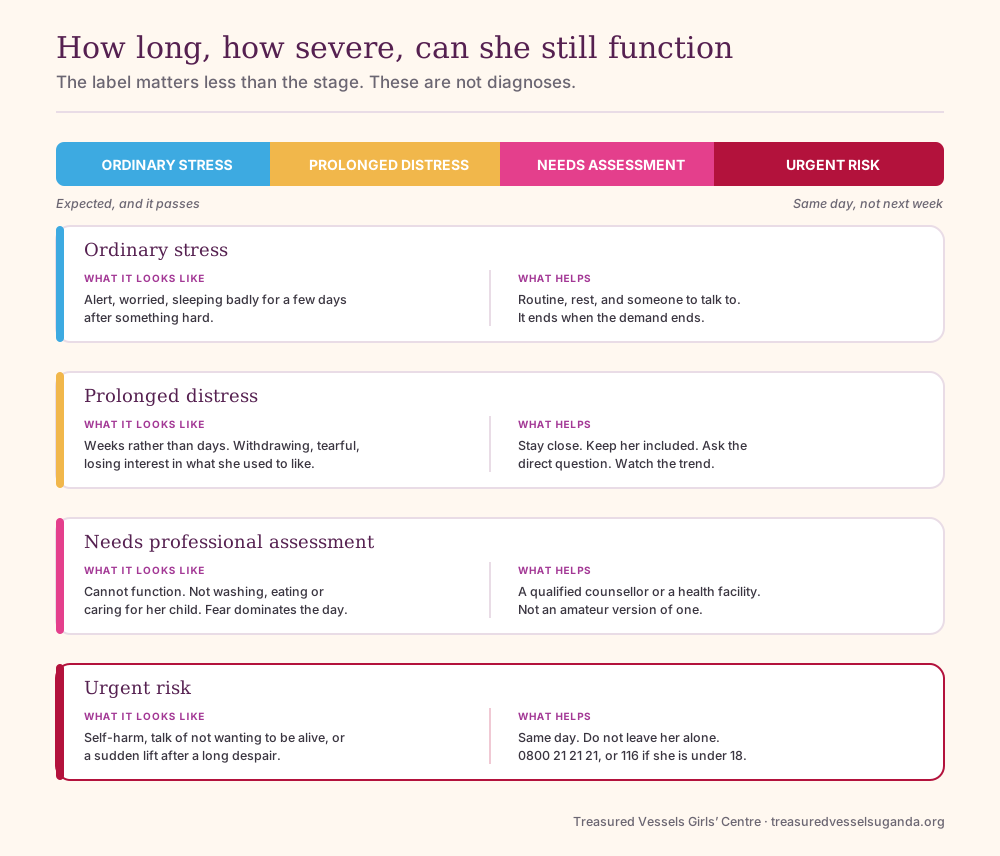
The distinction that matters is not which word fits. It is how long, how severe, and whether she can still function. A week of poor sleep after a frightening event is expected. Two months of not getting out of bed is not.
What the evidence actually says
Be careful with mental health statistics, including these. Studies measure symptoms with questionnaires rather than diagnosing people, they are usually done in one region, and the numbers move depending on the tool used. What follows is worth knowing, and none of it is a national rate.
Anxiety in children and adolescents. A study across four districts of rural north-eastern Uganda found anxiety disorders in 26.6% of children and adolescents, and higher in girls at 29.7% than in boys at 23.1%. The most common were specific phobia at 15.8%, post-traumatic stress disorder at 6.6% and separation anxiety at 5.8%. That figure is carried into Uganda's Child and Adolescent Mental Health Policy Guidelines. It comes from districts with a particular history, so treat it as an indication of scale rather than as the number for Jinja.
Young mothers specifically. A study of 195 adolescent parents aged 15 to 19 in south-western Uganda, 155 of them mothers, found depressive symptoms in 52.0% of the mothers against 33.3% of the fathers, and severe symptoms only among the mothers. Same age, same district, same event, and the weight lands differently depending on who is expected to carry the child.
School-going adolescents. A 2025 study of 2,845 adolescents in poverty and conflict-affected parts of Uganda found a substantial proportion reporting at least moderate symptoms of depression and anxiety.
Put those together and the picture is consistent rather than precise: this is common, it is more common in girls, and it is more common again in the girls our programmes exist for.
Why these three situations in particular
The title names violence, pregnancy and school exclusion because they are not three separate problems. They are frequently the same girl in three consecutive years, and each one carries its own kind of damage.
After violence, the harm is often to trust rather than to the body. She has learned that the people who are supposed to be safe may not be, and that knowledge does not switch off when the danger does. Where the person responsible is still in the house or the village, the fear is not a symptom. It is accurate.
After a pregnancy at fifteen or sixteen, she is doing an exhausting job with no sleep, usually without the father, often having been told by people she loves that she has disgraced them. Add the ordinary hormonal drop after birth and a large share of these young mothers are carrying something the community reads as laziness or sulking.
After exclusion from school, the loss is of a future she could previously describe. Girls who have been out of school for a year do not usually say they are depressed. They say there is no point. That sentence deserves more attention than it normally gets.
The common thread is the loss of control over her own life. That is what the evidence keeps pointing at, and it is also what determines whether anything gets better.
Signs that this needs more than friendship
Ordinary low mood after a hard year is not an emergency, and treating every sad teenager as a clinical case does its own harm. These are the things that mean the answer is a professional rather than a kind friend.
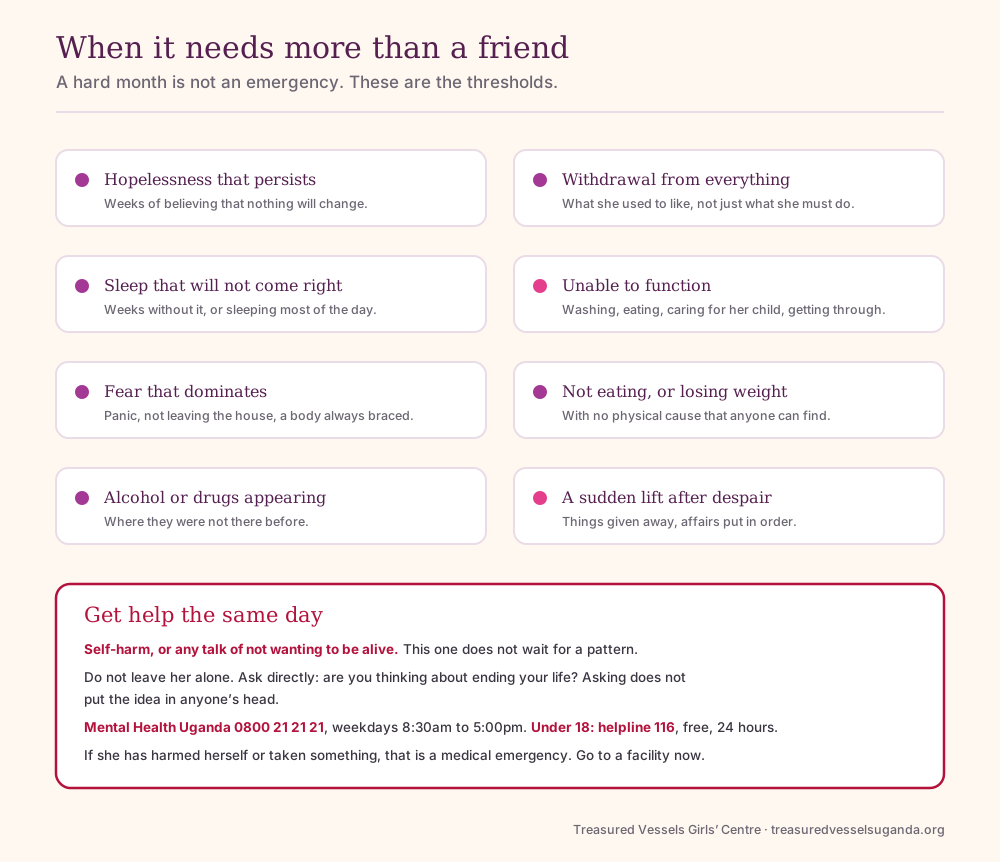
Hopelessness that persists. Not a bad week. Weeks of believing that nothing will change and that there is no point trying.
Withdrawal from everything. Leaving the things she used to like, not just the things she has to do.
Sleep that will not come right. Unable to sleep for weeks, or sleeping most of the day, or waking every night at the same hour.
Unable to function. The clearest single test there is. Can she wash, eat, look after her child, get through a day. If the answer has been no for a sustained period, that is the threshold.
Fear that dominates. Panic, refusing to leave the house, a body constantly braced.
Not eating, or losing weight with no physical cause.
Alcohol or drugs appearing where they were not before.
Self-harm, or talking about not wanting to be alive. This one is different from the others. It does not wait for a pattern and it is not a stage to watch. See the box below.
And one sign that is easy to miss: a sudden lift after a long period of despair, with things being given away or affairs being put in order. That is not always recovery.
Prayer, friendship and their limits
We are a Christian organisation and we are not going to be coy about this.
Prayer matters here. So does a church that keeps including her, a friend who visits without needing to be asked, and a group of women who have been through the same thing and do not flinch at it. These are not a soft substitute for real help. Isolation makes every one of these conditions worse, and being genuinely held by a community is one of the few things that reliably protects people.
And none of that is an assessment.
A woman with severe depression is not short of faith, and telling her she is adds guilt to an illness. The instruction to pray harder, given to somebody who cannot get out of bed, is heard as an accusation. Where there is risk to her life, spiritual support and clinical care are not alternatives to choose between, and a church that treats them as alternatives will eventually bury somebody it could have helped.
The position we hold is simple. Pray with her, stay with her, and get her to somebody qualified. All three, in that order of comfort and the reverse order of urgency.
What we can honestly offer, and what we cannot
We do not employ clinicians. No psychiatrist, no psychologist, no clinical counsellor. It would be easy to describe what we do as counselling, and a good many organisations do exactly that. It would not be true.
What we can do:
Notice. Trainers see these young women several days a week over months, which is more contact than most services get. Noticing early is genuinely valuable and it does not require a qualification.
Sit with it without flinching. Supportive, non-judgemental contact, without advice, without a verdict, and without repeating it to anybody.
Refer, with her consent. Which is the part that costs money: the fare, the time, the staff member who goes with her, and the follow-up that finds out whether she arrived.
Keep her in the room. Routine, work with her hands, a reason to be somewhere at nine in the morning, other women around her. None of that is treatment. All of it is protective, and it is the thing we are actually good at.
What we will not do:
We will not provide amateur therapy. Asking a survivor to talk through a traumatic event, with no training and no plan for what happens next, can make her worse. Trauma work belongs to people who have been taught to do it.
We will not diagnose. Not in a conversation, not in a report, not in a funding application.
We will not pass on what she tells us. The confidentiality rules in what to say when someone discloses violence apply here in full.
Two commitments follow from this, and they are the point of the article. Every member of staff and every regular volunteer should complete psychological first aid training, which teaches exactly this boundary: how to be useful in the first conversation and how to hand over. And mental health is one of the nine categories in the referral network we are building for Jinja. It is the thinnest category in the district, and we would rather say so than pretend otherwise.
If someone is at risk right now
Do not leave her alone. Stay, or make sure somebody she trusts is with her.
Ask directly. "Are you thinking about ending your life?" Asking does not put the idea in anyone's head. It is the single most useful question available to you, and people are usually relieved to be asked plainly.
Remove the obvious means if you can do so without a confrontation.
Get help the same day. Not next week's appointment.
Mental Health Uganda's toll-free helpline is 0800 21 21 21, Monday to Friday, 8:30am to 5:00pm. Trained counsellors provide confidential support and referral, with an automated menu in several Ugandan languages.
For anyone under eighteen, the Uganda Child Helpline is 116, free from any network, 24 hours, run by the Ministry of Gender, Labour and Social Development.
Outside those hours, go to a health facility. Any facility. Ask for the mental health worker, or ask them to refer. Butabika National Referral Mental Hospital is the national specialist centre, and referrals to it normally come through a health facility rather than by turning up.
If she has taken something or harmed herself, this is a medical emergency. Go to a health facility now and say what has happened.
The law is better than the reputation
Uganda's old mental health law was the Mental Treatment Act of 1938, and it read like it: custodial, written about people rather than for them, and using language no one would defend today. It was repealed by the Mental Health Act 2019, which is built instead around consent to treatment, the rights of the person being treated, and care in the community rather than confinement.
That matters for a practical reason. A great deal of the fear attached to seeking help in Uganda is attached to the old system and to what people believe still happens. Asking for help with anxiety or depression does not lead where families are afraid it leads.
What this asks of you
If you are a parent, a teacher, a pastor or a trainer: learn the difference between a bad month and the list above. Ask the direct question when it is warranted. Keep including her. And when it crosses the line, get her to someone qualified rather than trying harder yourself.
If you are the girl in the first paragraph: what you are carrying is common, it is not a character failure, and it is treatable. The fact that nobody around you names it does not mean you are the only one.
Download the when-to-get-help card as a printable PDF Two A4 pages. Page one is a wall chart: the four stages, the eight signs, and the numbers to ring, sized for a staff room, a vestry or a health centre. Page two is for whoever will be in the first conversation, covering what to do, what not to do, and where the line is. It photocopies in black and white and may be freely copied.
If you want to fund the part of this that costs money, there are two things and they are both unglamorous.
Confidential counselling referrals. The fare, the consultation fee, a staff member's day spent going with her, and the follow-up that finds out whether she arrived and whether it helped.
Psychological first aid training for our staff and volunteers. So that the first conversation, which is the one we will always be present for, is a help rather than a harm.
Fund counselling referrals and staff training
If you are a counsellor, psychologist or psychiatrist working in or near Jinja, we would rather verify you than guess. Please get in touch.
Frequently asked questions
What is the difference between stress, trauma, anxiety and depression?
Stress is the ordinary response to a demand and it ends when the demand ends. Trauma is what can be left after something overwhelming, showing as unwanted memories, jumpiness, avoidance and numbness. Anxiety is fear that has outlasted its cause and spread. Depression is a heaviness that does not lift, with loss of interest, exhaustion and feelings of worthlessness. What matters more than the label is how long it has lasted, how severe it is, and whether she can still function.
How common are anxiety and depression among adolescent girls in Uganda?
Common, and more common in girls than boys, although the exact figures depend heavily on the study. A survey across four districts of rural north-eastern Uganda found anxiety disorders in 26.6% of children and adolescents, 29.7% of girls against 23.1% of boys. A study of 195 adolescent parents in south-western Uganda found depressive symptoms in 52.0% of the young mothers against 33.3% of the young fathers, with severe symptoms only among the mothers. These are regional studies rather than national rates.
When should someone see a professional rather than just talk to a friend?
When hopelessness persists for weeks, when she withdraws from everything including what she used to enjoy, when sleep is badly disrupted for a sustained period, when fear dominates her day, when she cannot manage washing, eating or caring for her child, or when alcohol or drugs appear. Self-harm or any talk of not wanting to be alive needs help the same day, not a period of watching.
Is prayer enough for depression or trauma?
Prayer, friendship and a community that keeps including her genuinely protect people, and isolation makes every one of these conditions worse. They are not an assessment. A woman with severe depression is not short of faith, and telling her she is adds guilt to an illness. Where there is risk to her life, spiritual support and clinical care are not alternatives.
Does Treasured Vessels provide counselling?
No. We do not employ clinicians, and describing what we do as counselling would not be true. We provide supportive, non-judgemental contact, a routine and a place to be, and referral to qualified services with her consent. Trauma work belongs to people trained to do it.
What should I do if someone tells me they are thinking about suicide?
Do not leave her alone. Ask directly whether she is thinking about ending her life, because asking does not put the idea in anyone's head. Remove the obvious means if you can do so without a confrontation. Then get help the same day: Mental Health Uganda's toll-free helpline on 0800 21 21 21 during weekday office hours, the Uganda Child Helpline on 116 for anyone under eighteen, or the nearest health facility. If she has already harmed herself or taken something, treat it as a medical emergency.
Where can someone get mental health help in Uganda?
Mental Health Uganda runs a toll-free helpline on 0800 21 21 21, Monday to Friday, 8:30am to 5:00pm, with trained counsellors and an automated menu in several Ugandan languages. The Uganda Child Helpline is 116, free and available 24 hours, for anyone under eighteen. Outside those hours, go to a health facility and ask for the mental health worker. Butabika National Referral Mental Hospital is the national specialist centre, reached by referral rather than by arriving.
Can someone be detained for seeking mental health treatment in Uganda?
The fear usually attaches to the Mental Treatment Act of 1938, which was custodial and is no longer the law. It was repealed by the Mental Health Act 2019, which is built around consent to treatment, the rights of the person being treated, and care in the community rather than confinement. Asking for help with anxiety or depression does not lead where families are often afraid it leads.