
Four articles on this site end the same way. A woman has told someone what is happening to her, or a girl has been hurt, and the practical next step is to get her to a service that can actually help. And each time we have had to write some version of the same sentence: we are still building a verified referral directory for Jinja, and we are not publishing names until each entry has been confirmed.
Readers have reasonably asked when that ends. This article is the answer: what we are building, the checks every entry has to pass, why we are refusing to publish the quick version, and how organisations in Jinja can get on the list.
It is written for partners rather than for supporters. If you run a clinic, a legal aid desk, a police protection unit, a counselling service, a school or a shelter anywhere in the Jinja area, the last section is an invitation to you.
Why a list of phone numbers is not a referral pathway
Almost every organisation working in this space has a list. Ours sits in a notebook and in several people's phones. It is the normal way this is done, and it fails in normal, predictable ways.
The number has changed. A staff member moves on and takes the working number with her. The one on the poster rings out.
The service has closed, or the project has ended. Donor-funded services run in cycles. A counselling programme that existed in March may not exist in November, and nothing announces this.
The hours were never what you assumed. A service described as available is available on Tuesdays and Thursdays, in the morning, when a particular person is in.
It costs money nobody mentioned. The consultation is free and the laboratory test is not. The form is free and the transport is not. A woman who arrives with nothing and is quietly sent away will not try a second time.
It cannot take the person you are sending. A service for children cannot take a nineteen year old. A service in one sub-county will not take someone from another. Eligibility rules are rarely written down anywhere a volunteer would find them.
Nobody knows whether she arrived. This is the largest failure of the six, and the least visible. Handing over a number feels like helping, and the person doing it never learns that the call was never made.
Timing makes all of this worse than an ordinary administrative nuisance. After a sexual assault, post-exposure prophylaxis to prevent HIV needs to be started as soon as possible and within 72 hours, and emergency contraception works best the sooner it is taken and can be used up to 120 hours. A day lost to a wrong number is not an inconvenience. It closes a clinical window that does not reopen.
Nine categories, mapped before any names are published
We are mapping the network by category first, because a category tells you what kind of help exists and a name without verification tells you nothing you can rely on.
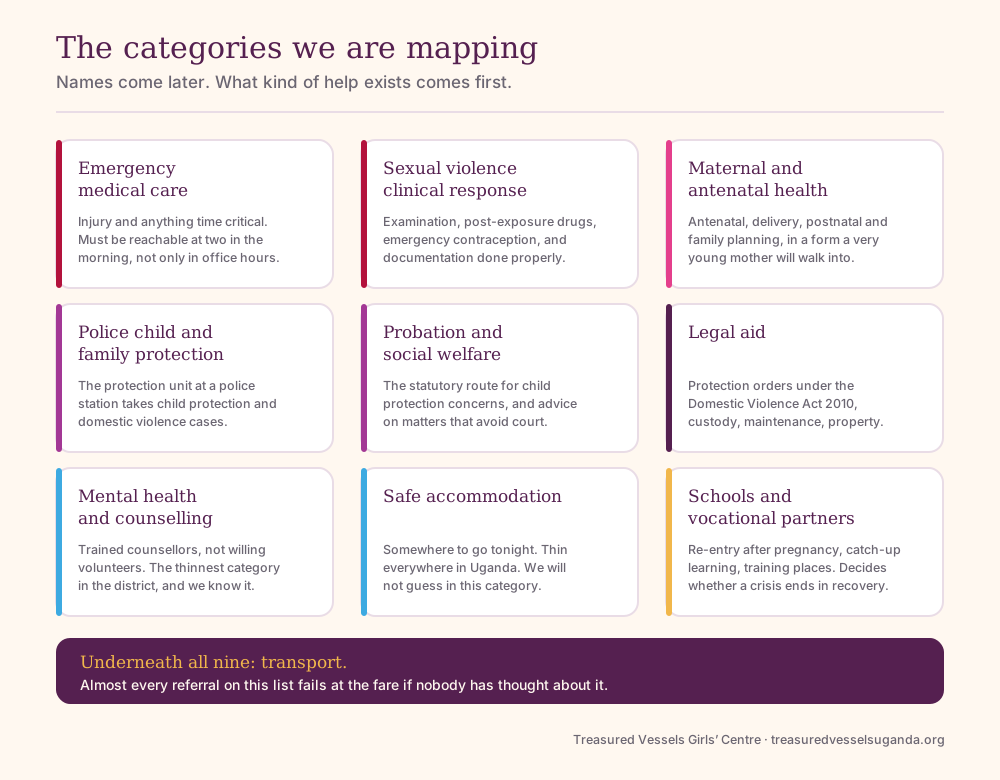
Emergency medical care. Injury, bleeding, anything time critical. This is the category where the answer has to be reachable at two in the morning, not just in office hours.
Sexual violence clinical response. The specific package: examination, post-exposure prophylaxis, emergency contraception, treatment for sexually transmitted infections, and documentation completed properly in case she later decides to report. The documentation matters. A medical record made at the time is often the difference between a case that can proceed and one that cannot.
Maternal and antenatal health. Antenatal care, delivery, postnatal care and family planning, in a form that a very young mother will actually walk into. We have written separately about what makes health services adolescent friendly, and it is not a sign on the wall.
Police child and family protection. The Child and Family Protection Unit at a police station handles child protection and domestic violence. Knowing which station, and whether there is an officer who does this work well, is more useful than knowing the category exists.
Probation and social welfare. The district probation and social welfare officer is the statutory route for child protection concerns, and can advise on family matters that never become police cases.
Legal aid. Protection orders under the Domestic Violence Act 2010, custody, maintenance, property and inheritance. Most of the women we work with will never pay for a lawyer, so what matters is which providers work without charge and what they cover.
Mental health and counselling. Trained counsellors, not well-meaning volunteers. This is the thinnest category in the district and the one we expect to struggle with most.
Safe accommodation. Somewhere to go tonight. Thin everywhere in Uganda, thin in Jinja, and the category we are least willing to guess about, because sending a woman to a shelter that cannot take her is worse than telling her honestly that we do not yet have one.
Schools and vocational partners. Re-entry after pregnancy, catch-up learning, and training places. This is the category that decides whether a crisis ends in recovery or in a life that never quite restarts.
A tenth category sits underneath all of them: transport. Almost every referral in this list fails at the fare if nobody has thought about it.
The eight checks
Nothing goes on the list because somebody remembers it being good. Every entry has to pass the same eight checks, and the checks are deliberately boring.
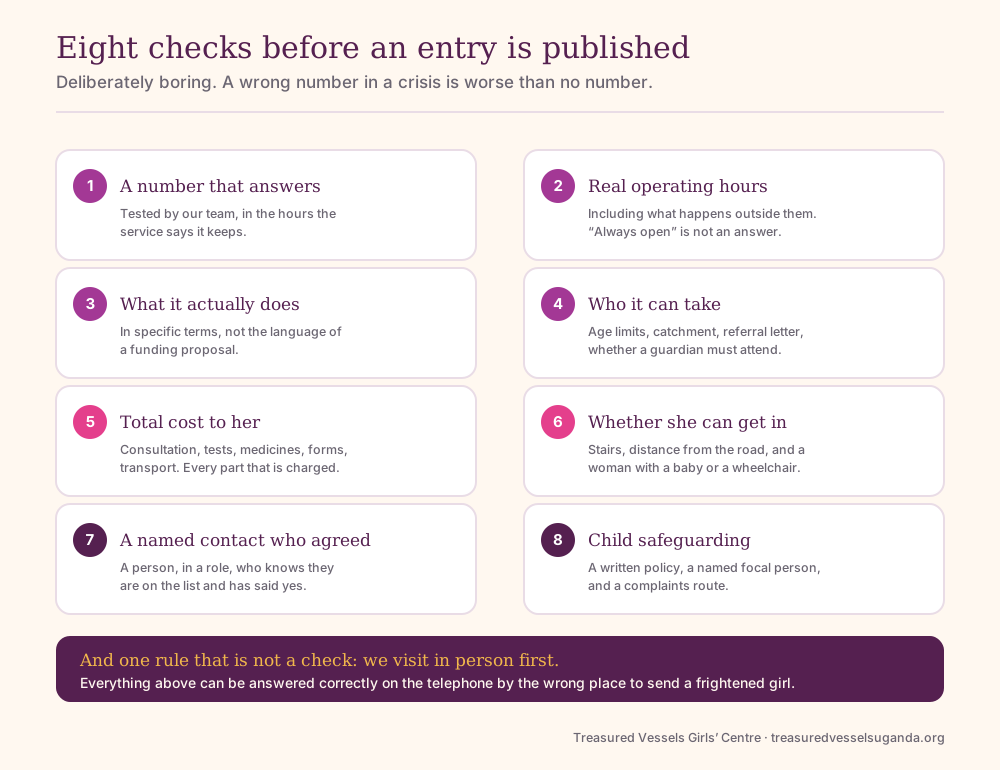
1. A telephone number that answers. Tested, by someone from our team, in the hours the service claims to keep.
2. Operating hours as they really are. Including what happens outside them. "Weekdays, eight to five, and after that the duty officer on this number" is an answer. "Always open" is not.
3. What the service actually does. Described in specific terms rather than in the language of a funding proposal. Not "supports survivors" but "examination, post-exposure prophylaxis, emergency contraception, and a completed police form on request".
4. Who it can take. Age limits, catchment area, whether a referral letter is needed, whether a parent or guardian must attend. Eligibility rules that only reveal themselves at the door waste a whole day.
5. What it costs her in total. Consultation, tests, medicines, forms, transport. If any part is charged, we want the figure, because the number we tell a woman has to be the number she pays.
6. Whether she can physically get in. Stairs, distance from the road, whether a woman with a baby or a wheelchair is genuinely able to use the service. A service that is technically available and practically unreachable is not available.
7. A named contact who has agreed. A person, in a role, who knows they are on our list and has said yes. We will not publish an organisation that has not agreed to be published. This single check removes most of the risk in the whole exercise.
8. Child safeguarding standards. A written policy, a named focal person, and a complaints route. Where a service will see children, this is not optional.
And one thing that is not a check but a rule: a visit in person before publication. Everything above can be answered correctly on the telephone by an organisation that would be the wrong place to send a frightened seventeen year old.
Two directories, not one
The public directory will contain categories, services, hours, costs, eligibility and a general contact route. It will carry the date it was last verified, and it will be reverified every quarter.
The staff directory contains what the public one should not: individual names and mobile numbers, which officers are competent and which are not, escalation routes when a first contact fails, out of hours arrangements, and our own notes on how previous referrals went.
The split exists because the two documents have different risks. A public list is read by anyone, including people a woman is trying to get away from. A named officer's personal number on a public web page is a security problem for that officer and, indirectly, for her. Publishing an honest assessment of which services perform poorly would also end our ability to work with them, and the people who lose from that are the women we would otherwise refer.
So the public version is accurate and incomplete on purpose, and the private version is the one our staff actually work from.
Closed-loop referral
A referral is not a piece of information you hand over. It is a task with an ending, and the ending is finding out what happened.
Open loop is what most of us do. Give her the number. Wish her well. Never learn whether she called.
Closed loop has four parts.
Consent and a warm handover. With her agreement, we contact the service before she arrives, so that someone is expecting her and she does not have to explain herself from the beginning at a counter.
Practical support to get there. Usually the fare, sometimes a staff member going with her. This is the part that costs money, and it is the part that decides whether a referral is real.
Follow up, on an agreed day, in a way she has chosen as safe. Did she get there. Was she seen. Did anything else turn out to be needed.
A record of the outcome. Not the details of what happened to her, which belong with the clinical and statutory services. Just whether the referral worked, so that a service which repeatedly fails people stops being recommended.
That last point is the whole argument for doing this properly. A directory nobody checks against outcomes slowly becomes fiction. A directory that records what happened corrects itself.
Consent, and the information that moves
Every part of a closed loop involves telling somebody something about a woman who has enough problems already. So the rule is simple and it does not bend.
We ask before we contact anyone. Not as a formality afterwards. Before.
We say exactly what we would pass on, and we pass on the minimum. A referral to a clinic does not need her history. It needs enough for the service to prepare.
A no is a complete answer, and it does not expire. She may refuse today and ask in March.
She chooses how she can be contacted. A phone may be shared or monitored, so the number, the timing and whether a message is safe at all are hers to decide.
The one exception is a child at risk or an immediate danger to life, and even then we say what we are doing and who we are telling before we do it. The reasoning behind all of this is set out in our survivor-centred response to gender-based violence and in what to say when someone discloses violence.
What we will not do
We will not publish an unverified list to look useful sooner. A wrong number in a crisis is worse than no number, because it consumes the one attempt a frightened person was willing to make.
We will not crowdsource case details. No comment threads, no social media replies, no "describe your situation here". Anyone needing help is asked to contact us privately, and anything we are told in confidence stays with the people who need it to act.
We will not position ourselves as the hub everything must pass through. UNFPA's SafePal work in Uganda, which connected survivors to psychosocial, medical, legal and protection services through a single application, is useful precisely because it treated no single organisation as a complete answer. We are a community-based organisation with a skills room and a pregnancy centre. We are not a clinic, a law firm or a shelter, and a referral network built to make us look central would be built wrong.
We will not list an organisation that has not agreed to it. Being publicly named as a service for survivors has consequences for a small organisation, and that decision is theirs.
Where this leaves a reader today
Until the directory is published, the honest position is the one we have given all along.
If a child is at risk or anyone is in immediate danger, the Uganda Child Helpline is 116, free from any network, 24 hours, run by the Ministry of Gender, Labour and Social Development.
For an adult, the Child and Family Protection Unit at the nearest police station also handles domestic violence, the district probation and social welfare officer can advise, and legal aid providers can explain the protection order route.
After a sexual assault, go to a health facility the same day if at all possible, because of the 72 hour and 120 hour windows described above, and ask for the examination to be documented whether or not she has decided to report.
And you can contact us. We will not investigate and we will not act without her agreement, but we can talk through the options and, where she wants it, go with her.
An invitation to organisations in Jinja
If you provide medical, protection, legal, counselling, accommodation, education or training services anywhere in the Jinja area, we would rather verify you than guess about you.
Download the referral verification form as a printable PDF Two A4 pages. Page one is the form itself, covering services, hours, eligibility, costs, accessibility, a named contact and safeguarding. Page two explains the eight checks and what happens after you send it back.
Complete it and send it to treasuredvesselsug@gmail.com, or get in touch and we will arrange a visit. If you are already on a list of ours and something has changed, tell us and we will correct it the same week. Corrections are more valuable to us than new entries.
There is no fee, no exclusivity and no obligation. We are not asking anyone to refer to us. We are asking to be able to refer to you accurately.
Apply to join or correct your entry
If you would like to fund the part of this that costs money, it is the referral itself: the fare, the consultation, the staff member's day spent going with her, and the follow up that finds out whether she arrived.
Frequently asked questions
What is a referral pathway?
An agreed route from the person who first hears about a problem to the service that can deal with it, with the steps in between written down. A real pathway names the categories of service, the conditions each entry has to meet, who makes contact, what information is shared and with whose consent, and how the outcome is checked. A list of telephone numbers is not a pathway.
Why has Treasured Vessels not published a list of services in Jinja yet?
Because an unverified list does harm. Numbers change, projects close, hours are not what was assumed, and charges appear that nobody mentioned. A woman who makes one attempt and is turned away usually does not make a second. We would rather publish later and be right.
What has to be confirmed before a service is added?
Eight things: a telephone number that answers in the hours claimed, real operating hours including out of hours arrangements, what the service actually does, who it can take, the total cost to her, whether she can physically get in, a named contact who has agreed to be listed, and child safeguarding standards. We also visit in person before publishing.
What is a closed-loop referral?
One that ends with knowing what happened. With her consent we contact the service before she arrives, help with the fare or go with her, follow up on an agreed day in a way she has chosen as safe, and record whether the referral worked. Open-loop signposting hands over a number and never learns whether it was used.
Will the directory include names and phone numbers of individual officers?
Not the public version. That carries categories, services, hours, costs, eligibility, a general contact route and the date it was last verified. Individual names, mobile numbers, escalation routes and our own assessments sit in a staff version, because a public list is also read by people a woman may be trying to avoid.
How often will the directory be checked?
Every quarter, and the public version will show the date it was last verified. Services close, projects end and staff move, so an unchecked directory becomes inaccurate within months of publication.
How can my organisation join the referral network?
Download the referral verification form, complete it and send it to treasuredvesselsug@gmail.com, or contact us to arrange a visit. There is no fee and no exclusivity, and you are not being asked to refer to us. If you are already listed and something has changed, tell us and we will correct it that week.
Where should someone go right now if they need help in Jinja?
If a child is at risk or anyone is in immediate danger, the Uganda Child Helpline is 116, free from any network, 24 hours. For an adult, the Child and Family Protection Unit at the nearest police station also handles domestic violence, and the district probation and social welfare officer can advise. After a sexual assault, go to a health facility the same day if possible, because of the 72 hour and 120 hour treatment windows.