
Advice about looking after yourself has earned a bad reputation, and it deserves most of it. Told to a woman with no money, no sleep and a baby, "make time for yourself" is not advice. It is a description of a life she does not have.
So this page sets a low bar on purpose. Five things that cost nothing, take minutes, and are unlikely to make anything worse. None of them is treatment. None of them fixes a situation. They are the small supports that make a hard stretch slightly more survivable, and they are worth doing for that reason alone.
This follows on from our article on mental health after violence, pregnancy or school exclusion, which covers the signs that something needs a professional.
Read this part first if someone is hurting you
Almost every piece of wellbeing advice ever written assumes one thing: that you control your own day. If somebody else controls it, most of that advice stops being useful and some of it becomes dangerous.
Going for a walk alone can be something you are punished for. Keeping a journal creates a document that can be found and read. Time to yourself can be read as evidence of something. Even a phone call to a friend leaves a record on a handset that may not really be yours.
If someone is hurting you or controlling you, your first need is a safety plan, not relaxation. That means knowing where you would go, who you would tell, what you would take, and how you would get out, worked through before it is needed. We describe what a safety plan contains in our survivor-centred response to gender-based violence.
Two of the five below still work in that situation: the one safe person, and the breathing. The rest can wait.
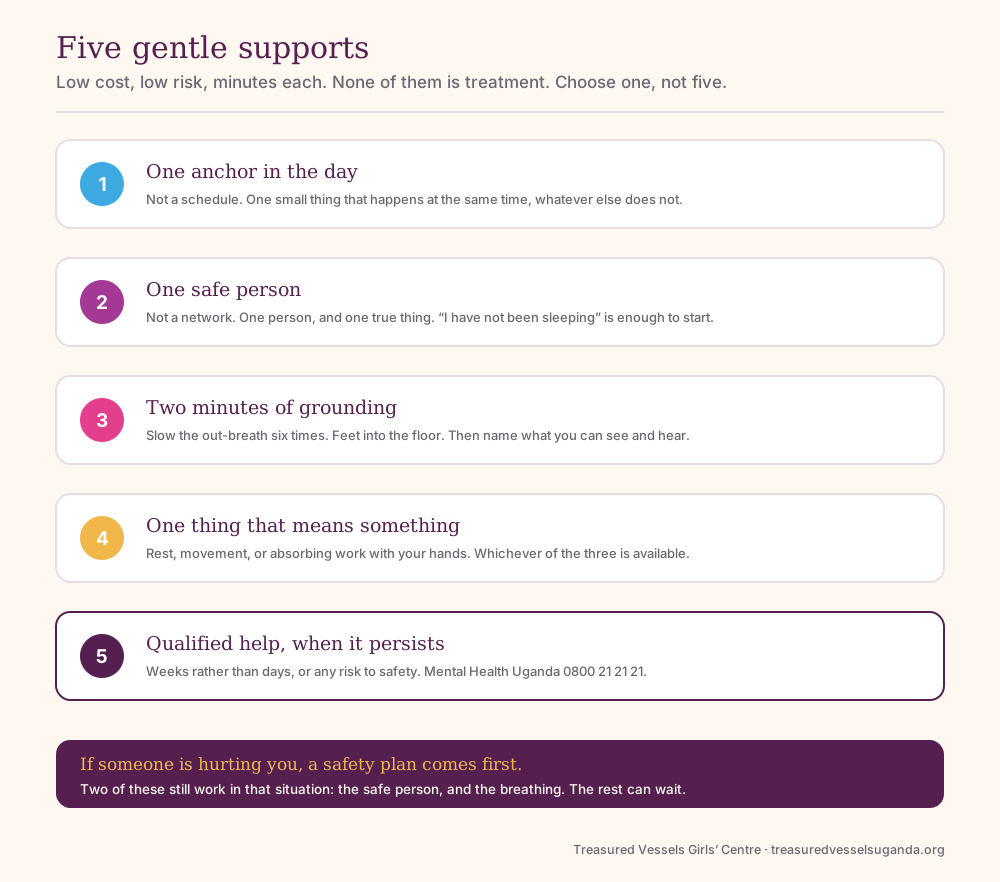
1. One anchor in the day
Not a schedule. One thing that happens at roughly the same time, whatever else does not.
Tea at six. Sweeping the step. Walking as far as the road and back. It does not matter what it is, and it works better if it is small enough that a bad day cannot cancel it.
Why it helps. When a lot has gone wrong at once, the days stop having a shape, and a shapeless day is much harder to get through than a busy one. One fixed point gives the rest of the day something to sit around.
The honest limit. A routine will not lift depression. It makes the difference between a difficult day and a day that disappears entirely, which is not nothing.
2. One safe person
Not a support network. One person you can be honest with.
Isolation is the thing that makes every one of these conditions worse, and it is also the thing that arrives first, quietly, while everyone assumes you want to be left alone.
How to do it. Pick the person. Tell them a small true thing rather than the whole thing. "I have not been sleeping" is enough to start with. You are not asking them to fix anything, and they will be relieved to hear it, because most people can tell something is wrong and do not know how to ask.
If you are the safe person: keep turning up. Do not wait to be invited, do not ask for detail, and do not go quiet because you were told everything is fine. Most people say that several times before they say anything else.
The honest limit. A friend is not a counsellor, and it is not fair to either of you to treat them as one.
3. Two minutes of grounding
This is the only one that works during the moment itself, when your heart is going and your thoughts are moving too fast to catch.
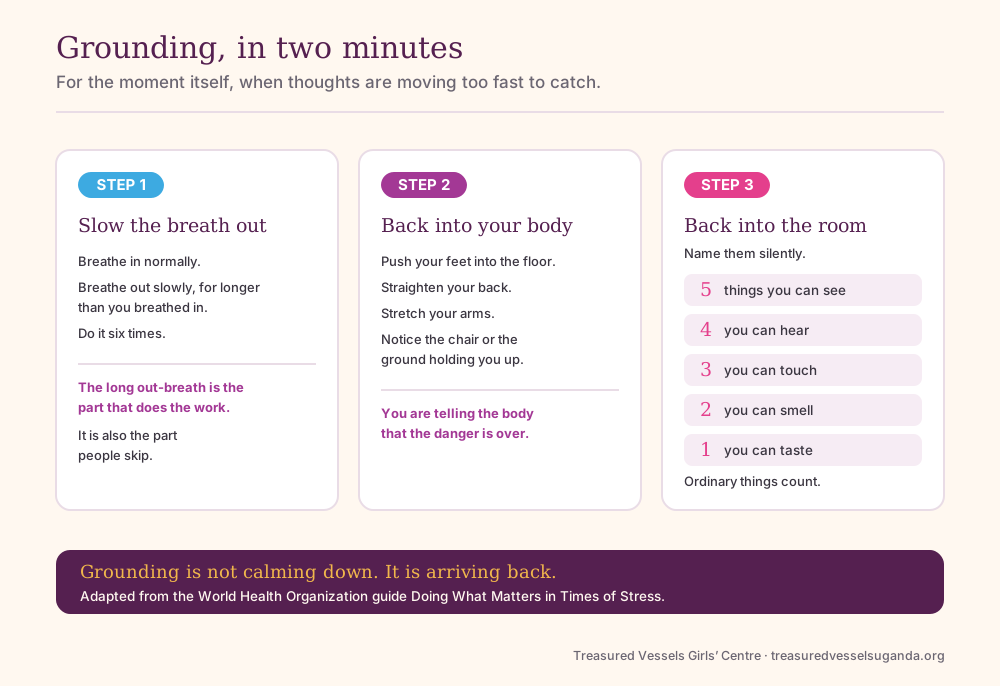
Slow the breath out. Breathe in normally. Breathe out slowly, for longer than you breathed in. Do it six times. The long out-breath is the part that does the work, and it is the part people skip.
Come back into your body. Push your feet into the floor. Straighten your back, stretch your arms, notice the chair or the ground holding you up.
Come back into the room. Name five things you can see, four you can hear, three you can touch, two you can smell and one you can taste. Say them silently. Ordinary things count.
That sequence is adapted from the World Health Organization's illustrated guide Doing What Matters in Times of Stress, which is free, drawn rather than written, and designed for exactly this.
Why it helps. Panic and flashbacks work by pulling you out of the present. Grounding is not calming down. It is arriving back.
The honest limit. It lasts minutes. Used during a flashback it is genuinely useful. Used instead of treatment it is a way of coping with something that should be treated.
4. One thing that means something
Rest, movement, or something made with your hands. Whichever of the three is actually available.
Rest is first, because it is the one most often missing and the hardest to arrange when there is a baby. Sleep when the baby sleeps is easy to say, and a nap in the afternoon while somebody else holds the child is a real intervention.
Movement counts even when it is not exercise. Walking somewhere, carrying something, working in a garden. The point is a body that has moved, not a plan to get fit.
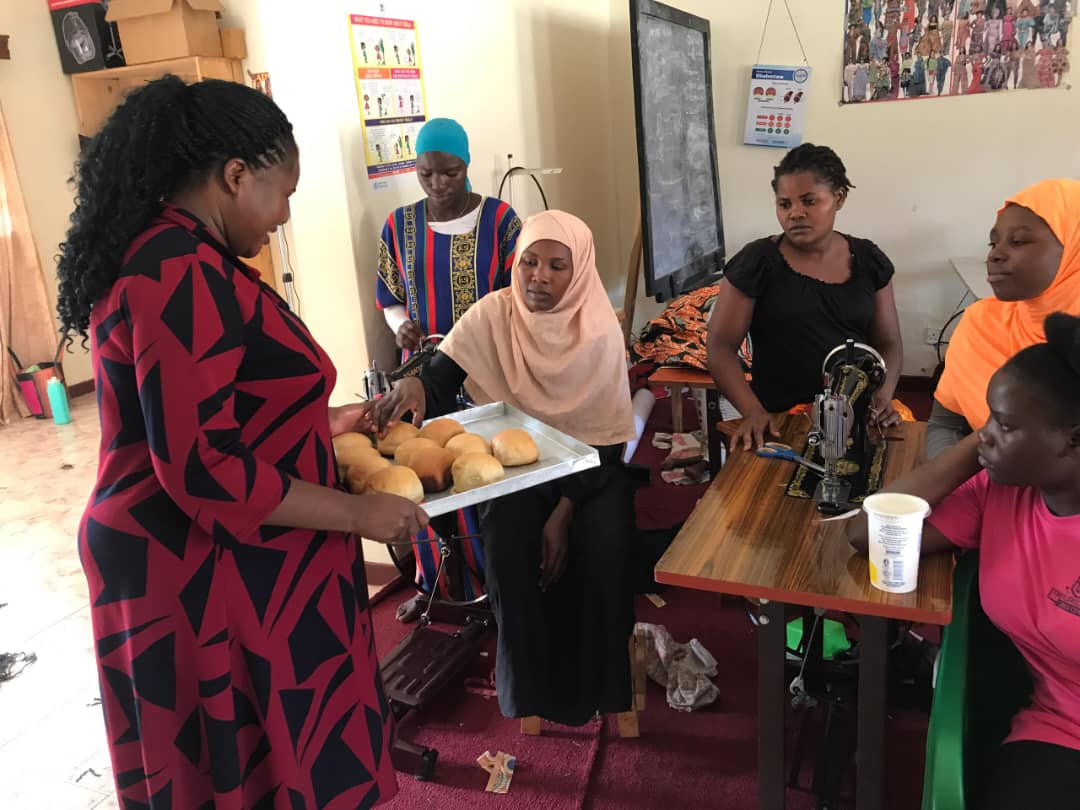
And something that means something. A trade, a craft, singing, cooking for someone. This is the part our own skills room turns out to be good at, slightly by accident. Women come for tailoring and detergent making, and a large part of what the room gives them is several hours a week of absorbing work with other women in it, which is protective whether or not anyone calls it that.
The honest limit. Activity distracts and it also rebuilds. It does not treat depression, and being unable to face any of it is itself a sign rather than a failure of will.
5. Qualified help, when it persists or safety is at risk
The fifth one is different from the others, because it is the one that makes the first four honest.
Ask for professional help when distress has lasted weeks rather than days, when you cannot manage washing, eating or caring for your child, when fear is running the day, or at any point when there are thoughts of not being alive. Those thresholds are set out more fully in the mental health article.
Mental Health Uganda's toll-free helpline is 0800 21 21 21, Monday to Friday, 8:30am to 5:00pm. Trained counsellors, confidential, with an automated menu in several Ugandan languages.
For anyone under eighteen, the Uganda Child Helpline is 116, free from any network, 24 hours.
Outside those hours, go to a health facility and ask for the mental health worker. Mental health is one of the nine categories in the referral network we are building for Jinja, and once that directory is verified it will name the local services instead of the national ones.
What none of this is
It is not positive thinking. Suffering is not a mindset problem, and the suggestion that it is adds blame to it. Nobody has ever been grateful their way out of a violent house or a hungry week.
It is not treatment. Breathing exercises do not treat depression any more than resting treats a broken leg. They make it more bearable while the real thing is arranged.
It is not a substitute for safety. If the problem is a person, the answer is a plan about that person.
It is not something you are failing at. If you cannot manage any of the five today, that is information about how heavy things are, not a verdict on you.
If you are at risk right now
Do not be alone. Stay with someone, or ask someone to come.
If you are supporting someone else, ask directly: are you thinking about ending your life? Asking does not put the idea in anyone's head, and people are usually relieved to be asked plainly.
Get help today, not next week. Mental Health Uganda on 0800 21 21 21 during weekday office hours. The Uganda Child Helpline on 116 for anyone under eighteen, free, 24 hours.
If someone has harmed themselves or taken something, that is a medical emergency. Go to a health facility now and say what has happened.
If the danger is another person, that is not a mental health call. The Child and Family Protection Unit at the nearest police station also handles domestic violence, and the Child Helpline on 116 covers anyone under eighteen.
Choose one
Not five. One, today.
Most people read a list like this, agree with all of it, and do none of it, because five changes at once is not a plan. Pick the one that is actually available to you this afternoon and let the rest wait.
Download the gentle support card as a printable PDF Two A4 pages in plain large text, with no images, so it prints and photocopies anywhere and can be read aloud. Page one is the five supports. Page two is the grounding sequence and the numbers to ring.
If you would like to fund the part of this that costs money, it is the step none of the five can do on its own: getting a woman to a qualified counsellor. The fare, the consultation, a staff member's day spent going with her, and the follow-up that finds out whether she arrived.
Frequently asked questions
What can I do today to support my emotional wellbeing?
Pick one, not five. Keep one small anchor in the day that happens at roughly the same time whatever else does not. Tell one safe person one true thing. Use two minutes of slow breathing and grounding when distress spikes. Make time for rest, movement or one absorbing activity. And ask for qualified help when distress persists or when there is any risk to your safety.
How do I do a grounding exercise?
Breathe in normally and breathe out slowly, for longer than you breathed in, six times. Then push your feet into the floor, straighten your back and stretch. Then name five things you can see, four you can hear, three you can touch, two you can smell and one you can taste. It takes about two minutes and the long out-breath is the part that matters most.
Does self-care work for depression?
It helps and it does not treat. A routine, company, rest and absorbing activity make a hard stretch more survivable and protect against the isolation that makes depression worse. They are not a treatment for it. Where distress has lasted weeks, where someone cannot manage daily life, or where there are thoughts of not being alive, the answer is a qualified professional.
Why might self-care advice be unsafe for someone experiencing violence?
Because it assumes she controls her own day. Walking alone, keeping a journal, taking time to herself or phoning a friend can each carry a cost when somebody else is monitoring her, and a written record of her feelings can be found. Her first need is a safety plan: where she would go, who she would tell, what she would take and how she would get out.
What is the difference between self-care and a safety plan?
Self-care is about coping with distress. A safety plan is about reducing danger from another person. If someone is being hurt or controlled, the plan comes first, because no amount of breathing changes what happens when she gets home.
When should someone seek professional help instead?
When distress has lasted weeks rather than days, when she withdraws from everything including what she used to enjoy, when sleep is badly disrupted for a sustained period, when fear dominates the day, when she cannot manage washing, eating or caring for her child, or when alcohol or drugs appear. Self-harm or any talk of not wanting to be alive needs help the same day.
Where can I get mental health support in Uganda?
Mental Health Uganda runs a toll-free helpline on 0800 21 21 21, Monday to Friday, 8:30am to 5:00pm, with trained counsellors and an automated menu in several Ugandan languages. The Uganda Child Helpline is 116, free from any network and available 24 hours, for anyone under eighteen. Outside those hours, go to a health facility and ask for the mental health worker.
Is there a free guide I can use on my own?
Yes. The World Health Organization publishes Doing What Matters in Times of Stress, a free illustrated guide to grounding and four other stress skills, drawn rather than written and usable without a counsellor. Our own printable card on this page covers the five supports and the grounding sequence in plain text.