
Ten Things a Menstrual-Friendly School Needs (Only One of Them Is Pads)
A school receives a delivery of sanitary pads. Photographs are taken. Somebody posts them, and everyone involved feels that a problem has been addressed.
On the Thursday of that same week, a girl leaves at eleven in the morning and goes home.
The pads were not the difficulty. The difficulty was that the girls' latrine has no working door, there was no water at the tank, and there is nowhere in the school to change that is not a cubicle with a queue outside it. She had what she needed in her bag and still could not use it.
This happens constantly, and it is the reason a menstrual programme that consists only of products tends to disappoint the people who fund it.
What follows is a ten-point check that a school can complete in about twenty minutes. It is drawn from Uganda's own national guidance rather than invented by us, and only one of the ten points is about pads.
Why products alone do not finish the job
Managing a period at school requires a short chain of ordinary things, and the chain breaks at whichever link is missing.
She needs something absorbent. She needs somewhere private to put it on. She needs water and soap. She needs somewhere to put the used one. If she is using a reusable pad she needs to wash it and dry it out of sight. If she has pain she needs it taken seriously. If something is genuinely wrong she needs to see a health worker.
Supply one link and the chain still does not hold. This is not an argument against providing pads, which remain necessary and which we provide. It is an argument for checking the other nine things at the same time.
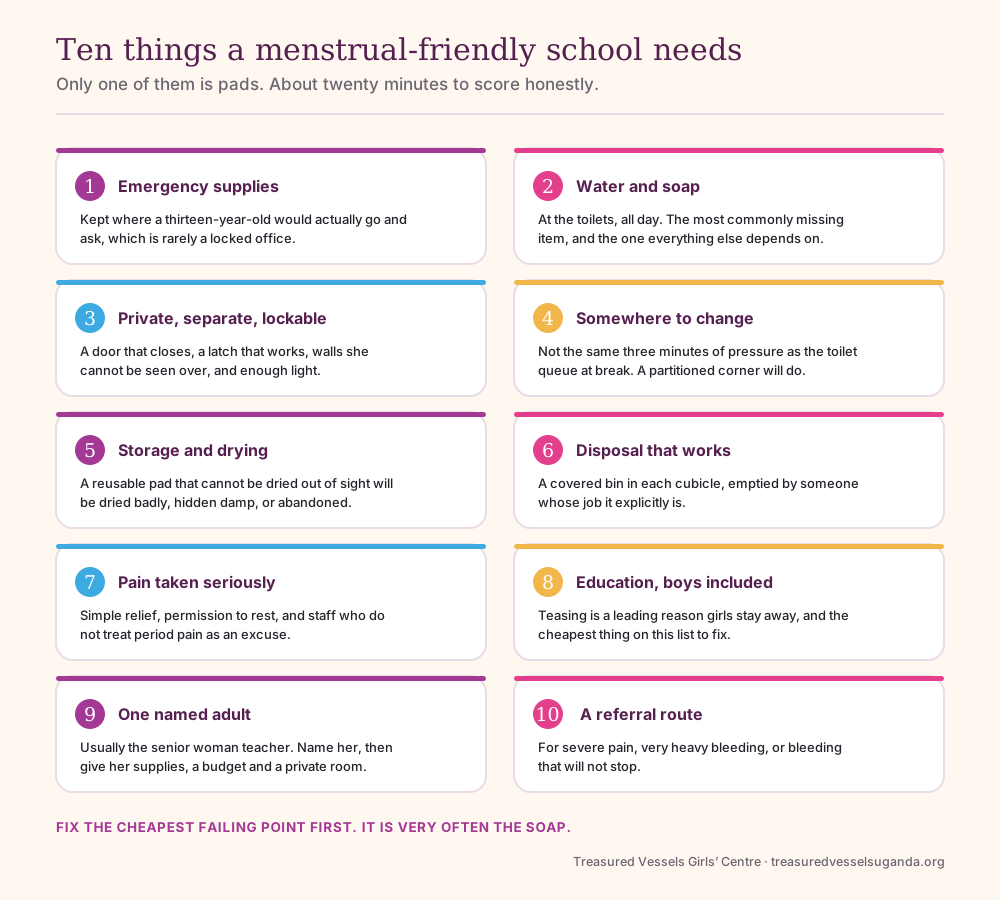
The ten-point check
Score each one honestly. A school that scores four is not a bad school. It is a school that now knows which four things to fix first, which is considerably more useful than a general sense that something ought to be done.
1. Emergency supplies she can get without an ordeal
A small stock of pads kept somewhere a girl can reach them the moment she needs them.
The test is not whether the school has supplies. It is whether a thirteen-year-old would actually ask. If the store is a locked cupboard in the deputy head's office and the deputy head is a man, the honest answer is usually no, and the supplies will sit there while girls go home.
2. Water and soap, at the toilets, all day
Not water at the tank on the other side of the compound. Not soap that ran out in February.
This is the single most commonly missing item in Ugandan school assessments, and it is the one that makes almost everything else on this list unusable.
3. Toilets that are private, separate and lockable
Sex-separated, with a door that closes and a latch that works, walls she cannot be seen over, and enough light to see what she is doing.
A latrine with a missing door is not a facility with a minor defect. For this purpose it is not a facility at all.
4. Somewhere to change that is not a cubicle with a queue
A changing space, however basic, that is not the same three minutes of pressure as the toilet queue at break.
Schools that have solved this have usually done it with a partitioned corner of an existing room rather than a new building.
5. Storage and somewhere to dry
Somewhere to keep her own supplies during the day, and, if she uses a reusable pad, somewhere private to dry it.
The drying problem is the one most often overlooked and the most frequently reported by senior women teachers. A reusable pad that cannot be dried out of sight will be dried badly, hidden damp, or abandoned.
6. Disposal that actually works
A covered bin in each cubicle, emptied by someone whose job it explicitly is, and a disposal method that does not require her to carry a used pad across the compound in front of everyone.
Where a school has no disposal at all, girls will use the latrine pit, which blocks it, and the school will conclude that the girls are the problem.
7. Pain taken seriously
Simple pain relief available, permission to rest briefly, and staff who do not treat period pain as an excuse.
Severe pain is not something to be endured as character formation. It is also sometimes a symptom, which is what point ten is for.
8. Accurate education, including for the boys
Both girls and boys taught what menstruation actually is, before it starts rather than after.
The boys' half of this is not a courtesy. Teasing is one of the strongest reported reasons girls avoid school during their period, and it is the cheapest thing on this entire list to address. A school that teaches only the girls has taught the wrong half of the problem.
9. A named adult everyone can identify
One person, named, whom every girl in the school can identify without asking a friend.
In most Ugandan schools this is in practice the senior woman teacher. National assessments repeatedly find that menstrual health has been left entirely to her, usually with no budget and no time allocation. That is not a system. Name the person, then give her the supplies, a small budget and somewhere private to have a conversation.
10. A referral route for when it is not normal
Somewhere to send a girl with severe pain, very heavy bleeding, or bleeding that will not stop.
Most periods need no clinical input at all. A few do, and a school with no route will simply send her home repeatedly. We set out what a referral that actually completes looks like in adolescent-friendly health services.
The guidance already exists
None of the above is our invention, and a head teacher can point to national instruction for all of it.
The Ministry of Education and Sports issued a circular in 2015 on the provision of menstrual hygiene management facilities to all primary and secondary schools. It called for clean and private toilets, a regular supply of water and soap, emergency supplies of pads and painkillers, training for teachers and inspectors, and the involvement of parents. The Ministry has since published fuller Menstrual Health Guidelines for schools and education institutions.
The framework those guidelines rest on, set out by UNESCO, is worth quoting because it maps almost exactly onto the ten points above: accurate and timely knowledge, available and affordable materials, informed and comfortable professionals, referral and access to health services, sanitation and washing facilities, positive social norms, safe and hygienic disposal, and supportive policy.
Now the uncomfortable part.
A review of 137 Ugandan primary and secondary schools found that 94% had received the 2015 circular and 17% were implementing it. A separate qualitative assessment across 75 secondary schools in 2021 found much the same picture: no school-level menstrual health policy, poor water and sanitation facilities, missing soap and safe water, unclean toilets, nowhere to hang washed materials, unclear responsibility, and no budget.
The gap in this country has never been the guidance. It is the delivery, school by school, which is why a twenty-minute self-assessment is worth more than another policy document.
The honest part about attendance
We need to say something here that works against the way this cause is usually sold, including by organisations like ours.
You will often see menstrual programmes justified with an attendance figure: give a girl pads and she stops missing school. It is an appealing claim. The strongest evidence available does not support it as cleanly as the fundraising implies.
The MENISCUS trial, a cluster-randomised study across 60 Ugandan secondary schools, delivered a multi-component menstrual health intervention and measured what happened. It found strong evidence that the intervention improved multiple dimensions of menstrual health. It found no clear effect on school attendance (11.2% of school days missed during menstruation in the intervention arm against 13.5% in the control arm) and no evidence of an effect on examination performance. Overall absence was 10.5% in both arms.
Three things follow, and we would rather state all three.
The intervention worked at what it measured most directly. Girls' experience of menstruation improved. That is a real result and a sufficient reason to do it.
Attendance is a harder outcome than it looks. Girls miss school for many reasons at once, as we set out in five barriers that push a girl out of school. Fixing one of five will not always move a number that all five are pushing on.
A claim that outruns its evidence damages the cause. If a school or a funder is told that pads raise attendance, measures it, and finds nothing, the next menstrual proposal they receive will be treated as marketing.
So we fund menstrual dignity because a girl should not have to manage a normal bodily function in an undignified, unhygienic or humiliating way. That reason is sufficient on its own and it happens to be true. We do not need the attendance statistic, and we would rather not lean on it.
Reusable pads, and the four conditions
We provide reusable kits, and we think they are a good option in the right circumstances. They are not automatically the right answer, and four conditions decide it.
Informed choice. She is offered the option and understands how it works, rather than being handed the thing the programme happened to buy.
Enough water. A reusable product with no reliable water supply is worse than a disposable one.
Private drying. Covered in point five, and the condition most often absent.
A product that meets a proper quality standard. Absorbency, materials and construction. A poorly made cloth pad teaches a girl that reusables do not work, and she will not try again.
Where those four hold, a reusable kit lasting about a year is genuinely good value and removes a recurring cost from a household that cannot always meet it. Where they do not, disposables and a functioning toilet will serve her better.
One request, made politely and meant seriously: please do not send unsorted product donations. Shipped consignments of mixed products arrive without the water, the drying space, the education or the sizing to make them usable, and the cost of receiving and sorting them frequently exceeds their value. Fund locally supervised production, education and water and sanitation instead.
Why we will not photograph your girls receiving supplies
The standard image for this cause is a line of schoolgirls holding packets, facing a camera.
We do not produce that photograph, and we will not ask your school to arrange one.
A girl in that picture is identifiable, in her school uniform, publicly associated with menstruation and with needing charity, in a permanent and searchable form, at an age when she cannot meaningfully judge what that will mean to her at twenty-five. She is also, invariably, standing next to the adults who helped her, which is not a setting in which anybody says no.
We set out the full argument in what responsible education sponsorship should include. It applies here with more force, not less.
What we ask for instead is the anonymous self-assessment: the ten points, scored honestly, with no names and no photographs. A completed check tells us and the school far more than an image of a distribution ever did.
Consumables and infrastructure are different problems
When a school asks what it needs, the answer separates into two lists that behave very differently. Confusing them is why menstrual budgets tend to fail in year two.
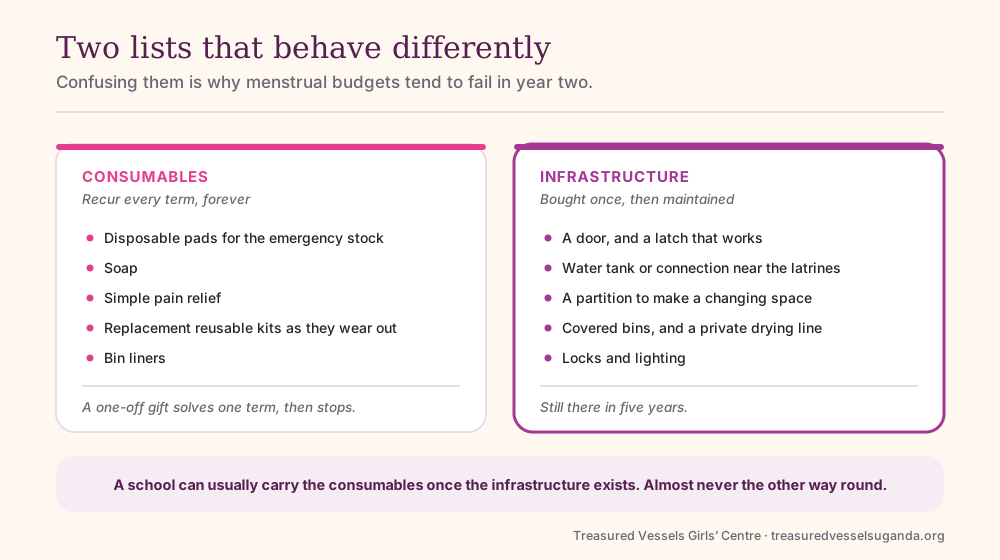
Consumables recur. Disposable pads for the emergency stock, soap, simple pain relief, replacement reusable kits as they wear out, bin liners. These need a line in the budget every term, forever. A one-off donation of consumables solves one term and then stops.
Infrastructure is bought once and then maintained. A door and a working latch. A water connection or a tank near the latrines. A partition to make a changing space. Covered bins. A drying line in a private place. Locks. Lighting.
The practical implication for anyone giving: infrastructure is the better gift. A door fitted this year is still a door in five years, whereas a term of pads is gone by Easter. The school can usually carry the consumables once the infrastructure exists. It is almost never the other way round.
A short word on shame
We are a Christian organisation, and we should be plain about something that occasionally comes from religious and cultural language rather than in spite of it.
Menstruation attracts a vocabulary of uncleanness in a number of traditions, and girls hear it. It is worth saying clearly from the front of a classroom or a church that a period is not a moral condition, not a punishment and not a thing to be hidden as though it were shameful.
"I will praise You, for I am fearfully and wonderfully made." Psalm 139:14, NKJV
A body that works the way it was made to work does not need apologising for. Where an adult in a school or a congregation says that out loud, the teasing described in point eight gets noticeably quieter.
Ask your school to do the ten-point check
This is the one thing we are asking for.
It takes about twenty minutes, needs no budget, and can be done by a senior woman teacher, a head teacher or a parents' association without anyone's permission. Score the ten points honestly, then fix the cheapest failing one first. It is very often the soap.
Download the ten-point check as a printable PDF → Two A4 pages, designed to photocopy in black and white. Page one is the check itself with a scoring box; page two carries the consumables and infrastructure lists and what to do about the three most common failures. It may be freely copied.
If your school is in or near Jinja, we run school outreach covering menstrual health education for girls and boys, reusable kit provision and support with the self-assessment. There is no charge. Please get in touch.
If you would rather support the work than host it:
- $15 provides a reusable sanitary kit that lasts about a year
- $50 keeps a girl in school for a full term
- $150 provides a sewing machine for a young woman building an income
Frequently asked questions
What is the ten-point menstrual-dignity check?
A short self-assessment a school completes in about twenty minutes, covering emergency supplies, water and soap, private lockable toilets, a place to change, storage and drying, disposal, pain relief, education for girls and boys, a named trusted adult, and a referral route. It is drawn from Uganda's national menstrual health guidance rather than invented by us.
Is it not simpler to just provide pads?
Pads are necessary and we provide them. They are not sufficient. A girl with a pad in her bag and no working latrine door, no water and nowhere to change still cannot manage her period at school. Products are one link in a chain of about seven, and the chain breaks at whichever link is missing.
Does providing pads improve school attendance?
The evidence is weaker than the claim usually made. The MENISCUS cluster-randomised trial across 60 Ugandan secondary schools found that a multi-component menstrual health intervention improved menstrual health across multiple dimensions, but found no clear effect on attendance or examination performance. We think menstrual dignity is worth funding for its own sake, and we would rather not rest the case on an attendance figure the strongest study does not support.
What does Ugandan guidance actually require of schools?
The Ministry of Education and Sports issued a circular in 2015 calling for clean private toilets, a regular supply of water and soap, emergency pads and painkillers, teacher training and parental involvement, and has since published fuller Menstrual Health Guidelines for schools. A review of 137 schools found 94% had received the 2015 circular and 17% were implementing it. The gap is delivery, not guidance.
Are reusable pads better than disposable ones?
They are better where four conditions hold: the girl has an informed choice, there is enough water, there is private drying space, and the product meets a proper quality standard. Where those conditions are absent, disposables and a functioning toilet will serve her better.
Can we send you a shipment of sanitary products?
Please do not send unsorted product donations. They tend to arrive without the water, drying space, education or sizing that would make them usable, and receiving and sorting them often costs more than they are worth. Locally supervised production, education and water and sanitation support are far more useful.
Will you photograph our students receiving supplies?
No. We do not produce distribution photographs and will not ask a school to arrange one. A girl in that image is identifiable, in uniform, publicly linked to menstruation and to charity, permanently and searchably, at an age when she cannot judge what that will mean to her later. We ask for an anonymous completed self-assessment instead.
Our school scored badly. What should we fix first?
The cheapest failing point, which is very often soap, followed by a working latch on the latrine door. Both cost very little and both unlock several other points on the list. Infrastructure generally deserves priority over consumables, because a door fitted this year is still there in five years.