
You have probably seen it shared: one thousand teenage pregnancies a day in Uganda.
It is a real figure from a credible source, and it is almost always posted without one. Stripped of where it came from, a number like that does two unhelpful things at once. It invites disbelief from anyone inclined to doubt it, and it invites despair from everyone else.
Neither reaction helps a single girl.
So here is the figure with its source attached, an honest account of what it does and does not measure, and, the part that matters, the four things that actually change the outcome behind it.
Where the number comes from
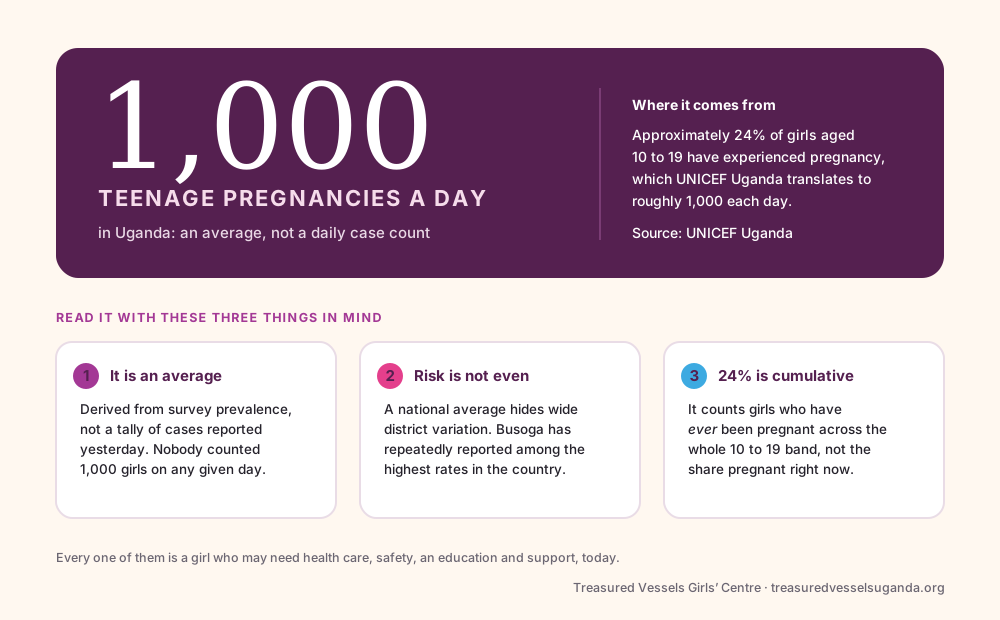
UNICEF Uganda reports that approximately 24% of girls aged 10 to 19 have experienced pregnancy, and translates that prevalence into roughly 1,000 teenage pregnancies each day.
That is the whole provenance. One organisation, one stated prevalence figure, one arithmetic step from prevalence to a daily average.
When you share it, share it like that. "UNICEF Uganda reports…" costs you eleven characters and makes the claim checkable, which is the difference between advocacy and a rumour that happens to be true.
Three things the number is not
None of what follows makes the situation less serious. It makes the claim more defensible, which matters when the person you are trying to persuade is a sceptical head teacher, a journalist or a funder.
It is not a count of cases
Nobody counted a thousand girls yesterday. There is no register being tallied at the end of each day.
The figure is an average derived from survey prevalence: a rate observed across a population, converted into a per-day expression to make it comprehensible. That conversion is a legitimate way to communicate scale. It is not a measurement of any particular day.
The practical implication: if someone challenges you to produce yesterday's thousand girls, they have misunderstood the figure, but so has anyone who presented it as though such a list existed.
It is not the same risk everywhere
A national average describes the country and no district within it.
Busoga has repeatedly been reported among the highest sub-regions in Uganda for teenage pregnancy. Other areas sit well below the national figure. Presenting one number as though risk were evenly spread makes prevention look like a vague national problem rather than something with a geography, and it is the geography that tells you where to put a programme.
The 24% is cumulative, not current
This one is subtle and it is the most commonly missed.
"Have experienced pregnancy" counts girls who have ever been pregnant, at any point in the ten-year span from age 10 to 19. It is not the proportion who are pregnant now, and it is not an annual rate.
A cumulative measure and a daily flow are different kinds of quantity, and translating between them requires assumptions about how pregnancies distribute across those ten years. That translation is reasonable. It is still a translation, and it deserves the word "approximately" that UNICEF gives it.
We set out the wider version of this problem, three different figures with three different denominators routinely quoted as one, in ending child marriage and teenage pregnancy in Uganda.
Why the caveats are worth the trouble
There is a temptation, in this work, to leave the qualifications out. They complicate a clean message, and the underlying situation is grave enough that hedging can feel like a betrayal.
We think that is a mistake, for a practical reason rather than a purist one.
Numbers shared without provenance get discounted. A district official who has been handed three contradictory statistics in a month stops responding to any of them. A journalist who cannot trace a figure will not print it. A funder who finds one overstated claim in a proposal will re-read everything else with suspicion.
Precision is not the opposite of urgency here. It is what makes urgency credible.
What the number is actually made of
Now the part that should follow every statistic and usually does not.
A thousand a day, on average, means that in the time it takes to read this article, girls in Uganda have become pregnant. Not statistics, but individual girls, each of whom now needs some combination of five things: medical care, physical safety, an education that continues, a family that stays with her, and protection from whoever is responsible if she was coerced.
Which of those five she needs, and in what order, is not something a national figure can tell you. It is why the work is done girl by girl, and why organisations that only publish numbers should be treated with mild suspicion.
It is worth taking each of the five seriously for a moment, because they are genuinely different problems requiring different people.
Medical care is the most time-sensitive. Adolescent pregnancy carries elevated risk, including obstructed labour, anaemia and complications that are more common in younger mothers, and antenatal attendance is often late, when it happens at all. The window in which a health worker can change the outcome opens early and closes.
Physical safety is a separate question, and asking it is not intrusive. Is she safe at home? Is the person responsible still in contact with her? A girl who is pregnant and unsafe needs protection before she needs anything else on this list.
An education that continues is the difference between a pregnancy that interrupts a life and one that redirects it. This is the need most often written off on her behalf, by people who have decided the matter is settled.
A family that stays with her is the one outsiders can least control and most easily damage. Handled badly, publicly and accusingly, an intervention can turn a wavering family into a hostile one. Handled well, the household becomes the thing holding the plan together.
Protection from whoever is responsible, where she was coerced. This is the need that a shame-based response erases completely, because it starts from the assumption that the question has already been answered.
Most girls need three or four of these. Almost none needs only the one that a particular organisation happens to provide.
How to check a statistic before you share it
Since this whole article is really about provenance, here is the method, which transfers to any figure you are handed.
Ask who published it, not who posted it. A screenshot of a number is not a source. The organisation whose research produced it is.
Ask what the denominator is. Twenty-four per cent of whom: all girls, girls of a particular age band, women looking back on their adolescence? Two figures can share a percentage and describe entirely different populations, which is precisely what happens with this one.
Ask when it was collected, not when it was published. Survey data is often several years old by the time it circulates, which matters enormously if you are claiming a trend.
Ask whether it is a stock or a flow. "Have ever experienced" and "per day" are different kinds of measurement, and converting between them always involves assumptions worth knowing about.
Four questions, perhaps a minute each. They are the difference between an advocate a journalist will call back and one they will not.
Four investments that change the outcome
If you want to do something with this statistic other than share it, here is where the evidence points.
1. Keep girls learning
The single highest-return intervention, and the least dramatic.
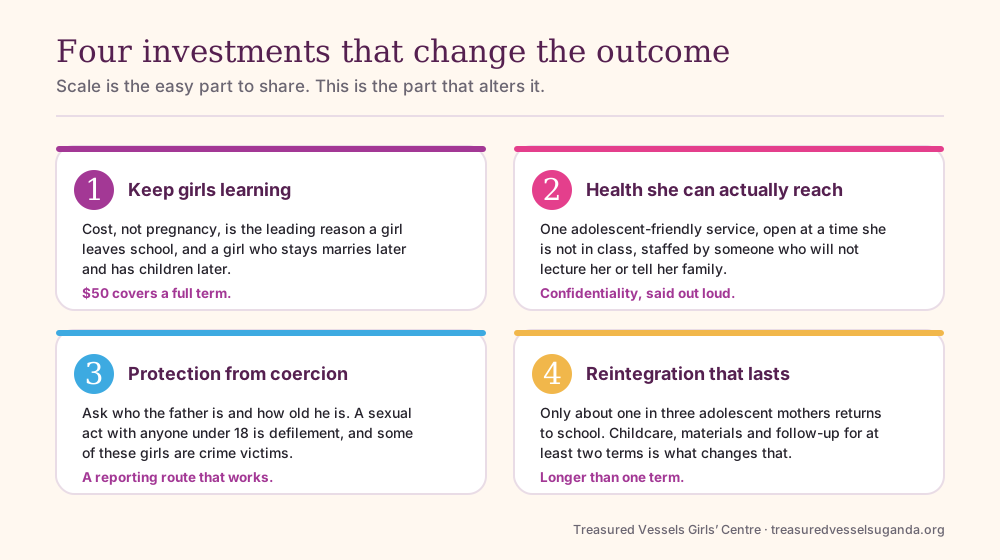
Cost, not pregnancy, is the leading reason a girl leaves school in Uganda, and a girl who stays in education marries later and has children later. Prevention, in most cases, looks like a paid school fee rather than a campaign.
$50 keeps a girl in school for a full term. We set out the five obstacles this addresses in five barriers that push a girl out of school.
2. Health services she can actually reach
Not "more health services". One service, reachable by a fifteen-year-old.
That means open at a time she is not in class, staffed by someone who will not lecture her, with a confidentiality practice stated out loud and honoured in a community where everyone knows her mother. Where those conditions are absent, the service exists on paper and not in her life.
3. Protection from coercion and violence
Any response that treats every adolescent pregnancy as the result of a choice a girl made will fail the substantial share that involved pressure, exploitation or force.
A sexual act with anyone under eighteen is defilement under Ugandan law. Asking who the father is and how old he is should be routine, not intrusive, and there needs to be a reporting route that a frightened girl believes will work. The plain-language version is in what Ugandan law says about child marriage.
4. Reintegration that outlasts the goodwill
Only about one in three adolescent mothers in Uganda returns to school after childbirth. That is not a lack of ambition on their part; it is the absence of childcare, materials and someone who follows up.
Support that lasts a single term rarely reaches the point where it works. The difficult stretch is weeks four to twelve, once the initial help has faded and the practical strain has not. We set out the full pathway in returning to learning after teenage pregnancy.
If you are going to share it
By all means share the statistic. We would ask two things.
Share the source with it. "UNICEF Uganda reports approximately 1,000 teenage pregnancies a day." One clause, and the claim survives contact with a sceptic.
Share an action, not only the alarm. A number on its own produces a feeling that fades by the afternoon. A number with one concrete thing attached, whether a term of school fees, a checklist for a head teacher or a helpline number, occasionally produces something else.
If you want a single thing to attach, the Uganda Child Helpline is 116: free from any network, 24 hours, run by the Ministry of Gender, Labour and Social Development. Someone reading your post may need it more than they need the statistic.
Turn the number into a term of school
A thousand a day is a figure about prevention failing. The most reliable way to make it smaller is unglamorous and well evidenced: keep girls in school.
- $15 provides a reusable sanitary kit for a year
- $50 keeps a girl in school for a full term
- $150 provides a sewing machine for a young mother building an income
Keep a girl in school this term →
Frequently asked questions
Where does the figure of 1,000 teenage pregnancies a day come from?
UNICEF Uganda. It reports that approximately 24% of girls aged 10 to 19 have experienced pregnancy, and translates that prevalence into roughly 1,000 teenage pregnancies a day.
Does that mean a thousand girls become pregnant every single day?
It is an average derived from survey prevalence rather than a count of reported cases. On any given day the real number will be higher or lower, and nobody is tallying it. The figure communicates scale; it does not describe a particular day.
Is the risk the same across Uganda?
No. A national average conceals substantial district variation, and Busoga has repeatedly been reported among the highest sub-regions for teenage pregnancy. Where a girl lives materially changes her risk.
What does "24% of girls aged 10 to 19" actually count?
Girls who have ever experienced a pregnancy at any point in that ten-year age band. It is a cumulative measure, not the proportion pregnant at this moment and not an annual rate.
Is this the same as the 24% figure from the Uganda Demographic and Health Survey?
They are similar numbers measuring different things, which causes real confusion. The UDHS 2022 figure of around 24% refers to girls aged 15 to 19 who have begun childbearing: already mothers or pregnant with a first child. The UNICEF figure covers ages 10 to 19 and asks about ever having experienced pregnancy. Same percentage, different question, different age band.
What is the most effective thing to fund?
Keeping girls in school. The evidence is unusually consistent: girls who remain in education marry later and have children later. Most other useful interventions support that one.
What should I do if I am worried about a specific girl?
Call the Uganda Child Helpline on 116, free from any network, 24 hours. Please do not name or identify a child on social media, which can increase the danger to her.