
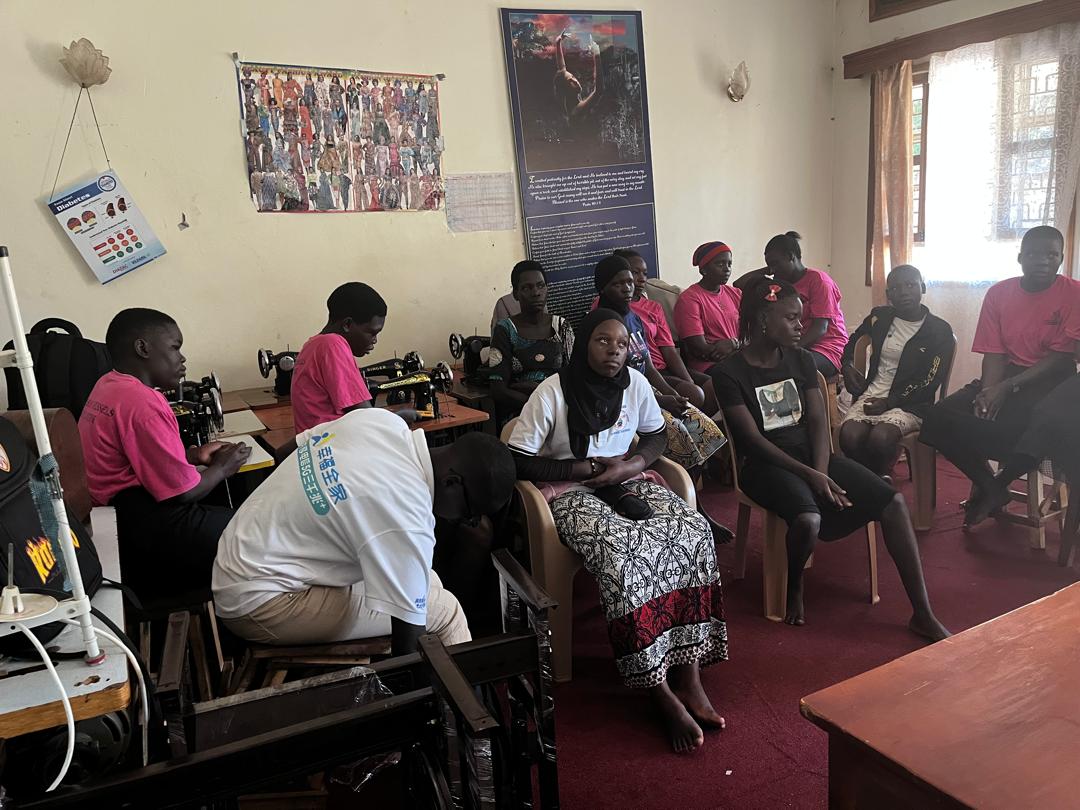
In most of the communities we work in, the church is the institution a woman sees most often. More often than a health centre, far more often than a police station, and for years before and after any project arrives or closes.
That means something uncomfortable. When a girl is pregnant at sixteen, or a woman is being beaten, the first person who hears about it is usually not a social worker. It is a pastor's wife, a choir leader, a woman from the fellowship, or the pastor himself. What that person says in the first two minutes shapes what happens next, often permanently.
Faith communities are the most present safeguarding infrastructure in Uganda, and the least trained. This article is written from inside that, not at it. Treasured Vessels is a Christian organisation and some of what follows is about mistakes our own tradition makes.
What faith actually contributes
Three things, and they are not small.
A reason to treat her as valuable that does not depend on what she has done. Scripture puts it plainly: "So God created man in His own image; in the image of God He created him; male and female He created them." (Genesis 1:27) A girl's worth is not reduced by a pregnancy, a marriage that failed, or a year out of school. That is not a nice sentiment to put on a poster. It is the whole basis on which this work is done, and it is why we do not use pity to raise money.
Presence that outlasts funding. Projects run in cycles. Congregations do not. A church that takes safeguarding seriously is still there in four years, which is the timescale on which most of this actually changes.
Reach that nothing else in the district has. A pastor speaks to several hundred people every week, with their attention and their trust. Nothing in our budget buys that.
And the third one is exactly why a wrong message is so expensive. The same pulpit that could say "a girl who is pregnant has not stopped being a daughter of this church" can also say something that follows her for years. Reach works in both directions.
Three sentences that do the most damage
Each of these is said regularly, almost always by someone who believes they are helping.
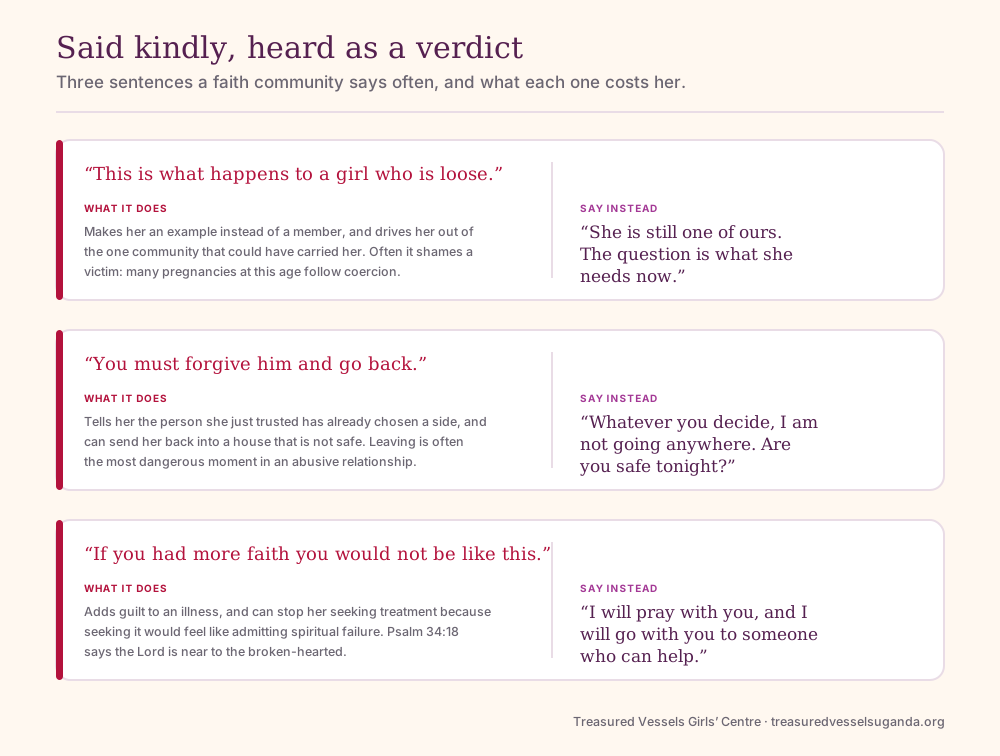
"This is what happens to a girl who is loose"
Why it is said. A genuine concern for younger girls in the congregation, delivered as a warning.
What it does. It makes her an example instead of a member. It drives her out of the one community that could have carried her, usually at the exact moment she needs it. And it is frequently untrue: a large share of pregnancies in girls of this age follow coercion, an age gap that is itself an offence, or an exchange for school fees or food. Treating the pregnancy as proof of her character often means publicly shaming a victim.
What Scripture actually shows. When a crowd brought a woman to Jesus to be judged, He addressed the crowd first: "He who is without sin among you, let him throw a stone at her first." (John 8:7) The passage is not neutral about her situation, but the first correction goes to the people holding the stones.
Say instead: "She is still one of ours, and the question is what she needs now."
"You must forgive him and go back"
Why it is said. A real belief in forgiveness, reconciliation and keeping a family together.
What it does. It tells a woman that the person she just trusted has already chosen a side. It frequently sends her back into a house that is not safe, and leaving is often the most dangerous moment in an abusive relationship. In faith settings this is the most common failure and the most damaging, because it arrives with authority behind it.
The distinction that matters. Forgiveness is between her and God, on her timing, and nobody can demand it on a schedule. Reconciliation requires repentance and changed behaviour from the person who caused the harm. Safety is a separate question from both, and it comes first. A man who is sorry can be forgiven and still be somebody she should not live with this week.
Say instead: "Whatever you decide, I am not going anywhere. Are you safe tonight?"
The fuller version of that conversation is in what to say when someone discloses violence.
"If you had more faith you would not feel like this"
Why it is said. A sincere conviction that God heals, and discomfort at not knowing what else to offer.
What it does. It adds guilt to an illness. A woman with severe depression is not short of faith, and telling her she is makes an already heavy thing heavier. At worst it stops her seeking treatment, because seeking it would be an admission of spiritual failure.
What Scripture actually says. "The LORD is near to those who have a broken heart, and saves such as have a contrite spirit." (Psalm 34:18) Near to, not disappointed in.
Say instead: "I will pray with you, and I will go with you to someone who can help." Both, in that order of comfort and the reverse order of urgency. We set out the signs that something needs a professional in mental health after violence, pregnancy or school exclusion.
Help is never conditional
This is our policy, stated plainly so that anyone can hold us to it.
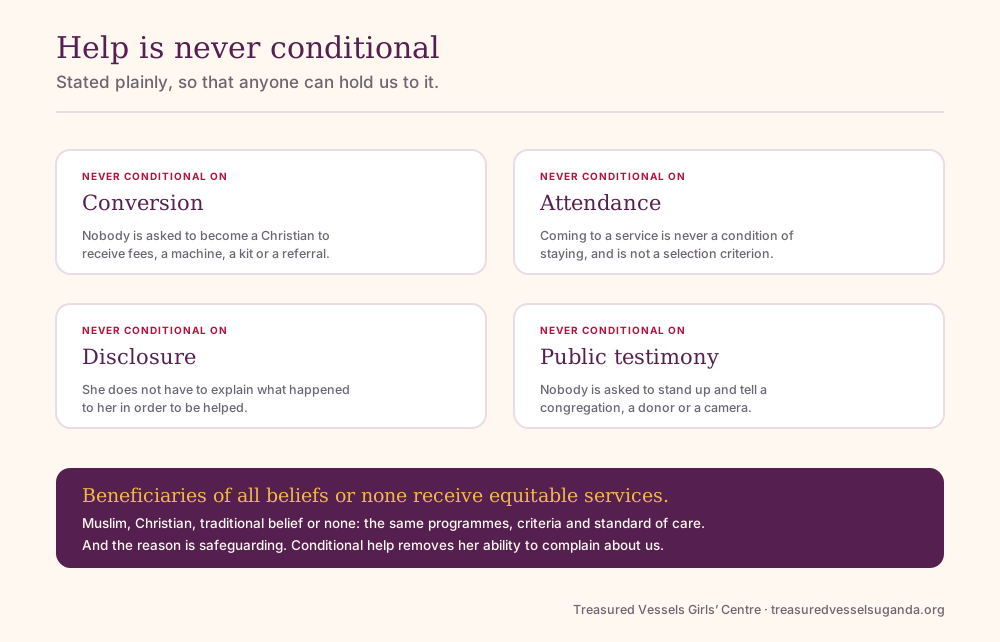
Not on conversion. Nobody is asked to become a Christian to receive school fees, a sewing machine, a sanitary kit or a referral.
Not on attendance. Coming to a service is never a condition of staying in a programme, and attendance is not a criterion in any selection decision we make.
Not on disclosure. She does not have to explain what happened to her in order to be helped. A woman who will not say why she needs a safe place still needs a safe place.
Not on public testimony. Nobody is asked to stand up and tell a congregation, a visiting donor or a camera what she has been through, in exchange for anything.
Beneficiaries of all beliefs or none receive equitable services. Muslim, Christian, traditional belief or no belief: the same programmes, the same criteria, the same standard of care.
Why this is a safeguarding rule, not just a courtesy
The usual argument for non-conditionality is that it is more respectful, which is true and is not the strongest reason.
Conditional help removes the ability to complain. If a woman believes her daughter's fees depend on staying in the good books of the organisation, she cannot safely report anything that organisation does to her. Not a staff member who behaves badly, not a trainer who takes a cut, not a volunteer who crosses a line. Every complaints procedure in the world is worthless if the person using it believes it will cost her the help.
So the rule exists to protect her from us, and the fact that it also respects her conscience is a second benefit rather than the first.
Conditional faith also produces nothing worth having. Professions of belief made to keep a place in a programme tell you nothing about anybody, and a church that counts them is counting the wrong thing.
A note on testimony
Testimony is the faith sector's version of a problem we have written about before. A woman sitting down with a visitor to describe what happened to her, with a notebook or a phone recording, is a disclosure whether or not anyone calls it that.
So the rules are the same as everywhere else on this site: her consent, given freely and revocable, no identifying detail she has not approved, nobody under eighteen, and no account of violence published at all. The reasoning is in our survivor-centred response to gender-based violence. A story told in a church hall is not exempt because the setting is sacred.
What compassionate practice means in the ordinary week
Four things, none of them requiring a qualification.
Listen without instructing. The urge to give advice arrives faster than the facts do. Ask one open question and then be quiet.
Protect confidentiality. What she tells you is hers. It is not a prayer request, not an illustration for Sunday, and not something to share with her husband, her mother or the elders without her agreement. The exception is a child at risk, and you say so before she tells you more rather than afterwards.
Reject violence without qualification. No teaching, no proverb and no reading of Scripture justifies beating a wife or a child. Corporal punishment of children is also prohibited in Uganda under the Children (Amendment) Act 2016, which applies to Sunday schools and church-run schools as much as anywhere else.
Respect her decisions, including the ones you disagree with. She knows things about her situation that you do not, and support that is conditional on taking your advice is not support.
An invitation to faith leaders in Jinja
We would rather work with churches than around them, and the four things we are asking for are small.
Take the training. Two hours, free, at your premises or ours. It covers what to say when someone discloses, what never to say, the limits of confidentiality, and when something must be passed on. No charge, no obligation, and we are not asking anyone to refer to us.
Know the referral routes. Where a woman actually goes for a medical examination, a protection order, a counsellor or a safe bed. Mental health and protection are two of the nine categories in the referral network we are building for Jinja.
Preach it well, once. One sermon that says a pregnant girl is still a member of this church, that forgiveness is not the same as going back, and that depression is not a faith problem, will reach more people in twenty minutes than we reach in a year.
Offer the practical. Childcare during services so a young mother can actually attend. A room for a group to meet. Fees for one girl. These are the things that change what is possible for her, and the church is usually the only body in the village able to provide them.
"Open your mouth for the speechless, in the cause of all who are appointed to die. Open your mouth, judge righteously, and plead the cause of the poor and needy." (Proverbs 31:8-9)
Sign the commitment
Download the faith and safeguarding commitment as a printable PDF Two A4 pages. Page one is the commitment itself, twelve undertakings with a space to sign, sized to pin up in a vestry or church office. Page two is the three harmful messages with what to say instead, and the numbers to ring. It photocopies in black and white and may be freely copied, adapted and used by any congregation without crediting us.
It was written to be checked by two people who will disagree with each other: a safeguarding professional and a church leader. If you are either, and something in it is wrong, tell us and we will change it.
Request the safeguarding training for your church
If you would like to fund this part of the work, it is unglamorous: the fuel to reach a congregation outside town, the printing, and the staff day it takes.
Fund safeguarding training for churches
Frequently asked questions
Do you require people to be Christian to receive help?
No. Help is never conditional on conversion, on attending a service, on explaining what happened, or on giving a public testimony. Beneficiaries of all beliefs or none receive the same programmes, the same selection criteria and the same standard of care. We are a Christian organisation and that shapes why we do this work, not who qualifies for it.
Is a teenage pregnancy evidence of sin?
Treating it that way is both unkind and frequently inaccurate. A large share of pregnancies among girls of this age follow coercion, an age gap that is itself a criminal offence, or an exchange for school fees or food, so shaming the girl often means shaming a victim. When a crowd brought a woman to Jesus for judgement, His first words were addressed to the people holding the stones.
Should a woman forgive an abusive husband and return to him?
Forgiveness, reconciliation and safety are three separate things and they are routinely collapsed into one. Forgiveness is between her and God, on her timing, and cannot be demanded on a schedule. Reconciliation requires genuine repentance and changed behaviour from the person who caused the harm. Safety is a separate question and it comes first, because leaving is often the most dangerous point in an abusive relationship.
Is depression a sign of weak faith?
No. Telling someone it is adds guilt to an illness and can stop them seeking treatment, because seeking it would feel like admitting spiritual failure. Psalm 34:18 says the Lord is near to the broken-hearted, not disappointed in them. Pray with her, and go with her to someone qualified.
Why does it matter that help is not conditional?
Mainly because conditional help removes the ability to complain. If a woman believes her daughter's school fees depend on staying in favour with an organisation, she cannot safely report anything that organisation does to her. The rule exists to protect her from us. That it also respects her conscience is a second benefit rather than the first.
Can a church share a survivor's story if it is anonymous?
Treat a testimony the same as any other disclosure. It needs her freely given and revocable consent, no identifying detail she has not approved, and nobody under eighteen. We do not publish accounts of violence at all. A story told in a church hall is not exempt because the setting is sacred.
Is corporal punishment of children allowed in church schools in Uganda?
No. Corporal punishment of children is prohibited under the Children (Amendment) Act 2016, and that applies to Sunday schools and church-run schools in the same way it applies anywhere else.
How can my church get safeguarding training?
Get in touch and we will arrange two hours at your premises or ours, free of charge. It covers what to say when someone discloses, what never to say, the limits of confidentiality, and when something has to be passed on. There is no obligation attached, and we are not asking you to refer anyone to us.